


Commentary: Agricultural 'roadmap' to guide research priorities
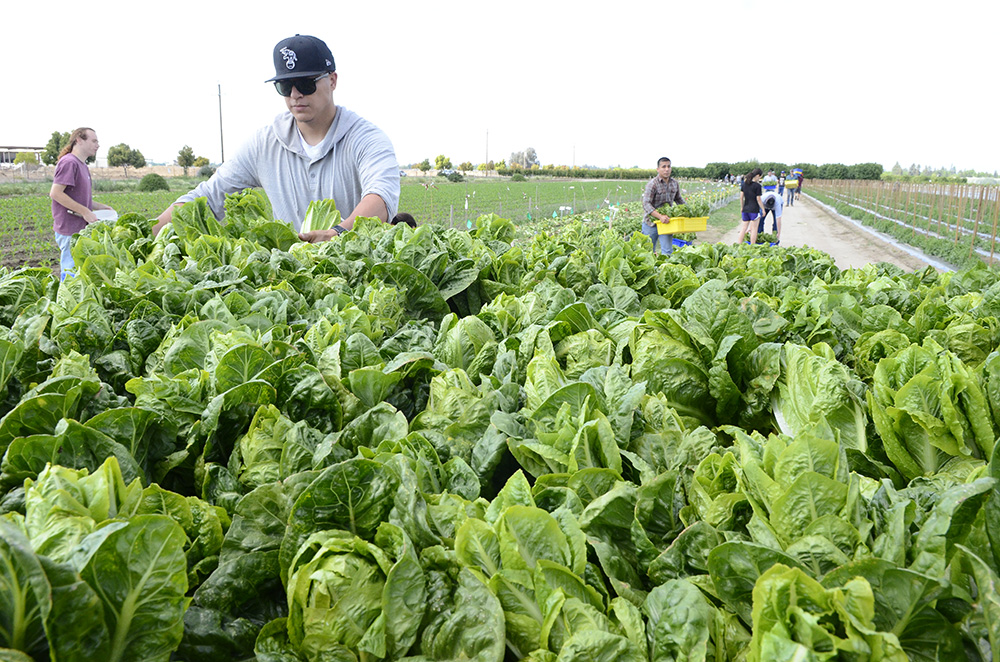
Students assist a research project and final harvest at California State University, Fresno, one of the Agricultural Research Institute’s four member campuses.
Photo/Courtesy of California State University


By David Still
California farmers and ranchers are concerned about their ability to stay in business. The challenges—from a complex regulatory environment to rising costs of inputs, climate change and labor availability—are both persistent and intensifying.

While it can be hard to think about the years and decades ahead when entrenched in the issues of today, investment in research and innovation is the key to overcoming current challenges while building opportunity for tomorrow.
The recently released California Agricultural Research & Innovation Roadmap is a deliberate strategic framework designed to guide and accelerate scientific discovery, commercialization and the real-world adoption of next-generation solutions. It is more than a document; it is a blueprint for action.
For those of us in the academic community, it represents a commitment to improving research efficiency across our institutions. Through greater collaboration, we can more effectively bridge the critical gaps that stand between a lab discovery and a field solution. In addition, this roadmap ensures that resources are focused on the highest-priority challenges facing our producers.
The roadmap was developed by a handful of critical partners, including the California Department of Food and Agriculture, University of California Agriculture and Natural Resources, California State University Agricultural Research Institute, California community colleges, Western Growers and California AgTech Alliance.
 It provides both a long-term focus via 10-year research priorities identified in collaboration with all partners and near-term solutions through innovation priorities, spearheaded by the California AgTech Alliance and updated every two years.
Research priorities identified in the roadmap include: climate resilience and environmental sustainability; water management, use efficiency and quality; integrated pest and disease management; food safety and consumer health; technology, automation and data-driven farming; and economics, policy and adoption pathways.
Together, the research priorities represent critical areas to maintain productivity, resilience and economic viability across California’s diverse agricultural systems, from a family farm in the Central Valley to the largest agribusiness.
For the Agricultural Research Institute, this roadmap is an extension of our mission to drive research that doesn’t just sit on a library shelf but delivers real-world impact. To turn this mission into action, we are prioritizing our core funding for research that directly addresses high-priority gaps identified in the roadmap, such as water management, automation and climate resilience.
We are also launching a new “collaborative innovation grant” to fund multi-institutional teams. The grants will require partnerships between at least two systems (for example, CSU and UC ANR) and an industry partner, while ensuring a clear pathway to improving economic efficiency and productivity.
Furthermore, we are committed to continuously evaluating and adapting our curricula. While much of the necessary training is already in place, we must ensure our courses remain aligned with the rapidly evolving needs of the industry. This is where ongoing industry feedback is invaluable, helping us refine the discipline-specific skills and critical thinking necessary for the next generation to succeed.
A prime example of this is the $9.5 million Agricultural Research Institute-NextGen program, an initiative funded by the U.S. Department of Agriculture specifically designed to equip CSU students with the technical expertise and problem-solving abilities required to lead in a high-tech agricultural landscape.
Accountability is a core principle of the research institute, and accountability is built into the roadmap. Each participating institution has committed to turning this roadmap into action, with each entity doing its part to move from ideas to implementation and experimentation to adoption and widespread impact. Not only have partners committed to action, but they have also committed to measuring impact through key performance indicators. That said, this roadmap is a living document—one that requires constant refinement to stay relevant.
At the Agricultural Research Institute, we will continue to actively seek industry feedback and direction, ensuring that our work stays aligned with the everyday challenges of the agricultural community. At the end of the day, we want to do the research the industry both wants and needs. The only way to truly know what is wanted and needed is to maintain a constant dialogue with those working the land.
Bringing the roadmap to life requires an approach that extends far beyond academic institutions and the other partners in the plan. While participation is voluntary, our collective success depends on the broader agricultural community taking a seat at the table. Innovation reaches its full potential only when ideas move beyond the lab and into the field, becoming solutions you can adopt and trust.
By working together to support the full innovation pipeline—from initial concept to commercial adoption—we can ensure that California research translates into practical tools that strengthen the productivity, efficiency and resilience of California agriculture for decades to come.
For the roadmap, visit bit.ly/ag-roadmap.
David Still is executive director of the California State University Agricultural Research Institute. He can be reached at dwstill@cpp.edu.
In this issue...
- Experts seek methane-cutting solutions
- California cherry crops decimated by spring storms
- Agricultural 'roadmap' to guide research priorities
- Why rocket scientists began counting nuts in California
- Advocacy in Action: Wolf rule repeal, safety rules and bird flu tests
- Farms increasingly use drones for aerial applications
- How should walnut husk fly be managed this season?
- Production forecast shows drop in several state crops
- Former dairy vet looks to improve welfare on farms
- How AI is transforming weather forecasting





.svg.png)
