


Fruits & Vegetables
- October 7, 2026
- Pumpkin growers target trends, Halloween demand
-
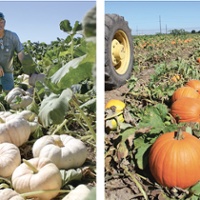
Alan Changala, left, who grows pumpkins in Tulare County, kneels next to a white specialty pumpkin called Porcelain Doll Improved, which he says he expects will be popular with customers of his pumpkin patch in Porterville. His farm grew 20 pumpkin varieties this year, including standard jack-o’-lantern types, right, with most of the crop going to wholesale markets.
Photos/Cecilia Parsons -
- September 2, 2026
- New 'smart' farm tech targets vegetable production
-
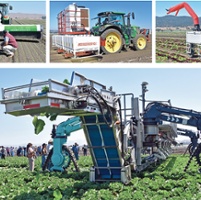
Sami’s autonomous lettuce harvester, above, uses rubber fingers to grab the top of the head while a knife cuts the stem. Verdant Robotics’ SharpShooter, top left, and Carbon Robotics’ LaserWeeder G2, top center, use artificial intelligence to differentiate crops from weeds. At top right, Padma Robotics’ DV-64 uses audio, lasers and a dancing inflatable tube man to deter birds.
Photos/Vicky Boyd -
- August 19, 2026
- Cyclospora fallout hits California farmers
-
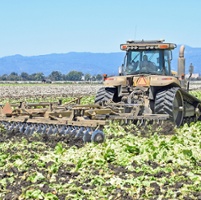
A lettuce field is destroyed this month in Santa Cruz County amid a decline in fresh produce sales following this summer’s cyclospora outbreak. While the outbreak was linked to iceberg lettuce grown in Mexico, the economic impact has largely fallen on California, which supplies most U.S. lettuce.
Photo/Vicky Boyd -
- August 5, 2026
- 'Rough' peach crop caps a bitter season
-
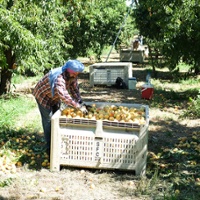
Cling peaches are harvested at Johl Orchards in Marysville. About a quarter of California’s cling peach acreage was ripped out this year following the collapse of Del Monte Foods. In recent years, Del Monte, which filed for bankruptcy last year, was one of two major buyers of the state’s cling peaches.
Photo/Caleb Hampton -
- August 5, 2026
- Processed tomato growers hope for market recovery
-
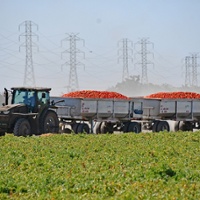
Harvest has started for processing tomatoes in California, with most growers expected to wrap up by the end of October.
Photo/Vicky Boyd -
- August 5, 2026
- Tomato variety key to controlling fusarium stem rot
-
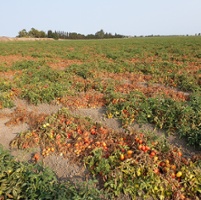
Fusarium stem rot and decline, commonly known as FRD, affects the water- and nutrient-carrying vascular portions of processing tomato plant stems and canopies. Eventually, vines begin to decline, collapsing and exposing the fruit to the sun, leading to potential sunburn.
Photo/Brenna Aegerter -
- July 8, 2026
- Growers look to grafted watermelons to battle pests
-
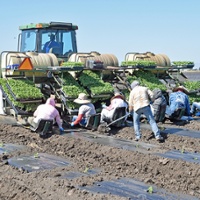
A work crew transplants grafted watermelons into a field in the San Joaquin Valley.
Photo/Vicky Boyd -
- June 3, 2026
- Moth damage rises as growers await new insecticide
-
Diamondback moth larva, left, infests a broccoli plant in a Central Coast field. At right, a diamondback moth caterpillar chews holes on leaves, feeds at young plants’ growing points, and eats floral stalks and flower buds of brassica crops. Some growers in 2025 were forced to destroy their crops at harvest because infestations made them unmarketable.
Photos/Courtesy of Ian Grettenberger/University of California, Davis -

- May 6, 2026
- Hot temps, new varieties boost strawberry volumes
-
Strawberries grow in a Santa Barbara County field. Unseasonably warm temperatures in February and March ripened Central Coast berries weeks earlier, with the region harvesting at the same time as the Oxnard growing district in Southern California. By the first week of April, Watsonville-Salinas growers picked 10 times more berries than the same period two years ago.
Photo/Courtesy of California Strawberry Commission -

- April 8, 2026
- Despite acreage decline, asparagus growers hang on
-
During harvest at a Fresno County asparagus field last month, workers use specially designed long-handled asparagus knives to cut spears just below the soil surface but not so deep that it damages the crown, or root mass. California asparagus acreage has dwindled through the years due to competition from Mexico, but a handful of growers and packers remain in the business.
Photo/Vicky Boyd -

- March 11, 2026
- Tomato agreement aims to manage parasitic weed
-
Branched broomrape, a parasitic weed, remains a significant threat in California, particularly to tomato fields.
Photo/Courtesy of University of California, Davis -

- March 11, 2026
- Canneries reduce tomato acreage to lowest in 50 years
-
Processing tomato plants are transplanted into a field in Yolo County. Farmers say rising costs for water, fuel and fertilizer could erase their margins on a crop that historically has been profitable.
Photo/Vicky Boyd -

- February 11, 2026
- Transplant nurseries celebrate seed improvements
-
A greenhouse worker at Westside Transplant’s Huron facility in Fresno County takes an inventory count of vegetable seedlings in production. Transplant nurseries are developing best practices for the industry, which is still considered new to agriculture. The Vegetable Transplant Nursery Association funds research aimed at offering guidance to its member-growers and state regulators.
Photo/Westside Transplant -

- January 14, 2026
- Lettuce virus cases creeping back up after reprieve
-
This Monterey County lettuce field fell victim to impatiens necrotic spot virus in 2022, when severe widespread outbreaks of the virus led to substantial economic losses for Salinas Valley lettuce growers, short supplies of the crop and soaring prices for restaurants and consumers.
Photo/Caleb Hampton -

- November 19, 2025
- Farm tech focuses on robotic weeding in vegetables
-
Tensorfield Agriculture’s Jetty moves through a simulated carrot field using its thermal microjetting system.
Photo/Mark Billingsley -

- October 22, 2025
- Cilantro trial tests herbicide to fight aggressive weed
-
University of California Cooperative Extension farm adviser Oleg Daugovish checks on cilantro plantings in a trial looking at the effectiveness of the herbicide Dual Magnum against yellow nutsedge weed. The product is currently not registered for use in California on cilantro.
Photo/Rob McCarthy -

- September 24, 2025
- Urban farm's microgreens punch up plates, palates
-
Joni Albers operates Los Angeles-based Hungry Gardens Urban Farm, which grows microgreens and edible flowers. She encourages other farmers and home gardeners to try growing microgreens because the young seedlings require little space and pack nutrition. The farm earns part of its income building gardens and farms for various organizations, restaurants and homeowners.
Photo/Lori Fusaro -

- September 10, 2025
- Tomato yields up as canneries try to reduce inventory
-
Tomato yields up as canneries try to reduce inventory
Graphic/Ag Alert; Source/USDA -

- August 27, 2025
- Farm finds market niche growing 'polarizing' okra
-
Twin brothers Andrew, left, and Eric Walker operate Farmboy Organics in Yolo County, where they grow a variety of fruits and vegetables, including okra, which thrive in California’s summer heat.
Photo/Steve German -

- July 30, 2025
- Sweet corn growers market crop locally, nationally
-
Sweet corn is harvested by machine in Tulare County near Tipton. The summertime staple is grown commercially for sale to retailers and locally by growers who sell directly to customers at farm stands and farmers markets.
Photo/Courtesy of Tom Barcellos -

- June 4, 2025
- Farm makes heirloom, specialty vegetables its focus
-
Andrew Gibson, president and CEO of Sunrise Organic Farm in Santa Barbara County, picks up harvested Nantes carrots, the farm’s most popular crop for the wholesale market.
Photo/Courtesy of Sunrise Organic Farm -

- May 7, 2025
- Strawberry growers work to keep pace with demand
-
The Watsonville/Salinas district, with 12,889 acres of strawberries in 2025, remains the state’s top growing region for fall-planted acreage, which produces fruit for winter, spring and summer. The Santa Maria district, however, has the most year-round acreage, with 11,432 fall-planted acres and a projected 7,469 summer-planted acreage, which produces strawberries for the fall.
Ag Alert file photo -

- April 9, 2025
- 'Shroom boom' keeps demand of the fungi constant
-
Francisco “Frank” Valle, general manager of Global Mushrooms in Santa Clara County, holds a box of white button mushrooms, which remain the nation’s best-selling mushroom variety.
Photo/Christine Souza -

- February 26, 2025
- Chico State farm focuses on regenerative practices
-
A test plot of established oats at the Center for Regenerative Agriculture and Resilient Systems at the California State University, Chico, was planted last fall as part of a study that looks at the feasibility of planting a winter cash crop of fava beans within an established cover to offset expenses while providing soil cover and reducing erosion.
Photo/Courtesy of Hossein Zakeri
-

- January 29, 2025
- Research eyes arugula for downy mildew resistance
-
Plant pathologist Shunping Ding, left, and graduate student Emily Lock-Paddon inoculate arugula with the downy mildew pathogen in the lab at California Polytechnic State University, San Luis Obispo. Researchers at the university are studying wild arugula varieties that could offer resistance to the disease.
Photo/Kallol Das
-