


Commentary
- August 27, 2025
- Commentary: Water reliability depends on forest health, resiliency
-
By Marwan Khalifa
Two of the most basic human necessities are access to food and water. Americans owe a debt to our nation’s farmers.
On average, one U.S. farm feeds 169 people annually in the U.S. and abroad, according to the American Farm Bureau Federation. Clearly, agricultural producers are doing their part to ensure families have access to nutritious and affordable food supplies.
Water suppliers such as members of the Association of California Water Agencies, or ACWA, are working hard to ensure families across California have access to reliable water in the home and on the farm. In California, forest health is important to both water providers and agricultural producers. Two-thirds of California’s water originates in our state’s mostly forested mountain regions. Whether it ends up as drinking water or supports growing food for families, its quality and potentially even quantity depend on the health of those headwaters.

Marwan Khalifa Catastrophic wildfires, burning at temperatures and on scales once unimaginable, threaten that health every year. But we are not without the tools, strategies and innovative drive necessary to combat these disasters. What we need is continued investment and political will to see this vital work through to a successful end.
Ongoing advocacy to secure and expand on that investment is where California water, agriculture and forestry policy intersect. Fortunately, longstanding collaboration between the water and agriculture community has proven effective in this mission. The work continues, and
challenges remain. But the stakes are too high to allow progress to slip into reverse.Decades of fire suppression in conjunction with a lack of investment in forest health projects, an emphasis on short-term management priorities, increased occurrence of pests and disease, weather extremes and a warming climate have contributed to the decline in headwaters forest resilience. A major consequence is forest overcrowding. This promotes rapid wildfire growth, creating catastrophic megafires that cause long-term damage to the region’s ecology and infrastructure.
Overstocked forests result in greater competition for water and increased evapotranspiration, reducing snowpack and water while increasing strain on water supplies during times of drought. At the same time, fragile ecosystems in unhealthy headwaters are at greater risk because of poor water quality, reduced in-stream flows, increased sedimentation of rivers and loss of habitat.
When catastrophic wildfires scorch unhealthy forests, intense heat bakes the ground into barren hardpan where snowpack melts and evaporates faster. Seasonal rains, now beginning earlier in a warming climate, wash ashes off this surface into streams leading to reservoirs that feed water treatment plants. This ash can alter the water’s chemistry and clog filters, making its treatment into drinking water more difficult. And while that primarily affects urban water suppliers, those same massive fires often smother rural ranching and farming communities in smoke, posing a major health risk.
The good news is there are solutions within our reach. Work to achieve those solutions is underway in many parts of the Sierra Nevada and are reversing a hundred years of well-intentioned but ultimately destructive forest management. Strategic forest thinning and use of prescribed fire have shown great promise toward nurturing healthier and more resilient forests.
One example of work on the ground is ACWA member Placer County Water Agency, which is leading a public-private partnership aiming to treat more than 22,000 acres of forest within the headwaters of the American River, a major source of water for the Sacramento area.
On the federal level, ACWA and our allies in the agricultural community, including the California Farm Bureau and Family Farm Alliance, among many, are continuing our collaborative advocacy to open pathways toward healthier headwater forests.
Earlier this year, this collaboration helped secure passage of the Fix Our Forests Act in the U.S. House of Representatives. Now being considered in the U.S. Senate, this bipartisan legislation would encourage more active management of federal forestlands, improve the regulatory process for forest health projects on federal lands, promote federal, state and local government collaboration, coordinate federal grant programs to better serve communities in high fire-risk areas and expand the use of technologies to address wildfire threats.
In 2014, ACWA and the California Farm Bureau helped found the California Forest Watershed Alliance, and this year we joined the Wildfire Solutions Coalition, which also includes the California Farm Bureau. Organized by The Nature Conservancy, this coalition is dedicated to building support for significant increases in local, state and federal funding to address California’s wildfire crisis.
Making California forests less vulnerable to catastrophic wildfires will require a long-term financial commitment and determination. However, as with many challenges with California water, collaboration has opened a clear path toward a more resilient future for our state’s headwater forests and the water supply on which our environment, farms, cities and future depend.
Marwan Khalifa is interim executive director of the Association of California Water Agencies. He can be reached at marwank@acwa.com.
See related news stories...
• Solar canal project provides low-cost energy, more water
• Tuolumne River salmon habitat enhanced
• Court green lights state's flows plan, rejects all claims
- August 13, 2025
- Inside Farm Bureau: Legal successes deliver results for California farmers
-
By Shannon Douglass
President
California Farm BureauAt the California Farm Bureau, we know our members would rather focus on growing food than deal with red tape. That’s why we invest in strong legal advocacy—to stand up for agriculture when laws and regulations create unnecessary hurdles.
Our legal advocacy efforts span a wide range of legal and regulatory issues that affect how agriculture operates in California. From utility rates and water policy to land-use regulations, pesticide rules and species protections, we advocate with one goal in mind: securing better outcomes for our members and county Farm Bureaus across the state.
With decades of combined legal experience and a deep commitment to agriculture, our in-house legal staff—including attorneys and support professionals, each with deep, personal commitments to agriculture and the mission of Farm Bureau—drafts legal briefs, testifies before regulatory bodies, provides legal analysis, attends hearings, and monitors legislative and agency actions. Through this work, we help shape practical, long-term solutions to the challenges farmers face every day.
Energy is one area where this work makes a clear impact. With power costs ranking among the highest operating expenses for farms and ranches, we engage in regulatory proceedings that affect electricity rates, generation and delivery. Farm Bureau’s team has built productive relationships with investor-owned utilities to help resolve issues and advocate for agriculture. By closely monitoring rate changes, we can step in to mitigate rising costs that directly impact the viability of farming operations.
In June, for example, Farm Bureau was the only agricultural advocate that took part in negotiations with Southern California Edison during a recent rate case. This work led to a favorable settlement for agricultural ratepayers, and the agreement—pending approval by the California Public Utilities Commission—resulted in an overall 0.58% decrease for the agricultural rate class.
Of most significance, large agricultural customers originally faced an increase of almost 10%. Farm Bureau’s sustained efforts on this case resulted in those customers instead seeing a substantially lower 1.13% increase. This outcome changed what would have otherwise been a significant rate hike, delivering a meaningful win for members who rely on affordable, reliable energy.
Water remains the foundation of California agriculture, and we’re engaged on all fronts—availability, supply, rights and quality. Our issue experts work closely together and often join coalitions to defend agricultural water rights and promote sound, workable policy. Our recent legal efforts include litigation tied to the federal “Waters of the United States,” or WOTUS, rule as well as the ongoing implementation of the state’s Sustainable Groundwater Management Act.
To strengthen our support in this area, we recently increased staff capacity focused specifically on water law, ensuring we remain responsive as state and federal regulations grow increasingly complex.
Our efforts center around providing sustainable business solutions for farmers and ranchers, and we’re doing just that. Farm Bureau’s sustained efforts have helped farmers save money under California’s Irrigated Lands Regulatory Program, which governs nitrate levels in groundwater. By advocating for a coalition-based compliance model, we were successful in gaining a framework that significantly reduces costs for growers. Through participation in a local water coalition, a farmer’s administrative fee is now just $1.50 per acre—compared to $37.40 per acre for the first 300 acres and $18.71 per acre thereafter under individual compliance.
Following litigation involving state regulations aimed at improving water quality and managing nitrates, we played a key role in the litigation and the convening of the original agricultural expert panel. A second panel has been reconvened to help ensure that practical solutions reflect on-the-ground realities for farmers.
Because agricultural lands are often subject to state and federal environmental protections, we weigh in on issues that could affect a farmer’s ability to operate. Our team regularly submits comments and legal input on our members’ behalf to ensure agricultural activity is taken into account. Recent examples include our responses to the proposed listings of the monarch butterfly as threatened and the Suckley’s cuckoo bumble bee as endangered under the Endangered Species Act—cases where we ensured agricultural activity would be considered in the final decisions.
We also provide direct legal support to county Farm Bureaus. Farm Bureau staff assists with governance and operational matters, including bylaw interpretation, lease agreements, employment issues, contracts, intellectual property concerns, and compliance with campaign finance, tax and lobbying rules.
Our work focuses on these cases that impact large segments of California agriculture—addressing issues that affect entire commodities, counties and regions, instead of individual legal representation.
Through skilled advocacy, trusted relationships and a long-term commitment to agriculture, California Farm Bureau continues to deliver results for farmers, ranchers and agribusinesses across the state. I’m proud to highlight the work we do together to support our members.
- July 30, 2025
- Commentary: As supplies thin, price of recycled water could go up
-
By Norm Groot
As we all manage the implementation of our groundwater management sustainability plans in the next 15 years, there will be some hard choices that communities will need to make. Most of these will include financing various water supply solutions, such as resource projects, land fallowing and repurposing, and even water allocations. Communities that rely exclusively on groundwater will have the hardest decisions to make.
With our state’s human right to water, there are more discussions on how our stretched-thin supply can continue to manage a growing state population and continue to produce food to feed our hungry nation. Yes, many are moving out of California due to any number of reasons, including the high cost of living, but there is still incremental population growth in many regions.
This brings to light our decades-old water delivery systems to larger municipal areas, which often see demand exceeding capacity. What was planned in an era when California encompassed half its current population now comes under scrutiny as we wrestle with how to get more water for housing development, industrial and manufacturing expansion, and let’s not forget farming. Almost all communities struggle with aging infrastructure.
Now we experience a rush to claim all “rights” to recycled or reclaimed water supplies. No longer is it possible to dump this effluent in the ocean as having no value. It is smarter to sell this reclaimed water to end users such as municipalities, constructed wetland and groundwater
recharge projects. This newfound value in reclaimed water has turned the wastewater paradigm on its end.In the Salinas Valley—the Salad Bowl of the World—wastewater effluent is coming under more demand than ever. Back in the late 1990s, a project was built to provide reclaimed water to 12,000 acres of farmland, primarily for two reasons: first, to relieve existing groundwater pumping in the coastal zone, and second, to take the wastewater from communities that didn’t want to deal with it or couldn’t process it for another use.
It was, in short, a wastewater nuisance, and agriculture stepped up and said, “we’ll take your wastewater, build the processing plant and then make productive use of it on our farmlands.” This was a first-of-its-kind reclaimed water project that was approved for fresh food production.
Fast-forward 20 years and that wastewater is now under increasing demand to supply shortfalls in domestic water in an area of Monterey County that has steadfastly refused to solve its own water supply issues, even under a California State Water Resources Control Board order.
Big dollar investments are going into increasing wastewater processing capacity and pipelines to supply an area encompassing 100,000 residents. Most of the source wastewater for this reclaimed drinking water supply is coming from interruptible flows that question the ability to manage consistent supply. Thus, the human right to water will trump other uses when those interruptions occur.
What this may ultimately cause is a significant increase in the costs of reclaimed water that farmers are entitled to use in their own delivery project—probably more costly than what can be sustained financially for even high-value crops. This then begs the question of how the impact to an already functioning project can be displaced by the newer demands for constant supply.
With everyone searching for any and all water resources to satisfy our sustainability plan requirements, the use of reclaimed water will become a targeted opportunity for municipalities, developers, water purveyors and groundwater recharge projects. The retail price of this reclaimed water will probably go higher than the actual cost of processing and delivery, in essence creating a bidding war for who can pay the most for this new resource.
As the price of all water moves to overly high values and impacts the financial stability of most farming operations, crop market pricing will not be able to support these additional costs. Farmers cannot compete in a bidding war and remain financially viable.
The Sustainable Groundwater Management Act presents us all with interesting challenges, but the most imperative is how much the solutions will end up costing our local communities. We cannot allow farmers to be priced out of the marketplace by the staggering water costs in a changing environment of groundwater equity.
The next 15 years will be telling as plans solidify and hard choices are made. And communities must find ways to pay for the resource projects and their economic impacts.
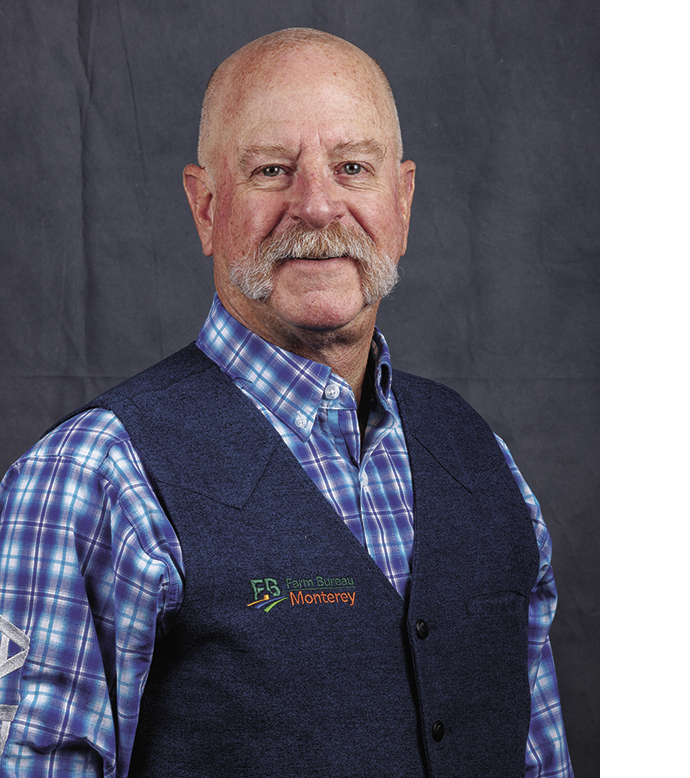
Norm Groot is executive director of the Monterey County Farm Bureau. He can be reached at norm@montereycfb.com.
- July 16, 2025
- Inside Farm Bureau: Farm leader shares thoughts on balancing work, life
-
By Shaun Crook
First Vice President
California Farm BureauI’m a second-generation logger and third generation in agriculture. Have you introduced yourself in a similar way? Ever thought about why you did so or the importance of it? We are often defined by our occupations. This isn’t necessarily good or bad, but what are the ramifications?
For most of us in production agriculture, farming is not just a job but a way of life. It is an amazing opportunity that God has entrusted us with. But if you are like me, finding balance is a constant struggle and a battle I’ve probably lost more than I have won.
I apologize if you expected forest management wisdom in this commentary, but I wanted to take this opportunity to talk about the struggles we don’t usually want to talk about.
 With all that we produce in California, time is still our most precious commodity. I’ve known for a long time that quality time together is my wife’s love language, as that is what is most important to her. Yet I have been guilty of sacrificing my presence with my family for working long hours in the woods, taking on too much extra work—and yes, even for Farm Bureau.
 The Bible talks a lot about the value and importance of hard work and service to others, and I agree completely. But we should also be mindful of the sacrifices our loved ones make because of our decisions and because we “have to work.”
In agriculture, “have to work” is often unavoidable. Many times, the livelihood of our livestock or crops is completely
dependent on our presence, and that means we have to work. But what about the times when things on the farm aren’t necessarily relying on our being there? Do we go to work anyway and miss that baseball game or performance at school? Our loved ones need us there more than we realize. And when we are there, are we really there or is our mind on the work that isn’t getting done?I guess I started to have this midlife crisis—even though at 47 years old, I realize I am past midlife and should have had this crisis at least seven years ago. When it comes to raising children, we have all heard “it goes fast,” “don’t blink” and a thousand other sayings. As an officially “old head,” I can tell you those sayings are true.
I first ran for the state Farm Bureau office more than eight years go. At that time, our oldest son hadn’t started high school, and our youngest could barely throw a baseball. With a couple of blinks, Gregory is a college graduate working on the East Coast, and Walker is about to start his first year at Cal Poly. Velina went back to school and is about to complete her bachelor’s degree. I couldn’t be more proud of my family, but I do have regrets that I wasn’t more present.
One huge change since we started this journey together is that my father passed away two and half years ago. Dad started our logging company and was in charge until the very end. He battled prostate cancer for about four years. He missed an appointment for a prostate screening test because he “had to work.” By the time his cancer was diagnosed, it was advancing to Stage 4. While I can’t be certain he would be here today if he had made it to that appointment, I can be certain that everything at work that day would have been fine if he had missed work to go to the doctor.
The other huge part of all this is we have bad habits of not talking about succession planning. When our patriarch gets diagnosed with advanced cancer, we want to be positive, and talking about how things will go without him doesn’t seem appropriate. It feels too late at that point. But not talking about these things with our families does more harm than good. As hard as it is, someone must start the conversation. Our partners at Nationwide, with the Land as Your Legacy program, have great tools to help in this process. But someone must have the courage to start the conversation.
It’s hard to separate life from work, but it is crucial for our well-being and state of mind to be present for our families. Do we live to work or work to live? Sometimes I must be reminded that being a logger is what I do and not always who I am. I want to first be remembered as a Christian, a husband and a father. Then I can be remembered as a logger.
Shaun Crook, who operates a family timber business in Tuolumne County, is first vice president of the California Farm Bureau. He can be reached at scrook@cfbf.com.
- June 18, 2025
- Commentary: Balance needed to protect livestock, pets and people
-
By Taylor Hagata
Growing up on my family’s cattle ranch in northeastern California, the words ranching and conservation didn’t often go hand in hand. But over the years, I’ve come to understand they’re one in the same.
For four generations, my family has lived and worked this land. We’ve raised cattle while stewarding wildlife, water and soil. My grandfather may not have used the word conservation, but he lived it. He knew, as all successful ranchers do, that the health of the land is tied to our own longevity and success.
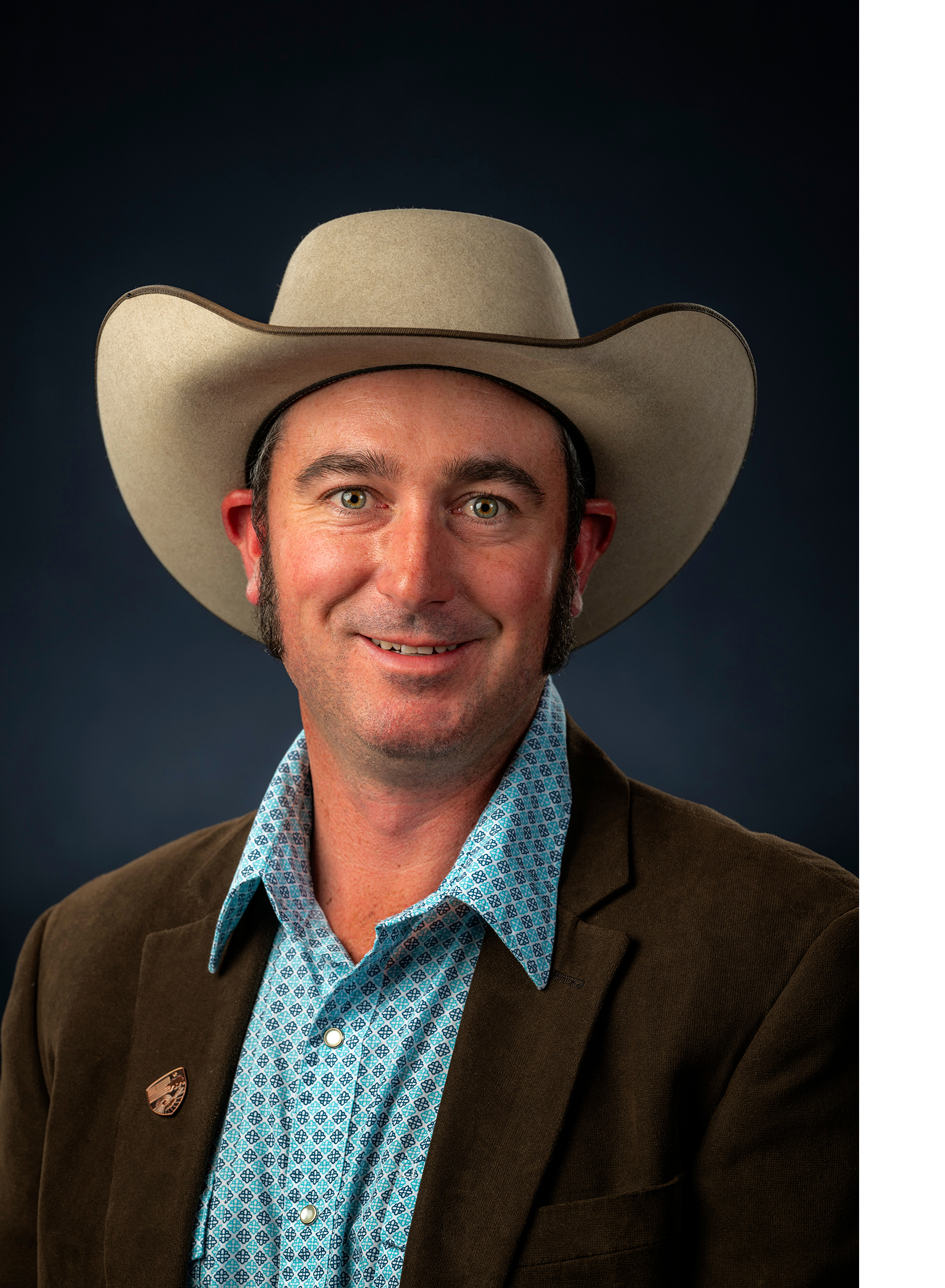
Taylor Hagata
Photo/Brian BaerBut today, that balance is being pushed to a breaking point. The pressures from rising apex predator populations—mountain lions, black bears and now gray wolves—are colliding with collapsing deer, antelope and elk numbers. The result is a growing wave of livestock losses, increasing danger to rural residents, and an uncertain future for ranchers and outdoorsmen alike.
I’ll never forget the day in the early 1990s when my grandfather and I saw a mountain lion running across our ranch road. He was nearly 70 and had spent his life outdoors, and yet he told me it was the first lion he’d ever seen. Fast forward to today, mountain lion encounters are common. I’ve lost two dogs in four years to lions on my own porch and have been losing calves at an increasing rate each year.
It’s not just animals being lost. A woman in Northern California was killed by a bear. Two brothers searching for deer sheds were attacked—one fatally. Locally, we’ve seen lions on school playgrounds, golf courses and in parking lots.
Something has changed.
For years, deer and antelope populations in my area have been in decline—made worse each time rules and regulations are put in place that focus on one apex predator. In response, deer have begun living in towns where they’re safer from predators. The predators have followed them.
At the same time, changes in policy, such as the 2013 ban on hunting bears with hounds, have made it harder to manage predator behavior. Bears now live in places they were rarely seen before, including the high-desert mountains of northeastern California. This has created a dynamic in which lions must hunt more often because they are losing kills to bears—kills they normally would feed on for days.
In 2011, the first gray wolf returned to California in nearly a century when OR-7 passed through our ranch. Now gray wolves are spreading across Northern California, killing livestock and worsening an already unstable predator-prey dynamic.
I understand the emotional pull wolves have after I saw a gray wolf for the first time in the wild on my ranch. They are large, incredible animals. But in a landscape where deer herds are struggling, apex predators don’t just compete with one another—they will eat what is available. And unfortunately, more times than not, that’s our cattle.
Ranchers in California have few tools to protect their livestock. Predator deterrents stop working after a short time. Compensation programs don’t replace lost genetics, years of work or the emotional toll. Most importantly, they don’t stop the next kill.
These issues aren’t just about ranchers. An overall decline in public safety in rural areas affects anyone who lives in or loves rural California. Parents like my wife and I now think twice before letting our children play outside. Communities built on outdoor living and the public that enjoys hunting are watching their way of life change with decreases in hunting tag quotas year after year. This creates a hunting-points system in which you are lucky to draw one deer, antelope or elk tag before you die.
I’m not calling for eradication. Ranchers understand balance—we live by it. But what’s happening now isn’t balance. It’s an unsustainable shift, one that’s endangering not just cattle and pets but people, livelihoods and rural identity.
We need the agricultural community, our local sheriffs, hunting groups and outdoorsmen to join forces to help bring positive change to our rural areas. We need thoughtful, science-based wildlife management policies that reflect on-the-ground realities. We need support for working lands, and we need voices in the rooms where these decisions are made.
We don’t want to look back in five or 10 years, see our rangelands consumed by massive wildfires and realize too late that wolves were the spotted owl of ranching, where regulations—like those protecting the owl—ultimately made it impossible to continue logging, resulting in mismanaged forests and wildfires that destroyed the habitat they were trying to protect for the owls.
I encourage everyone to attend your local and state Fish and Wildlife meetings. Call your legislators. Speak up for the people who feed you and care for the land, those who are protecting open spaces every day.
We need smart rules and regulations that don’t focus on one group of apex predators, forgetting about all other wildlife. We need to protect property rights and public safety, regulations that let farmers and ranchers continue to do what they do best—creating safe, reliable food for the world while conserving open space for wildlife and future generations.
Lassen County rancher Taylor Hagata serves on the board of the California Farm Bureau, representing Lassen, Modoc and Plumas-Sierra counties. He can be reached at media@cfbf.com.
- June 4, 2025
- Inside Farm Bureau: Farm Bureau expands its reach through community
-
By Dan Durheim
Chief Operating OfficerAs I reflect on where we are as an organization and where we are headed, the words community, engagement and shared values come to mind.
We are in what I’d call the heart of advocacy season, a time of tremendous opportunity to activate our grassroots energy, create meaningful conversations and renew our shared purpose.
 During the past few months, I’ve had the privilege of traveling to county Farm Bureau events across the state—from San Diego and Orange to Siskiyou, Butte and El Dorado. Each stop reinforces something essential: Community is still alive and well. But it’s up to us to keep it vibrant, connected and relevant. We do that by showing up, listening to our members and creating authentic opportunities where they feel heard, supported and inspired.
The events I attended weren’t just celebrations of agriculture. They were vibrant demonstrations of what Farm Bureau stands for.
In San Diego County, the Graze at the Fields event held at the beautiful Carlsbad Flower Fields brought together farmers, chefs, local businesses and community members around food and kinship. The San Diego event was a powerful example of our mission in action. From the smoked tuna chowder to the educational exhibits and the presence of Ag in the Classroom, this was agriculture brought to life. We didn’t just talk about the importance of farming. We showed it.
Orange County’s Steakfry had its own unique flavor both literally and figuratively. Santa Maria-style barbecue and the energy of 4-H and FFA youth reminded us of the deep roots we have in our communities.
In El Dorado County, people came together across generations to reclaim a community space, dance and celebrate their rural lifestyle. This is what makes Farm Bureau more than an organization. It makes us a movement.
Advocacy is no longer something we do once a year with a large contingent in Washington, D.C., or Sacramento. Through our Calling on the Capitol Series, we are reimagining what member engagement can look like. Smaller groups meeting more frequently are building stronger, more personal connections with elected officials. Members who’ve never advocated before are stepping up, supported by our staff and empowered with information.
This approach is delivering tangible results: more confidence among our members, better visibility with policymakers and deeper relationships. Our advocacy is becoming more accessible, more dynamic and more effective because it’s rooted in the lived experiences of our members.
Whether in board meetings or at community events, what I hear again and again is a desire for connection, support and relevance. People are craving meaningful engagement.
At a recent gathering in El Dorado County, I sat with a family that was raising their kids in the agricultural lifestyle. They didn’t regularly attend board meetings, but they were there, involved and invested to secure the future of the next generation.
That’s why listening is at the core of everything we do. It’s how the Calling on the Capitol Series evolved. It’s how we’re shaping programs at the county level, and it’s how we ensure that innovation and relevance stay central to our mission.
We know the headwinds farmers face: uncertainty with tariffs, high costs and added regulatory pressure. These are real challenges impacting livelihoods. So how do we respond? With new ideas, solutions and a commitment to making Farm Bureau essential to the people we serve.
This year, we’ve made intentional growth to increase operational engagement and align our work with three clear goals: advocacy, organizational strength and member value. We’ve reorganized the board around these pillars, and the questions coming from our leadership reflect a forward-looking mindset: What does the Farm Bureau of the future look like? How can the state office better support the counties?
Today’s world is filled with distractions, and lifestyle changes have pulled people away from the traditional concept of community. But what I see—event after event, county after county—is that people still want to come together. And when Farm Bureaus provide the right opportunities, they do—by the hundreds.
When we talked in January about the three pillars—policy advocacy, business solutions and leadership development—we committed to not just talk but act. I can confidently say that we are moving the needle. The unity I’ve seen among members, the curiosity and engagement of youth, and the dedication of our board and staff are a testament to that.
The heart of our strength is our people. Our power lies in our unity and our grassroots energy. Let’s keep growing. Let’s keep showing up. Let’s keep connecting.
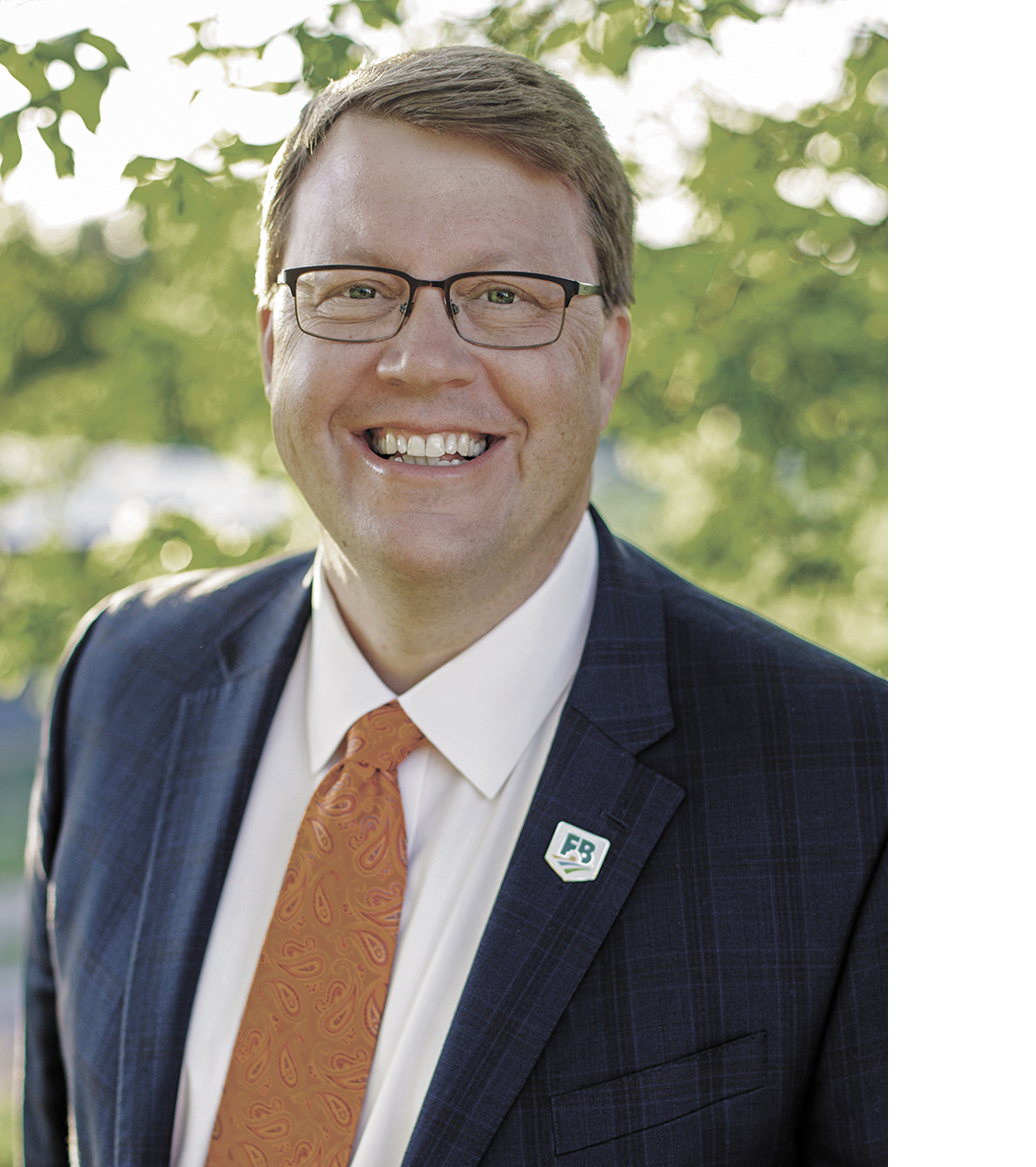
Dan Durheim is chief operating officer of the California Farm Bureau. He can be reached at ddurheim@cfbf.com.
- May 21, 2025
- Commentary: Technical knowledge needed for state's water future
-
By Stuart Styles
Efficient water management is a growing priority in California as agriculture, urban and recreational development, and environmental needs increasingly compete for limited resources.
There is a pressing need for professionals who understand water system complexities but also can design, manage and optimize irrigation systems. To meet this need, professionals need an excellent source of irrigation education that includes extensive written material to emphasize the details and a tested hands-on component to help understand complex topics.

Stuart Styles Cal Poly’s Irrigation Training and Research Center, or ITRC, plays a critical role in addressing that need.
I started working for the ITRC in 1993 and have been director since 2000. Founded in 1989 by Dr. Charles Burt and housed within the BioResource and Agricultural Engineering Department, ITRC was specifically developed to ensure long-term positive benefits to Cal Poly’s academic irrigation training program, emphasizing the “Learn by Doing” motto.
The center’s work spans irrigation district modernization, supervisory control and data acquisition systems, or SCADA, and canal automation, flow rate management, on-farm irrigation system evaluations, energy efficiency and evapotranspiration measurement.
ITRC balances its academic irrigation program while also serving as a technical resource for the water industry. It integrates training, research and technical support to serve students and professionals across California. The center is operated by 15 professionals and 30 part-time student technicians.
ITRC offers year-round technical training for irrigation district staff, engineers, consultants and growers. These workshops combine classroom instruction with hands-on experiences at the Irrigation Performance Facility and the Water Hydraulic Laboratory.
Thirteen irrigation courses are available to Cal Poly students. During COVID-19, these were among the few classes held on the Cal Poly campus. The outdoor facilities provided a perfect classroom setting, bringing safe instruction. Courses designed for students have been shared with irrigation dealers, districts and the broader industry. These 525 professional offerings have served more than 11,700 participants, with 157,200 professional education hours logged over 35 years.
Irrigation System Evaluation, or ISE, short courses, sponsored by the California Department of Water Resources, prepare participants for ITRC Certified Distribution Uniformity Evaluator certification. ISE1 combines theory with lab practices, while ISE2 involves complete field evaluations of drip and microirrigation systems in the San Joaquin Valley.
 Certified evaluators perform summer distribution uniformity evaluations statewide. Offered free through DWR and the California Department of Food and Agriculture, these assessments involve measuring pressures and flows and inspecting system components. Students input the data, analyze it with staff support, then compile reports with results and recommendations. They also meet growers to review findings and suggest improvements, often boosting yield and crop quality.
The Designer/Manager School of Irrigation program offers courses in scheduling, hydraulics, pumps, row crop drip irrigation, and drip and microirrigation design aligned with Irrigation Association certifications. Most exams and books were provided by ITRC and authored by me and Charles Burt, who has been my mentor.
For water districts, the Irrigation District School of Irrigation courses are held during the winter months. The workshops are sponsored by the U.S. Bureau of Reclamation, California Great Basin region. The program includes courses in flow management, pumps, modernization and SCADA.
ITRC is updating its popular flow management short course to become a certified program, which will include a formal exam and certificate. This new certification is designed to strengthen industry standards and better prepare participants for real-world applications. The certified course is expected to be launched soon. The SCADA course now features cutting-edge Schneider Electric 474i controllers, offering water districts a state-of-the-art training for modernizing canal and pump control systems.
The Certified Irrigator Program is sponsored by the CDFA Water Efficiency Technical Assistance program. The two-class sequence focuses initially on basic irrigation principles and advances to topics such as pipeline hydraulics and irrigation efficiency. These classes are offered in English and Spanish and are targeted for on-farm irrigation professionals, with an emphasis on drip systems. After completion of each in-person course, attendees can take an exam to receive certification.
ITRC also provides two self-paced online courses that are available year-round. The online Certified Fertigator course is sponsored by CDFA’s Fertilizer Research and Education Program and is available in English and Spanish. The classes cover techniques in the control and application of fertilizers through irrigation systems and strategies to conform to nitrogen regulations in California.
Other key topics include the characteristics and behavior of nitrogen fertilizers, challenges associated with phosphorus and potassium applications, use of growth enhancers and organic-compliant methods for keeping drip systems clean. The course emphasizes increasing crop yields per acre-foot of evapotranspiration through improved fertility management, a critical objective for California growers facing ongoing water and regulatory pressures.
Cal Poly’s ITRC continues to be a vital hub for irrigation education, research and innovation, training the next generation of professionals to meet California’s water management challenges. For more information about projects or short courses, visit itrc.org.
Stuart Styles is a professor of irrigation and director of the Irrigation Training and Research Center at California Polytechnic State University, San Luis Obispo. He may be contacted at sstyles@calpoly.edu.
Victoria Paolini, agricultural communications technician at Cal Poly’s Irrigation Training and Research Center, contributed to this commentary.
- May 7, 2025
- It's time to activate for agriculture. Here's how.
-
By Shannon Douglass
President
California Farm BureauActivate. It’s one of the most important words in Farm Bureau’s vocabulary. It’s not passive. It doesn’t wait. It doesn’t settle. It moves. It organizes. It amplifies.
To activate is to engage with purpose. And that’s exactly what Farm Bureau does every day. Together, members and staff activate to protect the future of farming and ranching in California and the quality of life that comes with it.
It’s not an easy path. But challenges don’t intimidate farmers and ranchers. They activate us.
And right now, the challenges are mounting.
California lost more than 15,000 farms between 2012 and 2022, according to the latest U.S. Census of Agriculture. That’s not just a number. That’s families, land, food production—a way of life—disappearing at an alarming rate.
One major reason? The cost of doing business has exploded. A Cal Poly, San Luis Obispo, study shows regulatory compliance costs for California farmers have increased nearly 1,400% in less than 20 years. That’s not sustainable—for family farms, rural communities or the millions who rely on California-grown food.
In just the past five years, we’ve lost more than 120,000 acres of irrigated farmland and seen a 10.5% drop in the number of farms. These aren’t isolated statistics. The state with the heaviest regulatory burden is also leading in farm loss—and the consequences ripple far beyond the farm gate.
But here’s what matters most: We can make a difference.
Last year, we proved that when we speak up, we’re heard. From key legislative wins to growing public awareness, our collective voice has power. The passage of Proposition 36 and momentum around issues like Measure J show that Californians are starting to ask the right questions and our elected leaders are beginning to listen.
Why? Because people like you are speaking up. Your voice matters. Together, we ensure decision-makers understand what’s at stake.
That’s what it means to activate. We speak up. We share the facts. But most importantly, we tell our stories—because that’s what people remember.
Like the farmer watching once-productive fields sit idle, only because the cost of staying in compliance is higher than the return on the harvest. Or the rancher losing cattle to predators—or worse, who’s hesitant to let his children play in the backyard because of those same threats.
These stories bring the statistics to life. They make the issue personal and impossible to ignore.
We need to keep that momentum going. It’s going to take all of us—farmers, ranchers, advocates and families—activating together.
That’s why we’re asking you to step forward in two powerful ways:
First, join your fellow Farm Bureau members for legislative visits this month during our Calling on the Capitol Series. These one-day trips are designed to maximize your voice while minimizing your time away from the farm. May is a critical time in the legislative cycle, and your story can make a real difference. (See Make time to voice concerns on issues affecting your farm.)
Second, if you can’t leave the farm, you can still activate in seconds. Sign up for FarmTeam to receive quick, impactful alerts via text and email. When legislation threatens agriculture, your voice—sent directly to elected officials—helps shape outcomes. It takes only 60 seconds, but it makes a big difference. (See details below.)
Let’s not wait for change. Let’s activate it.
FarmTeam makes it easy to activate
 When policy decisions threaten the way of life for California farmers and ranchers, timing is everything.
FarmTeam provides a fast, effective way to make your voice heard in both Sacramento and Washington, D.C. Members sign up to receive timely alerts via email and text about critical legislation that impacts California agriculture. With just a few clicks on your phone or computer, you can send a message directly to your elected representatives.
It’s quick. It’s easy. And it works.
FarmTeam has played a key role in stopping harmful bills before they become law—because lawmakers listen when they hear from the farmers and ranchers they represent.
FarmTeam is a service of Farm Bureau, but membership is not required to participate. Anyone concerned about the future of California agriculture is encouraged to sign up.
Join the more than 40,000 members of FarmTeam and make your voice heard.
- April 9, 2025
- Overtime tax credit bill a plus for farmers, workers
-
By Bryan Little
When the California Legislature rewrote the overtime rules for agricultural employees in 2016, the California Farm Bureau warned policymakers their action would have serious, detrimental consequences for agricultural employees, their families and their rural communities. Unfortunately, those warnings proved prescient.
For decades, employees received overtime when they worked more than 10 hours in a workday for a maximum of six days in a workweek because of the highly seasonal nature of agricultural work. For most agricultural employees, work in the fields is available only a few weeks a year. Agricultural employees need to work when work is available to make up for the weeks after harvest and in the winter each year when farm work is unavailable.

Bryan Little Dr. Alexandra Hill of the University of California, Berkeley, found in 2023 that the change in agricultural overtime rules decreased employees’ weekly working hours and earnings—to the surprise of no one who warned policymakers back in 2016 about the likely impact of the change. (See related story, Research shows overtime law costs workers $100 per week.)
The price to an agricultural employer for each hour worked by agricultural employees after eight in a workday and 40 hours in a workweek went up by 50%—an increase agricultural employers cannot recover by simply raising the market price of what they grow. Unsurprisingly, California agricultural employers—who can’t control the cost of fuel, fertilizer, electricity, pesticides, seed and everything else they need to produce a crop—are trying to control one area of production cost they actually can manage.
Senate Bill 628, by state Sen. Shannon Grove, R-Bakersfield, will reimburse California agricultural employers for the cost of overtime premium wages (the “half” in “time and a half”) by claiming a credit for that cost from what they remit to the state for payroll taxes. Not a single dime of this tax credit will enrich California agricultural employers because an employer will not be able to claim the credit until overtime—and the straight hourly time that goes with it—have already been paid to employees.
Every dime an agricultural employer can claim under this tax credit will have already been paid to their employees—millions of dollars that will go straight to agricultural employees’ pockets that they will spend for gas and groceries, clothes and shoes for their kids and electricity to cool their homes this summer. Those dollars will be poured into struggling rural communities in California.
California farm employees will tell you the 2016 overtime policy change made it harder for farmworkers to work and earn. We know this because they tell the Farm Bureau members who employ them every day. SB 628 is a commonsense solution that ensures farm employees have more opportunities to earn and support their communities and families.
In Sacramento, policymakers like to talk about affordability—making it more affordable to live, work, start a business and create jobs in California. But the reality is that California is a difficult and expensive place to farm, and California farmers are challenged to compete with producers from other states and countries.
For nearly 20 years, researchers at California Polytechnic State University, San Luis Obispo, have tracked the cost of growing food in California. They found that for one lettuce producer in Monterey County, regulatory compliance costs have risen 63.7% since 2017 and a whopping 1366% since 2006. Regulatory costs now amount to $1,600 per acre, or 12.6% of production costs for this farmer. Meanwhile, the value for their lettuce increased only 0.37% from 2017 to 2024.
If we want to continue to grow food in California, with the highest labor standards, the most protective occupational safety and health standards, and the highest food safety standards in the world, this situation is unsustainable.
SB 628 gives California farmers an opportunity to put more money into the pockets of the people who are absolutely essential to growing the food that feeds California and the world.
In passing SB 628, the California Legislature can make an important stride to improve the sustainability of California agriculture, employees’ families and rural communities. By turning a new page, California can continue to be America’s and the world’s Salad Bowl for generations to come.
Stay updated at cfbf.com/sb628.
Bryan Little is director of employment policy for the California Farm Bureau and chief operating officer for the affiliated Farm Employers Labor Service. He may be contacted at blittle@cfbf.com.
- April 9, 2025
- Building leaders through Farm Bureau involvement
-
By Daniel Jones
I started my leadership role in Young Farmers & Ranchers in 2020, and at the time, I was asked to represent a district on the state level where I resided. As the year progressed, I was approached about potentially running for the executive team in years to come.
I was motivated to get involved at a level higher than just the county, and as someone who has farmed in multiple areas, it made sense to pay close attention to issues that could directly affect the family business. I wanted to be at the forefront of new technology and advancements through research.
I always believe that those of the agrarian lifestyle are some of the best caretakers of the lands on which they farm or manage. I knew even then that being a leader for tomorrow—and following in the footsteps of someone like my dad—meant I had to gain the knowledge and experiences involved with being a great leader.
I followed through and applied and was generally surprised back then to have been accepted into the executive role at such an early point in my “state committee” career. Furthermore, I had applied at a similar time to be involved in California Leadership Farm Bureau, or LFB.
LFB gave me greater insight into the inner workings of the grassroots organization from both a state and national level. I was exposed to the many different roles that staff members have and was shown the value in what they do on a day-to-day basis.
I took a tour with the 2022 LFB class of North Carolina, where we met with the North Carolina Farm Bureau delegation and discussed their operational standards, all while comparing what was going on in California. Through such interactions, I was able to gain lifelong friendships with leaders both near and far across the country, which propelled me into my next California Farm Bureau role.
In the fall of 2023, I applied to serve on the American Farm Bureau YF&R National Committee. I was nominated by then-California Farm Bureau President Jamie Johansson, and my application was accepted by AFBF President Zippy Duvall by Christmas that year to serve the two-year term.
At the national level, I have made some of the greatest personal connections to date through AFBF. Being the only active member on the committee west of the Mississippi River at the time gave me a unique opportunity to showcase Western agriculture and life. I am proud to reveal the heritage behind one of the most diverse states in the nation, using my platform to highlight the more than 400 different types of crops and commodities we grow in the state, from Modoc to Imperial counties. In countless meetings and small talks given, I make it my mission to highlight not only California but also include the other Western states that I represent.
This past January I became the vice chair of the AFBF YF&R Committee. I saw an opportunity to promote and employ the skills I have learned at the national level in many different facets. I am responsible for helping to coordinate the nationwide CONNECT calls, which are virtual events that offer professional development and networking opportunities for YF&R members. I also serve as a liaison between the AFBF YF&R and Young Farmer programs in Canada and Japan, helping to strengthen global agricultural connections.
As the 2025 chairman of the California YF&R State Committee, I plan to use all the leadership skills I have gained through Farm Bureau in the past decade to lead a great group of people forward to ensure the goals are consistently met for us to continue to inspire future leaders in Farm Bureau through education, experiences and hands-on learning, all while maintaining and building relationships that will last a lifetime. The theme of our last annual meeting was Stronger Together, and I am proud to say that the mindset of that theme will be carried forward into 2025.
My leadership stemming from the California Farm Bureau has reached the lives of many across this beautiful country, and I am proud to be part of an amazing group of farmers and ranchers who work hard every single day to put food on tables locally and around the world. My piece of advice to anyone looking to build their leadership skills is: Just start somewhere, no matter where.
Daniel Jones is a fourth-generation farmer in Solano County. He grows almonds, hay and other forage crops. He also runs a custom farming business and works as a crop insurance adjuster.
- March 26, 2025
- Help ensure California agriculture has secure future
-
By Steven Fenaroli
California’s agricultural industry is diverse and vast, contributing more than $50 billion to the state’s economy. It touches nearly every corner of life in the state— from the food we eat to the jobs that sustain our rural communities. Yet, the complexity of agriculture often means that many decision-makers may not have direct experience with farming or ranching. In such a world, it is essential to have a strong voice in the political process.
Through FarmPAC, the political action committee of the California Farm Bureau, the organization raises money and supports rural and agriculture-focused candidates, and forges relationships with urban and suburban officials to educate them on how policies impact farmers, ranchers and their constituency.
State and federal elections happen every two years without fail. Newly elected officials arrive, and incumbents depart. In a year that demanded unity, advocacy and strategic political engagement, FarmPAC rose to the occasion. Through Farm Bureau member engagement and financial backing of candidates, FarmPAC had an impressive success rate of 92%—the percentage of candidates who won elections with our support. We demonstrated just how critical our role is in supporting candidates who are attuned to the needs of California agriculture but who help introduce agricultural perspectives to those who may not have previously understood the challenges and opportunities farmers and ranchers face.
Our high success rate in 2024 reflects our strategic planning and the deep understanding that we have developed for candidates who champion the needs of farmers and ranchers both in Sacramento and Washington, D.C. We make decisions based on more than just political affiliation. We consider the values, vision and willingness of each candidate to collaborate with the agriculture community to address complex challenges and to hear our perspective on potential law.
Don’t be mistaken. This doesn’t come without losses and doesn’t mean that every elected official agrees with us 100% of the time. After all, we don’t agree with our friends or family all the time. But we continue to educate officials and meet with representatives, communicating the stories of farmers—or, when possible, ask farmers and ranchers to share their stories directly.
A key aspect of FarmPAC’s success is our ability to identify and support candidates who are willing to listen to and learn about the needs of agriculture. For many candidates, the world of farming and ranching is unfamiliar, and we have played a key role in bridging that gap.
We’ve created opportunities for candidates to meet with farmers, tour local farms and learn firsthand about the policies that shape the agricultural landscape. These interactions provide a
real-world education that many politicians can’t get elsewhere. It allows them to see the hard work, ingenuity and dedication that goes into every harvest, every ranch operation and every decision that impacts agriculture.One of the most gratifying aspects of our success has been the relationships we’ve built with candidates from both sides of the aisle. By working across the aisle and with a diverse range of candidates, we’ve been able to build coalitions to help secure the future of California agriculture, no matter a lawmaker’s party affiliation. We helped elect new candidates such as state Assembly Member Jeff Gonzalez, R-Coachella Valley, who has been an ally for agriculture during his short time in Sacramento.
We also supported Assembly Member Esmeralda Soria, D-Fresno, chair of the state Assembly Agriculture Committee, who without hesitation visited a Merced County field to see the impacts of a lygus infestation.
As we look ahead, FarmPAC’s mission remains steadfast. We will continue to advocate for policies that support farmers and ranchers—from improving water infrastructure to streamlining labor regulations—to ensure that our rural communities thrive. But our work goes beyond electing legislators who pass legislation. It’s about continuing to build relationships with lawmakers and candidates, educating them about agriculture and ensuring that the next generation of leadership is equipped to address the challenges of the future.
The success of FarmPAC is a testament to the strength of the California Farm Bureau and our unwavering commitment to agriculture. Our work is far from over. The future of California agriculture depends on strong, informed and committed leaders, and FarmPAC will continue to play a vital role in making sure that the agricultural community is well represented at every level of government.
Together, we will ensure that California agriculture remains a thriving, sustainable industry for years to come.
How can you continue to help? Every time you renew your California Farm Bureau membership, consider adding a donation on your renewal for FarmPAC. Additionally, donations can be made online at cfbf.com/farmpac.
Steven Fenaroli is a director of policy advocacy for the California Farm Bureau and director of FarmPAC. He may be reached at sfenaroli@cfbf.com.
- March 12, 2025
- Commentary: Building relationships vital to Farm Bureau success
-
By Ron Peterson
Second Vice President
California Farm BureauHaving recently completed my first year as a California Farm Bureau officer, one of the most exciting aspects of my position has been traveling to different parts of the state and connecting with our county Farm Bureau leaders and members.
I believe relationships are critical to making a leader successful. When I was first elected, I wanted to help the organization build relationships with farmers in different counties so that they can reach out to me when they have problems, and I can reach out to them when I need advice on specific issues.
One year into my post as the second vice president of the largest agricultural organization in California, I understand that relationship building is also essential to the long-term success of the organization.
I came to my role as part of a new leadership team, and from the start, we saw unique opportunities to make meaningful changes this past year. With Farm Bureau being a grassroots organization, it’s important that county Farm Bureau members create and direct policies. Our job in the leadership team is to then implement their policies.
California’s diverse crops, climate zones and farming population can make policy development challenging. Different regions face different issues, and developing policies that meet everyone’s needs can be tricky.
That’s why getting my boots on the ground has been so vital in my leadership journey. Traveling to the state’s various regions has allowed me to hear more opinions and perspectives. This has allowed me to bolster relationships with counties to ensure we’re serving the needs of our members.
My travels have also allowed me to see how different parts of the state operate, and I’ve had a chance to receive important feedback from farmers in those regions. I’ve heard that California Farm Bureau can do better communicating and supporting counties with issues they’re tackling. I know some counties have felt as though they’ve been on an island sometimes and that they weren’t getting the assistance they would have liked.
The leadership team has worked tremendously hard to be more responsive by meeting with farmers and leaders in different regions and helping them find solutions by involving our legal staff or policy team.
During Farm Bureau’s Annual Meeting last December, members had a chance to work through high-ranking topics during various breakout sessions. The meetings allowed people to literally sit at the table and provide input. The process was very well received, and we plan to continue and improve upon it.
We’ve also changed the format of our commodity advisory committees—the grassroots of our policy development. Whereas we previously restricted the committees to one person from each county and spent about a week in March discussing specific topics, we’re now bringing more farmers into the fold by opening the input sessions to all Farm Bureau members and holding the committee meetings during an extended period.
To encourage more participation and engagement, different county Farm Bureaus are hosting committee meetings in person and virtually. This change has really opened the process, with more people getting involved in the initial discussion that’s been key to how the organization forms policy.
As with most businesses and organizations, California Farm Bureau has had to grapple with tight budgets, but we’re working through those challenges and making sure we’re operating within our means.
Going forward, I know California farmers and ranchers continue to face natural and regulatory challenges that threaten our existence, with the top one being water. We know that without water, there won’t be farms and ranches. That is why Farm Bureau is committed to finding workable solutions that allow California agriculture to thrive.
It’s important that Farm Bureau remains a strong organization. We have been around for more than 100 years, and our leadership team wants to make sure we’re here for the next hundred-plus years and beyond so that we can continue to support California farmers and ranchers.
As a leader, I believe we should always think about who’s coming behind us and whether we are giving them the resources and skills to be future leaders. In my role, probably the most important contribution I can make is to provide opportunities and experiences for younger farmers to become the leaders of tomorrow.
Growing up, I had plenty of opportunities that helped me become the kind of person and leader I am today. I remember as a kid sitting around the kitchen table with my grandfather and his brothers, listening to their conversations about business, politics and social issues. Those talks helped form my perspective about life and establish my values.
In building our leaders, Farm Bureau offers similar opportunities, albeit more formally through programs such as commodity advisory committees, listening sessions, Leadership Farm Bureau and Young Farmers & Ranchers that allow up-and-coming leaders to be part of the conversation as we solve problems for the future.
We also need to continue to inform the public about farming and the rich abundance of safe, affordable agricultural products we deliver every day. Everybody likes to eat, but people tend to forget how that food gets on their plates. In all policy discussions, we need to remind the public what it takes to do our job so that we can continue to bring the state’s agricultural bounty to people’s tables.
Ron Peterson, a dairy farmer who also grows silage crops and almonds and raises beef cattle in Stanislaus County, is second vice president of the California Farm Bureau. He may be reached at rpeterson@cfbf.com.
- February 26, 2025
- Investing in healthy soils strengthens farm resilience
-
By Margaret Honig
Soil health isn’t just a buzzword. It’s the foundation of productive farms, resilient crops and long-term sustainability. As someone who works closely with farmers, I see the challenges firsthand: unpredictable weather, water restrictions, rising input costs and shifting regulations, all of which make soil management feel like one more hurdle in an already demanding industry.
Yet, healthy soil is an investment. It directly impacts yield stability, disease resistance, water efficiency and overall farm resilience. In California’s citrus industry, where growers are battling huanglongbing, extreme heat and increasing regulatory pressures, soil health can be a critical tool for long-term success.
Research consistently shows that improving soil health leads to better fruit quality and yield stability, stronger root systems that support longevity, greater resilience to drought and erosion, and reduced reliance on synthetic fertilizers and pesticides.
The challenge? Many soil health practices require upfront investment and long-term commitment, and in an industry where margins are already tight, not every grower can afford to take that risk.
That’s where the Healthy Soils Program comes in. Funded by the California Department of Food and Agriculture, this program helps farmers implement
research-backed soil health practices such as compost application, cover cropping, reduced tillage, nutrient management, hedgerow planting and more.At the California Bountiful Foundation, the nonprofit research affiliate of the California Farm Bureau, we administer the Healthy Soils Block Grant Program in partnership with the California Citrus Quality Council and the Xerces Society. Together, we help citrus growers access funding, implement best practices and receive technical assistance tailored to their operation.

Photo/Christine Souza The benefits of healthy soil aren’t just theoretical. They’ve been proven through years of research, on-farm demonstration trials and farmer feedback. Here’s how some of the program’s most impactful practices contribute to better soil health management:
• Compost application: Compost adds organic matter, improves microbial diversity and enhances water retention. Research from the University of California, Berkeley, found that compost-amended soil stores more carbon and improves water-holding capacity, which is critical for drought resilience and long-term fertility.
• Cover cropping: Cover crops such as legumes and grasses reduce erosion, fix nitrogen and suppress weeds. A UC Davis study found that cover crops can replace synthetic nitrogen fertilizer needs, helping farmers reduce input costs while maintaining soil health.
• Reduced tillage: Excessive tilling disrupts soil structure and accelerates carbon loss. Studies show that reducing tillage enhances water infiltration, preserves soil microbes and helps retain carbon in soil while improving farm resilience in drought-prone regions.
• Hedgerow plantings: These native plantings increase pollinator activity, improve biodiversity and help reduce
pesticide use. A UC Cooperative Extension study highlights how hedgerows can support beneficial insects that help control common citrus pests. By planting species such as California lilac, buckwheat, toyon and sage, growers can attract natural enemies such as parasitic wasps, lady beetles and lacewings, all of which can reduce the need for chemical pest control.Even with proven benefits, many farmers hesitate to adopt new soil-health practices due to:
• Economic hurdles: Upfront costs for equipment, labor and materials can be prohibitive, even with cost-share support from the Healthy Soils Program. Continued funding and financial incentives are critical for widespread adoption.
• Short-term vs. long-term returns: Some practices such as composting and cover cropping take years to show measurable results, making them difficult to justify when farmers need immediate returns to stay profitable.
• Market pressures: Consumers and food companies increasingly demand sustainability, but there’s no consistent financial incentive for farmers implementing these practices, meaning the cost burden often falls on the producer.
• Extreme weather, water scarcity and soil erosion: In some California regions, topsoil loss due to heavy rainfall, wind erosion or drought can undermine efforts to rebuild soil structure. Without incentives for cover cropping and reduced tillage, soil degradation will continue to impact productivity.
The Healthy Soils Program helps bridge the transition by offsetting costs and providing technical support. The California Bountiful Foundation and its partners have awarded 39 projects to citrus growers in Fresno, Imperial, Kern, Placer, Riverside, Tulare, San Diego and Ventura counties.
Each participating citrus farm receives up to $200,000 to improve soil health, water retention and carbon sequestration. Among the widely adopted practices are compost application, cover cropping and wood-chip mulching. The California Bountiful Foundation also provides technical assistance, regional hedgerow guidance and material sourcing support. At the foundation, we’re committed to helping farmers integrate soil-health strategies while keeping their operations profitable and productive.
The Healthy Soils Program helps improve soil fertility, water retention and long-term productivity. While challenges such as upfront costs and technical adjustments remain, the 39 awarded projects in citrus groves lay the groundwork for stronger, healthier soils. As these practices take hold, they will drive lasting benefits for citrus growers, agriculture and the future of California food production. At the California Bountiful Foundation, we are committed to supporting this progress and ensuring that healthy soil continues to strengthen California farms for years to come.
To learn more about soil-health practices that can benefit your farm, visit www.nrcs.usda.gov/resources/guides-and-instructions/conservation-practice-standards.
(Margaret Honig is the Healthy Soils Program Project administrative lead for the California Bountiful Foundation, an affiliate 501(c)(3) of the California Farm Bureau. She may be contacted at mhonig@cfbf.com.)
- February 12, 2025
- Grassroots engagement by members guides policies
-
California farmers and ranchers are the backbone of our state. These individuals work hard to grow food for the nation and contribute billions to the economy while supporting working lands and the environment.
The state’s farmers face challenges such as drought and uncertain water supplies, workforce shortages, increased government regulations, higher costs and market volatility. To navigate these issues and support our members, the California Farm Bureau stands ready to engage and advocate for solutions.
As a grassroots organization, the Farm Bureau’s strength is our members, who drive policy and set priorities through involvement in commodity advisory committees, which meet regularly throughout the year. The committees bring members together to discuss important issues that relate to their respective crops. To encourage increased participation and engagement, we decided to hold meetings in person at regional locations as well as virtually this year.
Last week, county Farm Bureaus hosted committee members of forestry and public lands; wheat, feed and small grains; and field crops. In the coming days and weeks, the committees for nut trees, fruit trees, livestock, grapes and horticulture will meet.
Discussions included water challenges, especially as many county Farm Bureau members navigate the state’s groundwater regulation, the Sustainable Groundwater Management Act, or SGMA. Our county Farm Bureaus are at the forefront and the first line of defense to protect and promote agriculture in the counties.
During the forestry and public lands advisory committee, hosted at the Butte County Farm Bureau, we had robust participation, covering federal lands management, fuels reduction and grazing on public lands. The committee drafted policy language to strengthen management of predators.
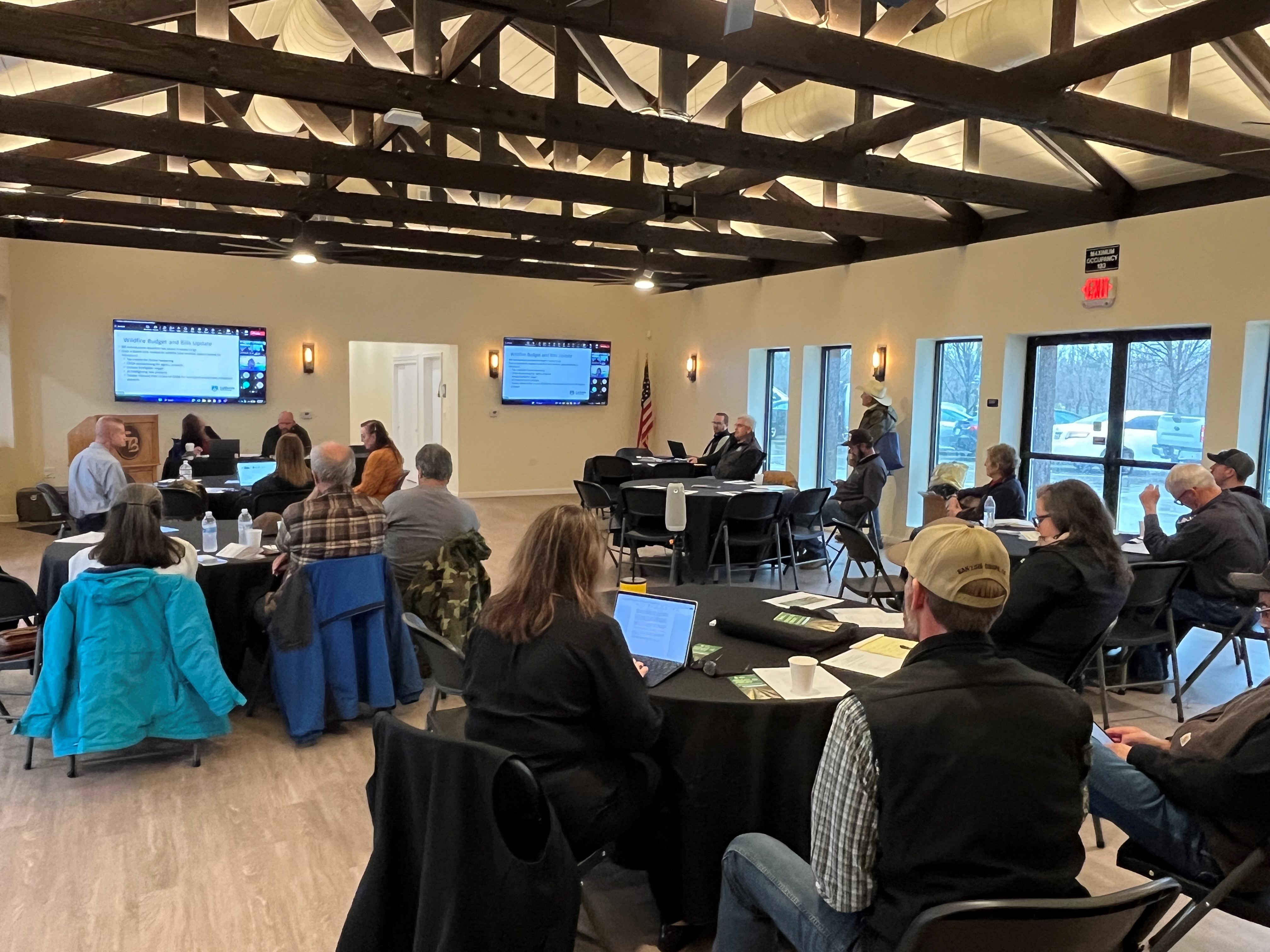
As part of the policy setting process, members of the California Farm Bureau forestry and public lands advisory committee and other interested members met last week, discussing land management, fuels reduction and grazing.
Photo/Ned CoeConnecting with members is important. There are times when somebody needs help with an issue and the California Farm Bureau can make a connection or point them in the right direction, or maybe another county has dealt with the same issue and can provide guidance.
Our members want to see that they are paying dues to an organization that is working for them. They want us to be visible, so we are present and making a difference. Attending events like the Red Bluff Bull & Gelding Sale, the Colusa Farm Show and the World Ag Expo is a great opportunity for state and county Farm Bureau staff to interact with members and reach prospective members. It gives them the chance to discuss issues or just say hello.
As I travel to different counties attending annual meetings, conferences and events, county Farm Bureau members have told me they value the relationship with the California Farm Bureau. There is an understanding that the state does care about what’s going on in my county. We are all part of the same family. That’s what you see at the American Farm Bureau Federation, too.
At the AFBF Annual Meeting last month in San Antonio, Texas, California Farm Bureau officers and other members saw the policy development process reach a conclusion as the organization approved national policy priorities. With 55 members from California attending, it was the largest presence that the Golden State has had in the past decade.
The AFBF Annual Meeting is an opportunity to connect with members from across the U.S. I heard from members from Kentucky, Montana and Delaware, and it was a reminder that farmers in other states are going through the same struggles that we are on our farms and ranches. In many cases, these members are dealing with issues that we in California have faced for years. Members from other states are now reaching out to the California Farm Bureau for solutions and advice, which is a big change.
It is significant that we get to come together to discuss challenges and conclude the meeting with some hope on how we can solve issues. With the AFBF Annual Meeting set for Jan. 9-14, 2026, in Anaheim, I’m hoping we can get 1,000 California Farm Bureau members and county presidents to attend.
We had a lot of momentum going into our California Farm Bureau Annual Meeting held in December in Monterey. Everybody was excited. They see the changes and the direction that we are headed in and are reinvigorated. They’re ready to face the challenges that we have in agriculture.
We all have a stake in ensuring that California’s agricultural sector remains strong and viable for generations to come. It’s time to stand with our farmers and ranchers, support their efforts and embrace the power of unity to tackle the issues that matter most.
Together, we can build a better future for California agriculture.
(Shaun Crook, who operates a family timber business in Tuolumne County, is first vice president of the California Farm Bureau. He may be reached at scrook@cfbf.com.)
- January 29, 2025
- Indoor heat rule headlines heap of new labor laws
-
By Bryan Little
California’s regulators and legislators seem to never sleep when it comes to adding to and changing California employers’ obligations and requirements, and 2024 was no different from years past.
New mandates affecting agricultural employers took effect in mid-2024 and Jan. 1, 2025.
Jan. 1 saw the final stage of implementation of Assembly Bill 1066, 2015 legislation changing overtime rules that apply to agricultural employers and employees. All agricultural employers are obliged to pay employees overtime after 8 hours in a workday or 40 hours in a workweek. Never mind the longstanding recognition in pre-2015 law that agriculture is inherently seasonal and that employees need to work and earn when work is available, or not at all.
The result that agriculture advocacy organizations such as the California Farm Bureau warned lawmakers about has come to pass. Thanks to AB 1066, studies have shown that agricultural employees are working less and earning less.
California Farm Bureau is working to help the new state Legislature see the merit of addressing this effect by helping farm employers bear the cost of overtime through a tax credit covering the cost of overtime.
This past November, California voters rejected Proposition 32, which would have mandated an $18 per hour minimum wage. However, the state’s underlying wage-and-hour law includes a minimum wage inflation escalator, so minimum wage for 2025 is $16.50 per hour. Some counties and municipalities’ local minimum wages are even higher.
The California Legislature and the state’s workplace safety agency, Cal OSHA, last year imposed two new one-size-fits-nobody mandates on California employers: the workplace violence prevention plan requirement and the indoor heat illness prevention regulation.
The workplace violence prevention plan addresses escalating urban crime by going after the symptom rather than the cause by requiring employers to “crime-proof” their workplaces.
This requirement expects employers to anticipate situations such as a workplace invasion or mass shooter incident and somehow prevent it by monitoring employees’ social media traffic—even on personal devices—and protecting employees from violence that should have been addressed by law enforcement.
Small employers in particular will struggle to implement this requirement, and agricultural employers may be puzzled about what to do. The Farm Employers Labor Service provides subscribers to the FELS Newsletter a sample plan and supporting documents to implement the requirement.
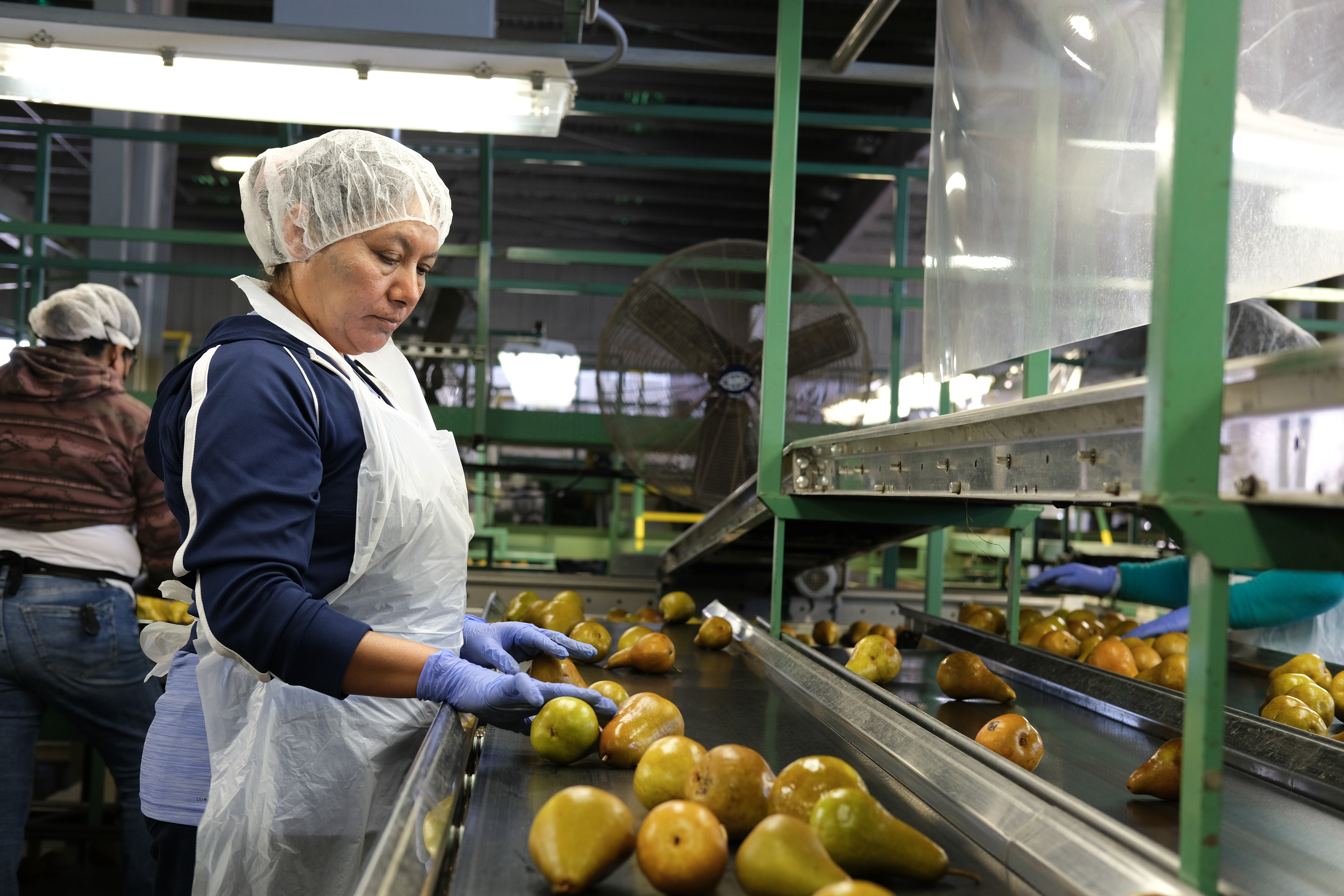
A large fan cools the sorting lines at Stillwater Orchards’ packinghouse in Courtland last August as employee Justina Ramos Aguilar selects Bosc pears for the fresh market and for canneries.
Photo/Caleb HamptonCal OSHA’s new indoor heat illness regulation to protect employees from indoor heat is another poorly conceived effort that will be difficult for employers. It affects those managing packing sheds, greenhouses and other inherently climate-uncontrollable workplaces. It will simply be unfeasible to maintain these workplaces at a temperature below 80 degrees as required by the standard.
The regulation covers workplaces that could reasonably be considered indoor or outdoor, such as the classic two- or three-walled packing shed that is enclosed when in use by high bay roll-up doors and truck and tractor cabs.
Agricultural employers have a strong record of protecting outdoor employees from heat illness by implementing the state’s outdoor heat illness standard. The new indoor regulation imposes new temperature monitoring, hazard analysis and recordkeeping requirements that the existing outdoor standard didn’t need to successfully protect outdoor employees.
California’s perennially active state Legislature moved to restrain California employers’ First Amendment rights to express to employees why they think adopting union representation might not be best, with Senate Bill 399 by state Sen. Aisha Wahab, D-Hayward.
SB 1100, by state Sen. Anthony Portantino, D-La Canada-Flintridge, prohibits employers inquiring whether an employee has a driver’s license or implying that a driver’s license is a job requirement, effectively restraining employers’ flexibility to employ people who can drive.
California’s lawmakers rarely shy away from regulatory diktats that are amazingly broad in scope or so seemingly trivial that one could wonder what public good the givers of law were trying to pursue. Still, California employers are forced to cope with it all.
California Farm Bureau and FELS will continue to work cooperatively to educate policymakers about the real-world implications of their policy choices, and to help agricultural employers cope with the consequences of those choices.
For employer resources such as on workplace violence prevention, outdoor and indoor heat illness prevention and other compliance resources, visit www.fels.net or subscribe to the FELS Newsletter.
(Byran Little is director of employment policy for the California Farm Bureau and chief operating officer for the affiliated Farm Employers Labor Service. He may be contacted at blittle@cfbf.com.)
- January 15, 2025
- Farm Bureau works to secure agriculture's future
-
By Dan Durheim
California Farm Bureau Chief Operating OfficerWith the start of a new year, I thought it appropriate to share my personal resolution of implementing the vision of the California Farm Bureau.
I also want to renew an old promise: The staff and board leadership are committed to securing the best possible future for California farms, ranches and farm families. It has been our mission for 106 years, and this mission will continue to drive our work in 2025 and beyond. This strategic direction is built on three foundational pillars: advocacy, on-farm business solutions, and leadership and networking opportunities.
It’s clear to me that Farm Bureau members and staff are eager for more. As we look to the future, we must ask ourselves: What does the future look like for Farm Bureau? What is our opportunity for growth? What is the opportunity for engagement?
Our goal is to get most of the market share of farmers, ranchers and other agriculturalists in California to belong to our organization. Imagine if 80% of the more than 63,000 agricultural operations in the state were part of Farm Bureau. The collective power and influence we could wield could drive even more impactful change.
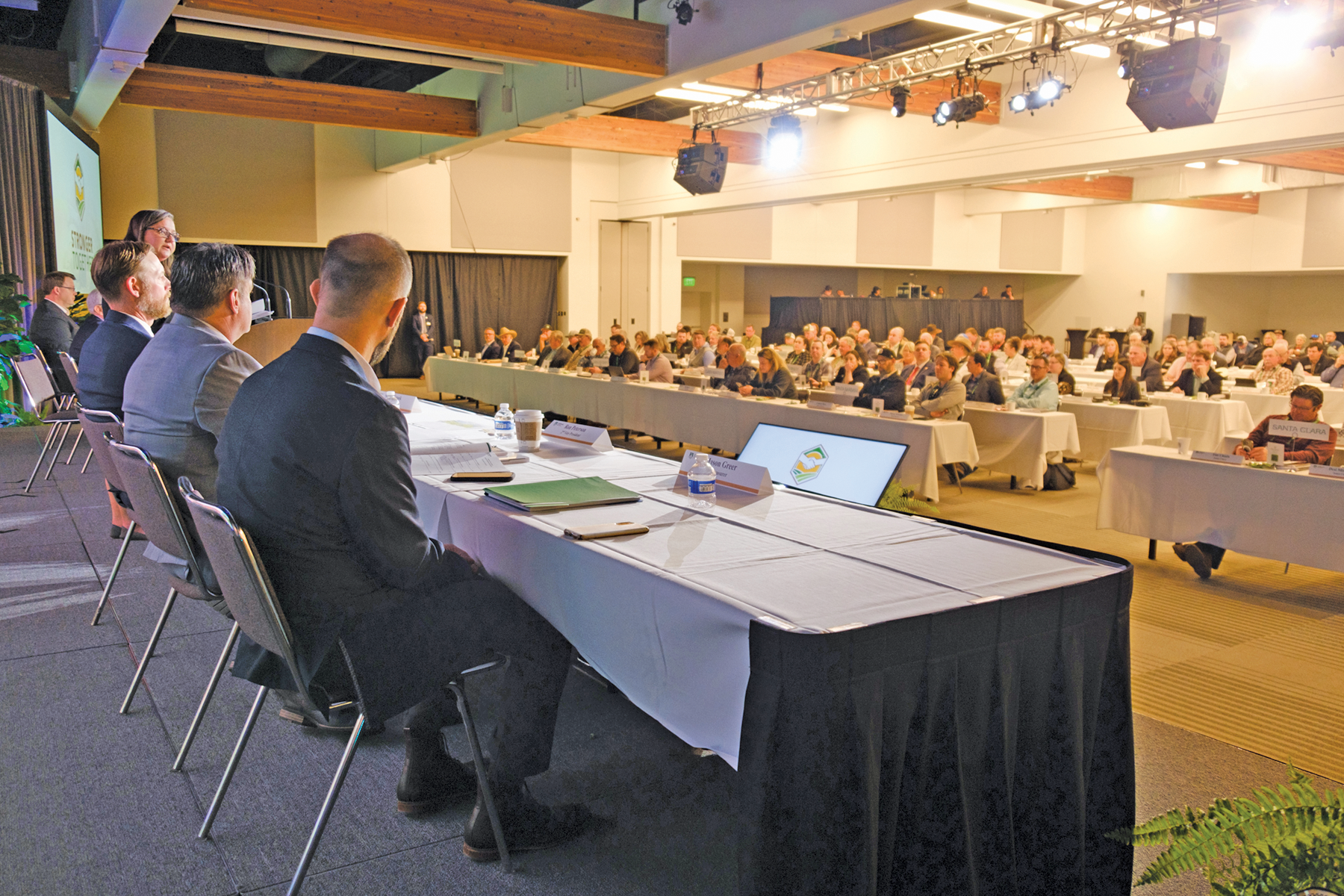
Under the theme “Stronger Together,” delegates from county Farm Bureaus vote on policies to guide future priorities during the 2024 California Farm Bureau Annual Meeting in Monterey in December.
Photo/Brian FarinasAs we strive to secure the future, we must also honor our history and rich legacy. Our power lies within the grassroots membership and the activation of those members through the county and state Farm Bureaus. The power of grassroots efforts cannot be overstated. Our strength lies in our members and the collective power of individuals coming together to advocate for common goals. Grassroots movements are the backbone of our advocacy work. They ensure that our policies and initiatives are grounded in the real-world experiences and needs of our members.
We are proud of the history of advocating for farmers and ranchers, and the legacy is the foundation upon which we built. However, to remain relevant and effective, we must also seek new ideas and embrace innovation. This balance between honoring our past and welcoming the future is crucial to our continued success.
To achieve our goals, we have an opportunity to work together as counties and states to increase our operational efficiencies. By improving these efficiencies, we can deploy the right resources at the right time in the right place to achieve relevant goals of advocacy, organizational growth and strength, as well as member value and engagement.
I’d like to dig a little deeper into the definition of these measurable goals. We describe advocacy as ensuring that our members’ voices are heard and that policies are shaped to benefit Farm Bureau members and the greater agricultural community.
Organizational strength is defined as expanding our membership and strengthening our organizational capabilities, member value and engagement, and providing valuable programs, resources, support and opportunity for Farm Bureau members to engage and grow.
One of our greatest strengths is our people. The staff and board leadership are among some of the best I’ve ever worked with. The state office team is amazing. Their dedication and expertise are invaluable assets that I rely on. We have an opportunity, and dare I say, even a responsibility to continue to develop this talent.
This commitment to growth ensures that we remain strong and effective in serving farmers. Unity is a powerful theme that resonates deeply within our mission. We are stronger together than we are individually. When we unite our efforts, we amplify our impact. This unity is not just about working together; it’s about supporting each other, sharing knowledge and standing together as one community.
As we look to the future, let us remember that our strength lies in our unity and honoring our legacy and the power of new ideas in grassroots efforts.
Our focus of growing Farm Bureau is with and through the county Farm Bureaus. Our growth in this state is about growing together with and through the county Farm Bureaus—and ultimately collectively bringing a competitive advantage to our members.
By working together, we can secure the best possible future for our members, farms, ranches and farm families. We can shape policies that benefit us all, implement solutions that enhance our operations and build a community that supports and uplifts each member.
Thank you for your dedication and commitment to Farm Bureau. Together, we are stronger, and together, we will achieve great things.
(Dan Durheim is chief operating officer of the California Farm Bureau. This commentary is adapted from his speech before members at the organization’s 2024 Annual Meeting in Monterey. He may be contacted at ddurheim@cfbf.com.)
- January 1, 2025
- President's Message: Your voice will guide Farm Bureau's policies in 2025
-
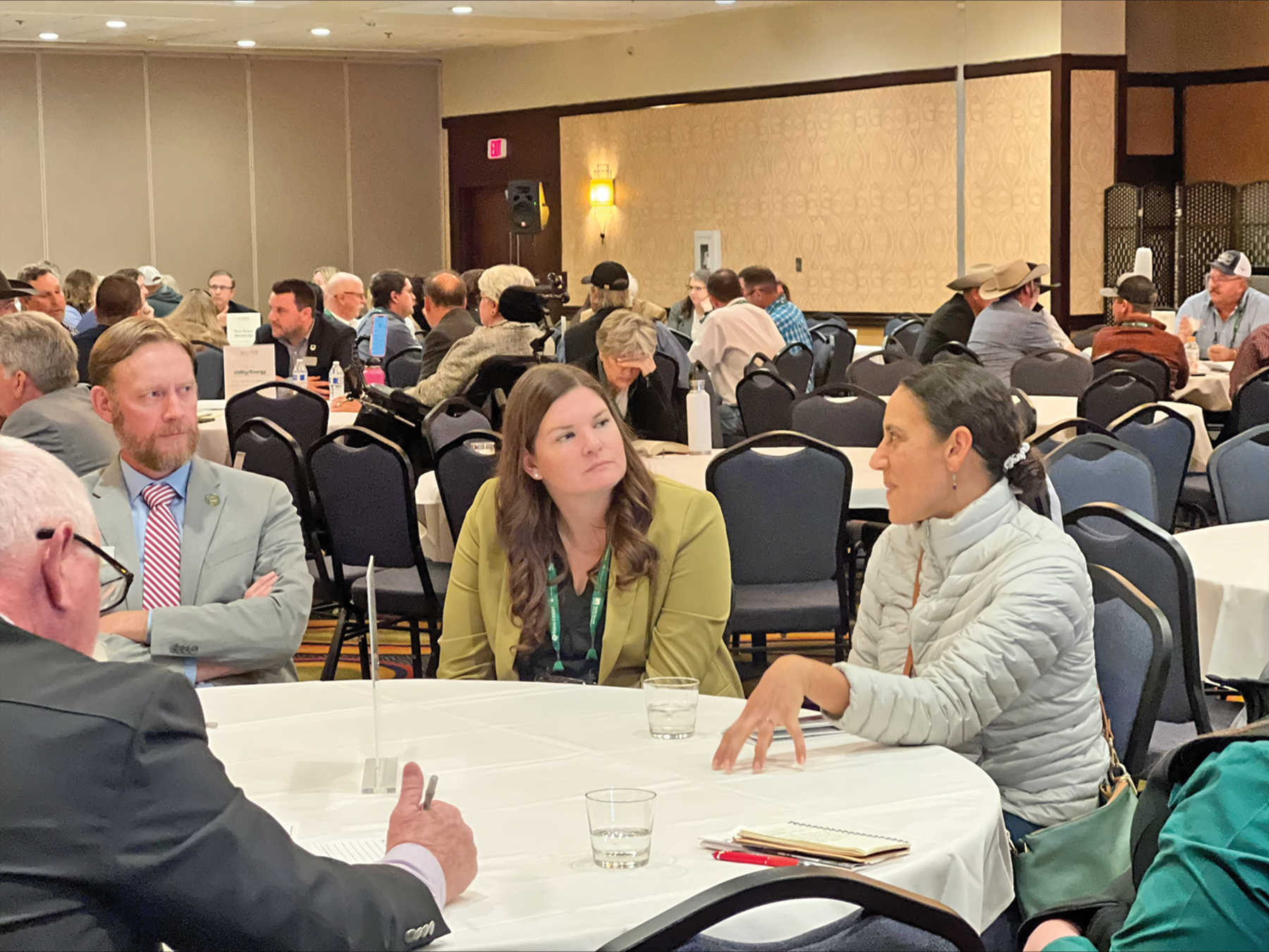
Mendocino County forester Estelle Clifton, right, discusses priority issues as California Farm Bureau natural resources and land use consultant Erin Huston, center, California Farm Bureau First Vice president Shaun Crook of Tuolumne County, left, and Jim Morris, Siskiyou County Farm Bureau member, listen. The talks were part of a listening session for members held at the organization’s Annual Meeting in December. As we step into 2025, we face no shortage of important issues to address while setting our priorities for the new year. This past fall, when we began planning for this year, I encouraged our team to do so with a renewed focus on truly listening to the voices of California farmers and ranchers. They rose to the challenge.
I’m excited to share with you, our farmer and rancher members, a new, year-long initiative focused on understanding your concerns and addressing your needs. This effort will be rooted in California Farm Bureau’s policy and legal advocacy work, while also encompassing all aspects of Farm Bureau’s mission. Together, we aim to uncover solutions to farm policy challenges, as well as opportunities for professional development and education that support your success.
We kicked off this process a few weeks ago at the California Farm Bureau Annual Meeting, where we hosted a series of listening sessions. Participants selected the topics they wanted to discuss and joined conversations led by our Board of Directors. These farmer and rancher leaders took detailed notes and gathered invaluable feedback about the pain points you’re experiencing at the farm gate. The conversations were heard by our staff, embraced by leadership and will shape Farm Bureau’s priorities as we advance to the next phase of engaging with and amplifying the voices of California farmers and ranchers.
The next step in this policy engagement process brings these conversations out of Sacramento and into county Farm Bureaus. Eight counties have stepped up to host Commodity Advisory Committee meetings, inviting all agricultural members to join either in person or virtually. At these meetings, you will hear from subject matter experts and have the opportunity to share concerns, challenges and proposed solutions directly to California Farm Bureau staff and leadership. Farmer and rancher members from across the state will chair the meetings, building on the issues-based discussions and priorities identified at the Annual Meeting. I encourage each of you to participate. Your voice—the voice of the farmer and rancher—is the one we’re listening for.
As part of this effort, two members of the Board of Directors will serve as official liaisons at each board meeting, ensuring the discussions are carried from the farm to the boardroom. Additionally, First Vice President Shaun Crook, Second Vice President Ron Peterson, Chief Operating Officer Dan Durheim and I look forward to attending the meetings, engaging with you and hearing your insights firsthand.
You’ll find a schedule of upcoming meetings below. Also, in the next several issues of Ag Alert®, you’ll see an ad with a QR code linking to details for each session, including the agenda and a virtual participation link. For those attending in person, lunch will be provided by the California Farm Bureau.
In 2024, we were reminded that we’re stronger together. In 2025, let’s remind everyone of the powerful voice of California farmers and ranchers.
2025 Commodity Advisory Committee meetings
Agricultural members are encouraged to help shape Farm Bureau policy priorities by attending one or more Commodity Advisory Committee meetings this winter. Meetings will be held in person and virtually, giving members an opportunity to discuss key issues affecting their businesses. Most meetings are tentatively scheduled for 10 a.m. at the county Farm Bureau office. Read Ag Alert® for more details.
• Feb. 4: Forestry/Public Lands – Butte County; includes grazing and other permit holders, representatives of forestry and logging.
• Feb. 5: Wheat, Feed and Small Grains – Glenn County; includes grower representatives of alfalfa, rice, hay crops, etc.
• Feb. 6: Field Crops – Colusa County; includes grower representatives of broccoli, strawberries, leafy greens, beans, etc.
• Feb. 13: Nut Trees – Fresno County; includes grower representatives of walnuts, almonds, pistachios, etc.
• Feb. 18: Fruit Trees – San Joaquin County; includes grower representatives of apples, citrus, stone fruit, etc. (This meeting will begin at 1 p.m.)
• Feb. 19: Livestock – Stanislaus County; includes grower representatives of beef, dairy, sheep, goats, poultry and aquaculture.
• March 4: Grape – Monterey County; includes grower representatives of table grapes, winegrapes and grape products.
• March 12: Horticulture – San Diego County; includes representatives of flowering and ornamental plants, and nurseries.
- December 18, 2024
- Commentary: What can agriculture anticipate from D.C. next year?
-

Matthew Viohl By Matthew Viohl
With 2024 drawing to a close, Washington, D.C., is in a period of transition. Near the Capitol, several congressional offices are clearing out as new tenants prepare to take over. Two miles down the road, the White House is no doubt preparing for the same.
While federal agencies largely remain unchanged following major elections—aside from political appointees and their staff—talk of “government efficiency” has many wondering just how different life might get in the nation’s capital next year.
Donald Trump is set to become just the second president to serve nonconsecutive terms, following in the footsteps of Grover Cleveland, our 22nd and 24th president. Maybe it’s time to update the saying, “Meet the new boss, same as the old(er) boss.”
There are signs this won’t be fully similar to President Trump’s first term though. The nominees for his cabinet positions appear to be more closely aligned to his own political beliefs rather than some of the more traditional picks from eight years ago.
While I won’t jump into the frenzy over specific nominees, what can we expect as an industry heading into 2025? The full reauthorization of the farm bill is all but dead barring any last-minute, lame duck theatrics. This means year three of Congress attempting to pass a five-year extension next session.
You may recall one of the Republicans’ key legislative victories in Trump’s first term was the Tax Cuts and Jobs Act, passed and signed into law in late 2017. It ushered in a number of changes to the tax code, including several items that were beneficial to agriculture, such as a stepped-up basis for inherited property and reduced pass-through tax rates.
Many of these changes are “sunsetting” though. This means they are timing out because they were never passed as permanent changes. Some of the limitations are due to the method it was passed: budget reconciliation.
This process allows the Senate to pass certain tax and spending measures with a simple majority instead of a “cloture-proof” vote of 60 senators. While Republicans are going from 49 seats to 53 in the new Congress, it is unlikely they’ll convince enough Democrats to support the tax changes they’re seeking. The expectation is that budget reconciliation will be used again to extend the tax measures.
Aside from the farm bill and taxes, border security and tariffs are receiving some of the most attention post-election thus far. On both issues, many in the agricultural industry are quite concerned about what the possible impacts could be.
We saw firsthand in 2019 that retaliatory tariffs can be extremely harmful to many commodities produced in the U.S., with billions in projected losses impacting a number of sectors. Soybeans are often mentioned first, but tree nut producers in California were negatively impacted as well.
It is impossible to predict which commodities or industries will be targeted by retaliatory tariffs, as we simply do not know whether Trump will follow through with his proposal to increase them on Mexico, Canada and China.
It could simply be a negotiating tactic ahead of taking over the White House, and if not, the three targeted countries could choose to implement increases across the board or make certain industries feel the pain more than others.
This line is also being used for plans surrounding “closing” the border and increasing the rate at which we deport immigrants lacking permanent legal status. While the issue of immigration and border security contributed to President Biden’s defeat, the total number of what we call “enforcement actions” was actually up considerably during his tenure.
Much of this was due to what are known as Title 42 expulsions, a policy President Biden worked on ending and that Trump could very well look to revive. Early talk from his transition team has focused on removing “criminal” immigrants who commit violent crimes and drug-related charges.
It is a fair question to ask what impact this might have on agriculture and other industries such as construction, and unfortunately, I simply cannot provide answers to something that hasn’t happened.
I’ll admit that is a bit of a cop-out, but I would point out that every president-elect has a long list of campaign promises and “Day One” commitments that are never kept. One of President Woodrow Wilson’s key slogans in 1916 was, “He kept us out of war,” which didn’t exactly hold up with our entry into World War I a year after his second inauguration.
While I would be pretty shocked if President-elect Trump did a 180-degree turn on some of his key campaign promises, nothing is set in stone until the ink dries. Until then—and after—we remain committed towards defending agriculture’s needs regardless of the party in power.
(Matthew Viohl is a director of policy advocacy for the California Farm Bureau. He may be contacted at mviohl@cfbf.com.)
- December 11, 2024
- Commentary: Farmers should brace for new state water rules, fees
-

Alexandra Biering By Alexandra Biering
California farmers and ranchers who divert water and violate orders or reporting requirements from the California State Water Resources Control Board may feel sticker shock when new increased penalties take effect Jan. 1.
The state water board’s powers to issue fines for water rights violations were first established in the 1980s and have remained mostly unchanged. In 1980, the California Legislature and Gov. Jerry Brown approved a law that gave the state water board the authority to issue cease-and-desist orders when the board has evidence that a diverter has violated an order.
Such an incident occurred in August 2022 with a group of diverters along the Shasta River. After several consecutive drought years, the diverters were placed under an emergency curtailment order to protect salmon. U.S. Geological Survey stream-flow gauges that year showed that the Shasta River water level dropped by more than half in less than a day, and the individuals were found by the state to be in violation of the order.
In response to the incident, California lawmakers introduced a bill sponsored by environmental groups that would have given the board new enforcement authority to increase fines for violating board orders from the levels set almost 40 years ago.
Through the advocacy of the California Farm Bureau and its allies, the bill was narrowed to only increase penalty fines without giving the state water board new regulatory powers. The legislation, Assembly Bill 460, was signed by Gov. Gavin Newsom and takes effect Jan. 1. It affects anyone with water rights claims, licenses or permits who diverts water illegally.
Under the changes enacted by AB 460, the penalty fine for violating a cease-and-desist order issued by the state water board increases from $1,000 per day to $2,000. The penalty fine for violating a water rights order or regulation or failing to report flood flow diversions for recharge during flood emergencies increases from $500 per day to $1,000.
The act of violating a curtailment order, such as what occurred on the Shasta River in 2022 and prompted the introduction of AB 460, will carry a fine of $10,000 per day and $2,500 per acre-foot diverted. In addition, on Jan. 1, 2026, the state water board is required to adjust the amount of penalty fines annually based on inflation.
As part of its adjustment of water rights fees and water quality fees this fall, the state water board established a new late fee that will be assessed each year to diverters who fail to report their annual water diversions or who report the information more than 30 days after the reporting deadline. The late fee scales up depending on the size of the water right and the amount of time that has lapsed since the reporting deadline. The board established a 30-day grace period beginning Feb. 1 before the late fee is assessed; however, starting March 2, fees will begin to accrue.
At the low end, diverters with water rights of less than 100 acre-feet and who submit their reports within 60 days after the deadline face a late fee equal to 25% of their annual water right fee. This percentage increases every 30 days.
At the high end, diverters with water rights of more than 25,000 acre-feet face a minimum 60% late fee and a maximum 85% late fee if they fail to report after the 30-day grace period.
All water rights holders are annually required to submit Water Diversion and Use Reports electronically to the board between Oct. 1 and Jan. 31 for the previous water year. The water year runs from Oct. 1 to the following Sept. 30. For example, this year, water rights holders would submit a report that showed how much water they diverted and used from Oct. 1, 2023, to Sept. 30, 2024.
The board’s establishment of a late fee for water diversion and use reports is intended to increase rates of reporting compliance, which are generally high among large diverters but lower for many small diverters who divert less than 100 acre-feet, according to the state water board.
View the state water board’s updated water rights fee schedule summary for fiscal year 2024-2025 at www.waterboards.ca.gov/resources/fees/stakeholder/docs/2024/fy2425-fee-schedule-summary.pdf.
(Alexandra Biering is a director of policy advocacy for the California Farm Bureau. She may be contacted at abiering@cfbf.com.)
- November 27, 2024
- Commentary: Give thanks for the resilience of farmers and ranchers
-

Masie Skelton By Masie Skelton
Resiliency has become a trending word in California agriculture, symbolizing the ability to endure and overcome the multitude of challenges farmers and ranchers face.
In the spirit of Thanksgiving, it is important to reflect on the agricultural community’s strength and how the word “resilient” captures the complexity of agricultural life, which I believe embodies the strength, adaptability and perseverance required to thrive despite adversity. In agriculture, resilience is more than just a trait; it is a way of life.
At the heart of this resilient spirit lies Zane Ranch in Paynes Creek in the Sierra Nevada foothills. For my grandparents, Steve and Peggy Zane, the ranch is more than a home; it is a legacy and a livelihood built on decades of hard work and sacrifice. Over the summer, a formidable hardship threatened that livelihood, one that continues to challenge my family even four months later.
Growing up, I was fortunate to be raised so close to my grandparents and to experience the agricultural way of life firsthand, which has wholly defined who I am and the values I hold. In my rural hometown, agriculture is more than an industry; it is the lifeblood of the community. It encourages a sense of belonging and shared responsibility, where neighbors are as close as family and everyone understands the meaning of hard work. My grandparents’ ranch has been a place where people come together—not just for the tasks of ranching, but to support one another during times of crisis.
On July 24, a wildfire ignited in Upper Bidwell Park in Chico, a spark that would quickly escalate into an all-consuming threat. By 11:48 p.m. the following night, the fire had grown to a staggering 145,171 acres, leading to widespread evacuation warnings, including for my nearby home in Dairyville. By noon on July 26, the fire had swelled to 178,090 acres and continued to rage northward with alarming speed. By 6:30 p.m., it had reached Zane Ranch.
In a single night, my grandparents, uncles and mother worked side by side with CalFire, employing every tool and ounce of energy they had to fight the encroaching flames. They cut fire breaks, cleared brush, extinguished spot fires, watered the pastures and barns, and filled water tanks, battling relentlessly to protect our cattle, homes and structures. The night was long and sleepless, but their determination was unwavering.
A few hours before the sun started to rise, it was clear that the threat of the fire destroying everything had essentially passed. The fire burned the rangeland, but the buildings and cattle were spared. The flames, though perilously close, had been held at bay, and my family was able to secure the ranch from a threat that could have been much worse.
Amid the chaos of that night, a moment of irony highlighted the resilience of life on the ranch. While my family fought to protect the land, the cattle were in the middle of calving season. That very night, as the fire raged nearby, three new calves were born—a poignant reminder that life in agriculture does not pause for disaster. No matter the obstacles, the cycle of life continues.
The impact of that Friday night extended far beyond our family. The fire displaced many residents of Paynes Creek, forcing families from their homes and disrupting lives. Yet, in the aftermath of the fire, the strength of the agricultural community shone through.
In this season of Thanksgiving, those who work in the agricultural industry deserve all of our thanks. Farmers and ranchers often face unpredictable challenges as a part of their daily lives, and a network of support is not just about physical aid but emotional encouragement since they understand the unique struggles that come with repairing after such a catastrophe.
The Park Fire, however devastating, illuminated the incredible spirit of recovery and cooperation that defines rural communities and farming families. In the aftermath, I am thankful for the challenges that farmers and ranchers go through to be able to improve and dedicate themselves to their work that provides for our country and the world. Those challenges make agriculturists tougher, more persistent, more dedicated and more equipped to handle more or worse challenges in the future. It also makes for tight-knit groups of individuals who understand the need for good neighbors and great families.
In the face of overwhelming loss, people came together—not just to rebuild their homes and livelihoods but to reaffirm the values of unity and collective strength, which I believe lie at the heart of agricultural life.
(Masie Skelton is a junior majoring in horticulture at the Purdue University College of Agriculture. A version of this piece was first published on the Purdue Sigma Alpha sorority’s Beta Chapter Blogs at purduesigmaalpha.com. She may be reached at masie.skelton12@gmail.com.)





.svg.png)
