


Ag program aims to upskill farmworkers
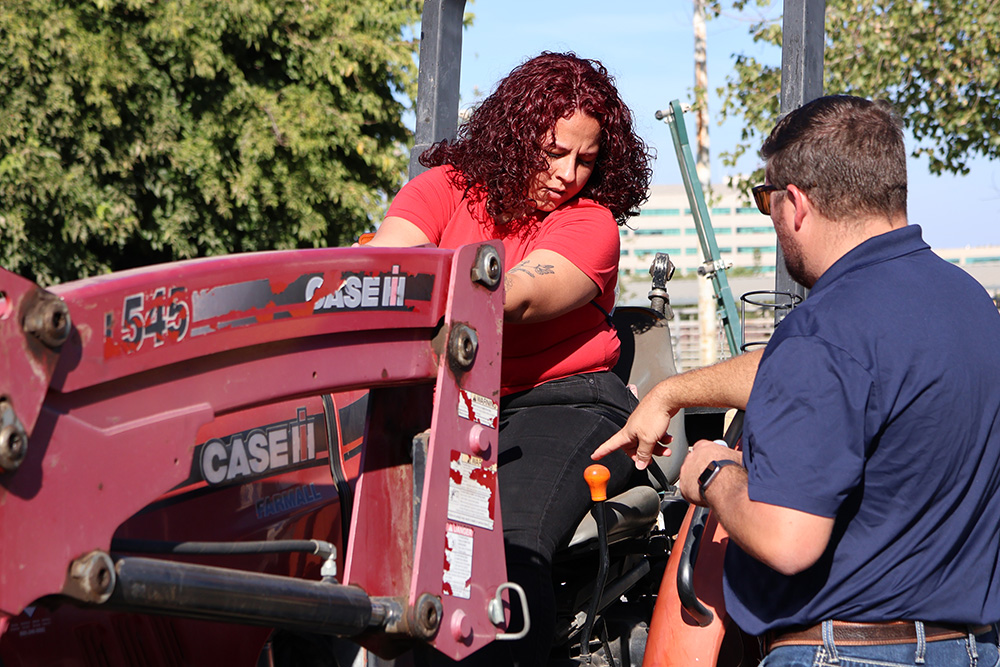
Ana Muñoz receives instruction on how to drive a tractor from Merced College professor Karl Montague, who teaches the Agricultural Technology and Education Collaborative, or AgTEC, program, which aims to help farmworkers advance their agricultural skills.
Photo/Manola Secaira



Este artículo está disponible en español. Léalo aquí.
By Manola Secaira
On a hot September afternoon, Ana Muñoz drove a tractor for the first time.
Following her instructor’s direction, she took a seat in the tractor with some apprehension. She was only a month into Merced College’s Agricultural Technology and Education Collaborative, or AgTEC, program, which aims to help farmworkers like herself advance their agricultural skillset to meet the sector’s changing needs.
This was her first in-person workshop. But with 12 years of farmworking experience under her belt, Muñoz is no stranger to agriculture.
“I’ve always loved working outside on a farm,” she said in Spanish.
 She’d long been interested in learning the new skills required to expand into other agricultural work—namely, driving tractors and operating other agricultural equipment. She said she’d gotten the gist of how to operate them by watching other people do it over the years. What was missing was the hands-on practice and training.
But even with her experience, she said she’s found it difficult to get those opportunities or otherwise move up the ladder in her job.
“At work, they told me that I couldn’t do much because I was more useful showing new workers how to harvest sweet potatoes and all that,” she said. “So, I never made my dream a reality.”
That changed earlier this year when she received a flyer about the AgTEC program while picking up her kids from daycare.
Merced College is one of six colleges in the Central Valley offering AgTEC courses. The program, launched in late 2024, aims to equip students with the knowledge and skills needed to thrive amid agriculture’s evolving technologies and needs. While it’s open to students of all backgrounds, it’s particularly oriented toward farmworkers interested in expanding their agricultural skills.
AgTEC is one part of a larger “Farms Food Future,” or F3, Central Valley initiative funded by a $65 million federal grant awarded in 2022. From its start, the program has seen more than 800 enrolled students and about 150 graduates spread across the participating colleges.
Karen Aceves, AgTEC’s regional director, said faculty at participating colleges developed the curriculum based on a survey of about 11,000 farmworkers who were asked what they needed and wanted in an agricultural development program designed with them in mind.
Aceves said the program can help fill a need in the changing world of agriculture while retaining workers already in the industry.
“We don’t know where our industry is going,” Aceves said. “We need someone who’s adaptable and can adapt to those changes.”
The program is free, with workshops and materials accessible for English and Spanish speakers. In-person workshop schedules are often tailored to farmworker schedules.
“If you offer night classes, if you offer child care, if you do it hybrid—which are all the components that we have in our certificate program—then people are much more likely to participate in education,” Aceves said.
The classes cover hands-on skills such as driving agricultural vehicles and using power tools, as well as agricultural software and digital literacy basics, including professional email etiquette and file sharing.
Leigh Bernacchi, director of agricultural innovation at Merced College, said digital literacy skills could help in seeking opportunities outside agriculture if a student wishes to explore.
“Those basic skills help you access so much in society,” she said. “It opens a bunch of doors.”
Bernacchi said offering this training to farmworkers also gives them an opportunity to move up and potentially apply for higher-paying positions.
“This curriculum lets a person not just do the task at hand but be the long-term farm staff, lets you be an essential team member, lets you be the person that they choose to keep on year-round,” Bernacchi said.
Aceves said more colleges have expressed interest in adopting the program, with three already signed on to launch their own AgTEC programs next spring. She said she hopes to give students the option to continue their education toward an associate or bachelor’s degree.
The demand is there, she said, recalling one student of the program who is going through it a third time.
“This is the only program that’s available to him, and he wants to keep learning,” she said.
Back at the workshop, student Muñoz said she was initially nervous about driving the tractor. But she quickly felt more at ease, thanks in part to her experience driving a manual transmission. She said she’s eager to return to more classes.
Rosa Nuna, a fellow student, has been working the fields for 26 years. Like Muñoz, she loves agricultural work. She learned about AgTEC through her employer, who handed out flyers to her and other workers.
Her curiosity about learning how to grow her own plants drew her to the program. She said she hopes to one day open her own rose greenhouse.
“That’s why I became interested in learning about the land, how it’s cultivated and how to use the necessary tools to work it,” Nuna said in Spanish.
Homer Duran, another student, had worked with agricultural vehicles before his first AgTEC class. But he welcomed the chance to better understand the equipment he uses, especially given his limited access to training.
“I want to improve and understand so I’m not learning on the go,” he said in Spanish. “That would make me more comfortable doing it.”
Muñoz said she hopes to graduate from the program in December and keep moving up, with aspirations of becoming a crew leader or supervisor.
“If I get that chance after I get my certificate, I’ll try to advance, both for myself and to give my kids a better life,” she said. “I want them to be proud of their mom.”
Manola Secaira is a staff writer for Ag Alert. She can be reached at msecaira@cfbf.com.
Reprint with credit to California Farm Bureau. For image use, email agalert@cfbf.com.