


Peach growers await pivotal cannery sale
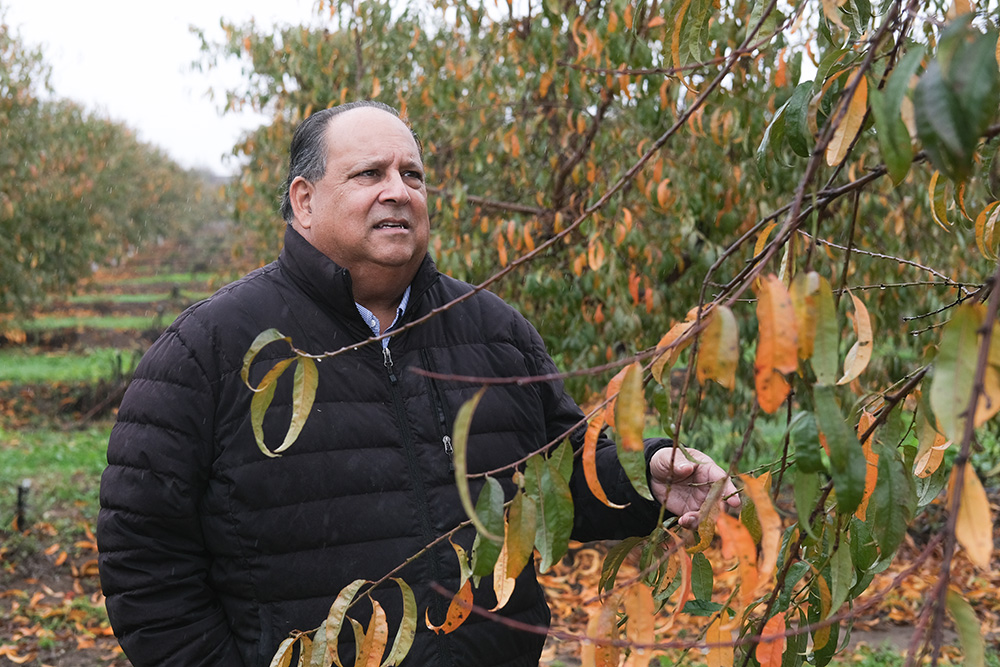
Sutter County farmer Ranjit Davit’s family has grown cling peaches in Live Oak since the 1940s. In 2023, Davit planted new peach trees under a 20-year contract with Del Monte Foods. This year, Del Monte filed for bankruptcy and voided the contract, leaving Davit without a buyer for his fruit.
Photo/Caleb Hampton


By Caleb Hampton
California cling peach growers face an uncertain future after long-term contracts worth more than a half-billion dollars in total were voided by Del Monte Foods, which filed for bankruptcy in July.
In August, the major canned foods company exercised its right under federal bankruptcy law to reject its contracts with members of the California Canning Peach Association, which represents about 70% of the state’s cling peach growers. In some cases, the contracts were signed this year and valid through 2044.
Del Monte’s rejection of peach contracts has left several dozen growers without a future buyer for their fruit, exposing some to steep losses should they fail to recoup the upfront cost—typically several thousand dollars per acre—of developing their orchards.
 “It’s a very delicate situation,” said Sutter County farmer Ranjit Davit, who chairs the peach association’s board of directors. “A lot of growers are affected.”
In recent years, Del Monte, which is based in Walnut Creek, contracted about 35% of California’s cling peaches, while Lodi-based Pacific Coast Producers contracted about 60% of the crop, with the rest purchased by a few smaller processors.
During the pandemic, demand for canned foods soared as more people ate at home. Del Monte responded by increasing production, making long-term commitments with peach growers and other suppliers. The new contracts caused a surge in peach plantings during the past few years, but the market soured before many of those trees produced their first piece of fruit.
The reversion of consumer habits to prepandemic trends left Del Monte “locked into excessive volume commitment,” Michael Sirota, managing partner at the law firm Cole Schotz, said on behalf of the company in a court filing, adding that Del Monte’s assets would be worth more to a potential buyer without the “burdensome” peach contracts.
Growers typically plant cling peach orchards only after securing contracts with processors that last 20 years, roughly the orchard’s lifespan.
Richard Lial, a third-generation peach grower in San Joaquin County, said losing his contracts with Del Monte “could turn out to be devastating.”
A couple years ago, Lial tore out a productive almond orchard to plant 50 acres of peaches under an agreement with the company.
“It took me two years to clean up the old orchard and plant a new orchard,” said Lial, who planted the peach trees and finalized his contract with Del Monte earlier this year. “Now, I’m sitting here without a contract.”
Peach trees do not produce at full capacity until they are at least 4 years old, and it can take close to a decade for growers to pay off their initial investment. Those left without contracts fear they may never make that money back.
“It’s a pretty big hit,” Lial said. “It’s basically a total loss if we don’t get somebody to come in and purchase the fruit.”
During the past three years, in which cling peach plantings roughly quadrupled, the peach association cautioned processors against contracting too much new acreage on the basis of pandemic-driven demand.
“We repeatedly warned them” to not over-contract, Davit said.
Del Monte did not respond to requests for comment from Ag Alert®.
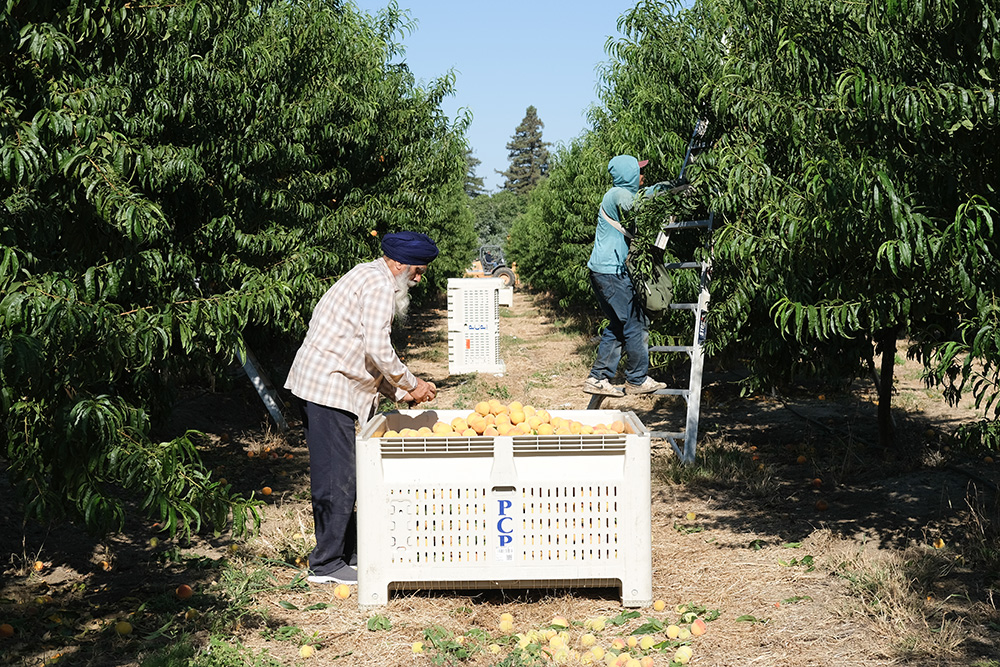
Photo/Caleb Hampton
On Nov. 5, the peach association filed a claim with the bankruptcy court for damages caused by Del Monte’s rejection of its contracts, the value of which it estimated to be $555 million.
But growers are unlikely to see much, if any, compensation, according to bankruptcy experts, because unsecured creditors such as the peach association that hold no collateral from Del Monte have low priority for repayment in bankruptcy cases.
“It’s awful for the peach growers,” said Linda Coco, a law professor at the University of the Pacific McGeorge School of Law in Sacramento. “There really isn’t any recourse.”
Bankruptcy law takes precedent over laws concerning business contracts, Coco said, and the bankruptcy code is written to prioritize the survival of the bankrupt company.
“The idea is to help sustain the debtor so they don’t have to completely go out of business,” she said, including by voiding financial obligations such as purchasing agreements. “In that process, lots of people are going to suffer.”
During bankruptcy proceedings, Del Monte also rejected contracts with pear growers in Oregon and Washington state, where it shut down a cannery earlier this year, and with California growers of freestone peaches, while leaving other contracts intact. The claim for damages from rejected cling peach contracts was by far the largest filed with the court.
Most of California’s cling peaches are grown by family farms, many of which have grown the crop for three or four generations. But declining demand due to the year-round availability of fresh fruit, combined with rising input costs and cheap imports, have challenged the sector.
Since 1969, the state’s bearing acreage declined from more than 63,000 to less than 14,000, according to the U.S. Department of Agriculture. Meanwhile, the number of processors dropped from 17 to five, only two of which—including Del Monte—contracted substantial acreage in recent years.
The loss of another major processor could cause the sector to shrink further.
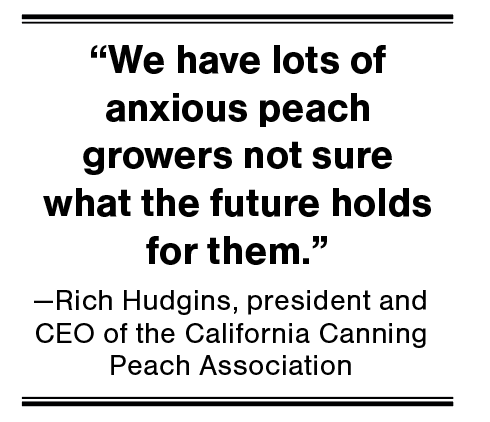
“We have lots of anxious peach growers not sure what the future holds for them,” said Rich Hudgins, president and CEO of the peach association.
Several years ago, Yuba County grower Sarb Atwal tore out 90 acres of 10-year-old peach trees, he said, after the closure of a cannery left him without a buyer.
The fourth-generation grower, who in August lost Del Monte contracts on 80 acres, said he was “not thinking about” the possibility of that scenario repeating itself. “I’m pretty optimistic that there will be a new buyer that will take up the contracts,” Atwal said. “I think there’s a market for cling peaches.”
The best outcome for peach growers, several said, would likely be for a buyer to purchase Del Monte’s cannery in Modesto with the intention of continuing to process their peaches at it.
Hudgins said last week growers were “on pins and needles” waiting for the auction of the company’s assets, which is scheduled for Dec. 4. He said he was hopeful the buyer of the Modesto cannery will announce its plans by the end of the year.
“It is vital that we move quickly,” he said.
With no buyer lined up for next year’s crop, work has been delayed in many peach orchards this fall.
Some growers have been unable to secure operating loans they need to pay for pruning, pest control and other orchard work, according to the association, because they have no guaranteed income to back up the loan.
Others said they were wary of investing more money in a crop they may be unable to sell.
“Growers are at a standstill,” said Davit, who has postponed pruning at least until after the court-supervised auction. “There’s always work to be done, and right now there’s not much we can do.”
Caleb Hampton is editor of Ag Alert. He can be reached at champton@cfbf.com.
See related news stories...
• Farmworkers set fear aside to pick California bounty
• Peach growers praise quality as yields dip
• Del Monte troubles shake up pear season






.svg.png)
