


Farmworkers set fear aside to pick California bounty
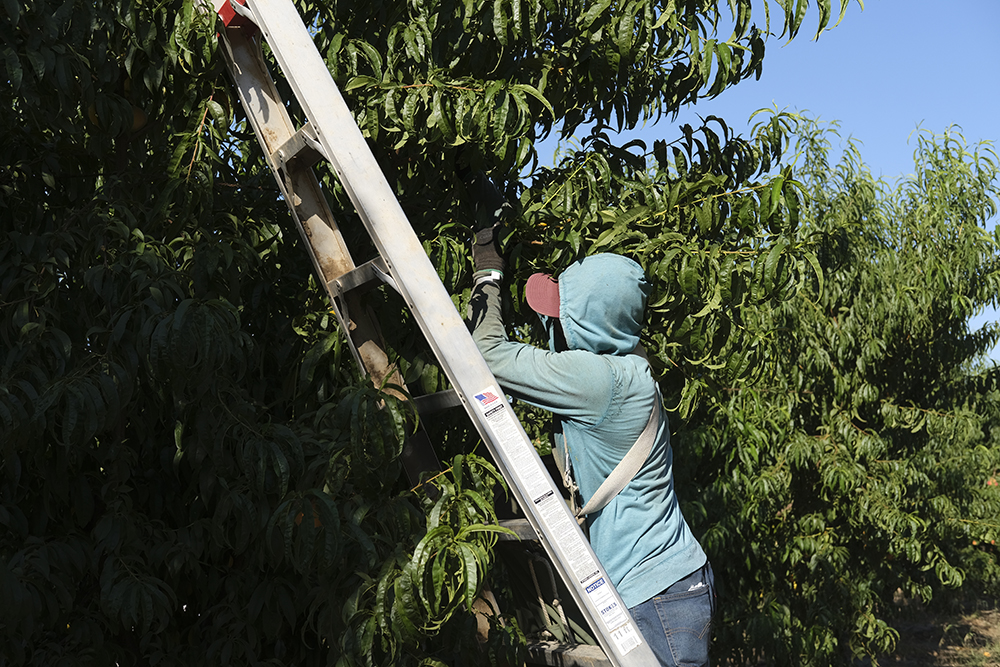
A farmworker uses a ladder to harvest cling peaches this past summer in a Sutter County orchard.
Photo/Caleb Hampton


By Caleb Hampton
Harvest for many of California’s specialty crops has wound down, with fields turning from green to brown, ladders carted away and packinghouse lines brought to a halt.
Going into the year, farmers warned that the Trump administration’s mass deportation agenda could leave produce rotting in fields.
Nowhere was there more at risk than California. The state’s farmers grow more than a third of the nation’s vegetables and roughly three-quarters of its fruits and nuts. At its peak, the feat depends on a workforce of half a million farmworkers—pickers, tractor drivers, forklift operators—more than half of whom are estimated to be undocumented.
“We were very concerned,” said Sutter County farmer Ranjit Davit, who relies on seasonal crews of up to 70 people to pick 160 acres of peaches.
But interviews with farmers in more than a dozen counties, and with farmworkers, researchers and trade group representatives, indicated workers largely showed up and harvested this year’s crops.
Daniel Hartwig, president of the California Fresh Fruit Association, which represents growers of 13 fruits and berries, said he was not aware of any crops perishing due to a lack of labor. In terms of production, Hartwig said, “we haven’t seen a significant impact.”
Researchers said the recent cancellation of two federal surveys could make it difficult to estimate actual farmworker turnout this year.
In August, the U.S. Department of Agriculture announced it was ending the Agricultural Labor Survey, which collected data on farmworkers’ wages and hours.
Last month, the U.S. Department of Labor canceled the National Agricultural Workers Survey, according to an official Labor Department document obtained by Ag Alert®. The department did not announce the NAWS cancellation, nor did it respond to questions from Ag Alert®.
Since 1989, the survey has provided data on work hours and much of the demographic information known about the U.S. farm workforce.
“With the cancellation of those two surveys, we will no longer have any information on hourly wage rates for farmworkers, or on hours worked,” said Alexandra Hill, an assistant professor of cooperative extension at the University of California, Berkeley, who researches agricultural economics and farmworker well-being.
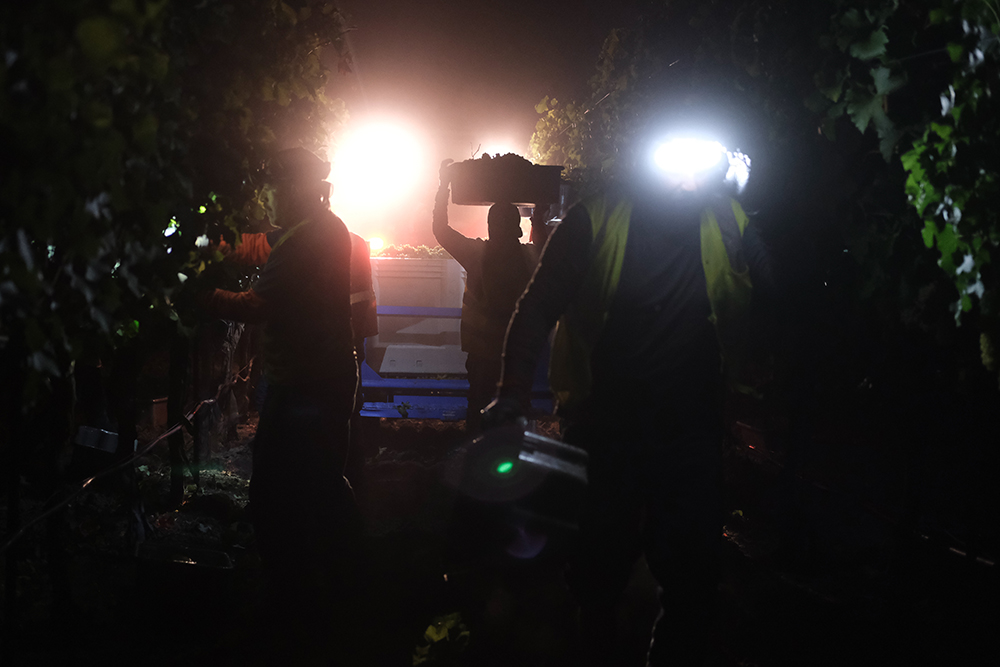
Guadalupe Gonzalez, a farm crew leader who has worked in Napa Valley for more than a decade, said she noticed a stark difference this year in the region’s vineyards.
“There was always fear,” Gonzalez said, adding that some workers missed shifts, but not so often that harvest was affected. Last week, her crew of 18 workers was handpicking chardonnay grapes for sparkling wine. “People show up because they have to pay their bills,” she said.
Photo/Caleb Hampton
Kern County
Some farms did face disruptions, primarily during two high-profile immigration raids.
In January, a sprawling U.S. Border Patrol operation in Kern County caused many workers to stay home during citrus harvest.
Peter Belluomini, who grows and packs lemons, mandarins and navel oranges east of Bakersfield, said most of his workers missed a few days, during which he used fruit he had in cold storage to fill orders.
Casey Creamer, president and CEO of the trade group California Citrus Mutual, said other Kern County growers experienced similar disruptions, but operations “went back pretty much to normal” when Border Patrol left the region. Creamer said he was not aware of any crop losses.
Ventura County
In June, immigration raids on the Oxnard Plain in Ventura County, a prominent vegetable and strawberry growing region, also led workers to stay home.
In the immediate aftermath, at least one farmer had strawberries go unpicked, according to Bryan Little, senior director of policy advocacy for the California Farm Bureau and chief operating officer of the affiliated Farm Employers Labor Service.
Lisa Tate, who grows avocados, coffee and citrus nearby in Santa Paula, spoke out against the raids in June, cautioning that they could leave produce to rot. Since then, Tate said, most farmworkers returned to the fields.
“I have not heard nor seen issues with people not showing up, or shortages related to that, other than in the initial few days,” she said.
Rob Roy, president and general counsel of the Ventura County Agricultural Association, which represents more than 200 farms, labor contractors and other businesses, said the raids did not result in major crop losses. Since June, Roy said, “we haven’t heard of any significant problems.”
Disrupted routes
Elsewhere, California’s $61 billion agriculture sector appeared to carry on. Norm Groot, executive director of the Monterey County Farm Bureau, said vegetable production in the Salinas Valley, the nation’s so-called “Salad Bowl,” was unimpeded. Davit, the Sutter County peach grower, said he encountered “no problems at all.”
Fresno County farmer Joe Del Bosque speculated that immigration enforcement discouraged some workers from driving long distances. He said he hired a 21-person crew from Arizona for his melon harvest, but the crew never arrived.
“They were probably afraid to go on the road,” Del Bosque said, adding he found a local crew, and was “able to go right along and harvest the crop.”
Farmers in Oregon and Washington state who rely on seasonal workers from California reportedly saw cherries spoil as workers declined to travel north.
A ‘huge’ effort
In California, the biggest impact of the raids, farmers said, was not on farms but in homes and communities.
“A lot of farmers have been concerned about the impact on their employees,” said Little, the Farm Bureau director and FELS executive.
After the Kern County raids, school absences increased 22% in the region, according to a Stanford University report.
Farmers said they felt the weight of workers making contingency plans in case of their deportation, drafting notarized contracts to transfer guardianship of their children, and retreating from public life.
“It permeates the atmosphere,” said Hartwig, the fruit grower advocate, who farms in Fresno County.
To protect their workers and operations, farmers prepared all year for immigration raids, attending legal workshops and training supervisors to deny federal agents access to private property.
In Ventura County, the training paid off, as growers succeeded in preventing agents without judicial warrants from entering most farms, according to the Farm Bureau of Ventura County.
Farmers on the Oxnard Plain have since taken additional measures, Tate said, including removing rows of berries or vegetables to make space for workers to park their cars on private property instead of on public roadsides.
“There was a huge stand-up effort,” said Hill, the UC Berkeley researcher, who met with farmworkers across the state this year. “A lot of farms did a really good job of communicating with their workers.”
Valued workers
Looking ahead, farmers said immigration raids remained a concern and a real threat to food production.
In July, Congress roughly tripled funding for interior immigration enforcement and detention facilities.
While President Donald Trump in June voiced the possibility of shielding farmworkers from deportation, U.S. Agriculture Secretary Brooke Rollins later said there would be “no amnesty” for undocumented workers, adding they would be replaced by U.S. citizens and automation.
Farmers warned against undervaluing the current farm workforce. In addition to possessing the work ethic farm labor requires, they said, many farmworkers in California have a lifelong connection to agriculture, specialized knowledge and passion for their work.
“These are really skilled jobs,” Hartwig said. “We need the people who know what they’re doing to fill them.”
Some quotes in this story were translated from Spanish. Caleb Hampton is assistant editor of Ag Alert. He can be reached at champton@cfbf.com.
See related news stories...
• Farm Bureau leaders seek results in D.C.
• Low prices, other woes put squeeze on farm economy
• Ventura County raids alarm California farm community







.svg.png)
