


Grape glut lessens as growers scrap vines
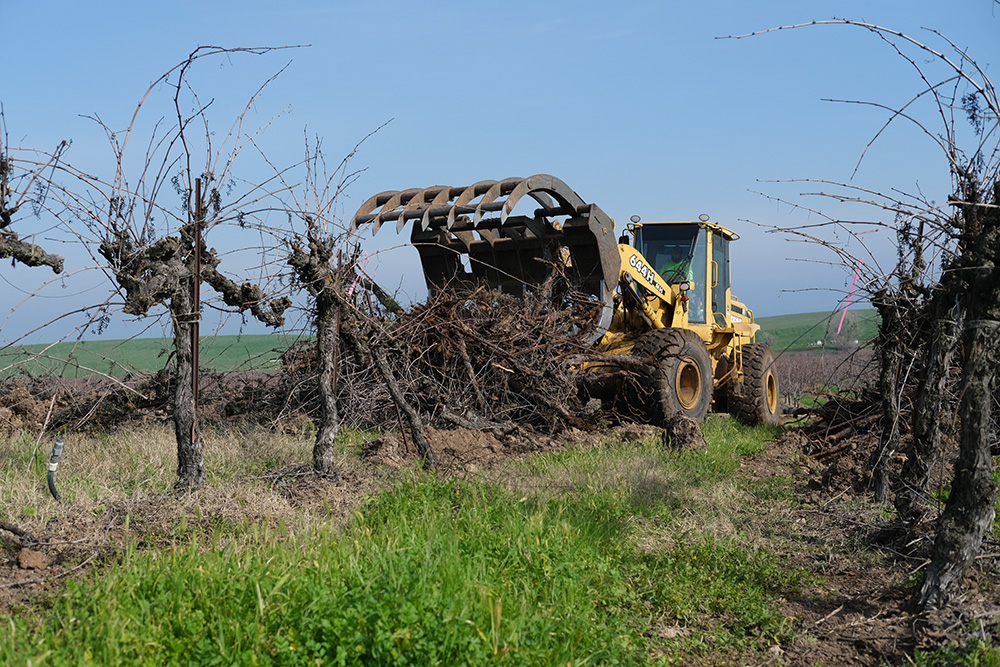
Jorge Vazquez, an operator for Waterford-based Fowler Brothers Farming, stacks discarded grapevines in San Joaquin County. In each of the past two years, low demand for winegrapes led growers to remove nearly 40,000 acres of vineyards, leaving California’s total acreage at about 477,000.
Photo/Caleb Hampton


By Caleb Hampton
A global downturn in wine consumption in recent years left California with a persistent oversupply of grapes. However, while wine sales continued to decline last year, the recent widespread removal of vineyards could help the market reach equilibrium in the near future, according to experts.
California’s grape-growing regions saw “an explosion” of vineyard removals during the past two years, Jeff Bitter, president of the grower-owned marketing group Allied Grape Growers, said last month at the Unified Wine and Grape Symposium in Sacramento.
Between October 2024 and August 2025, winegrape growers removed more than 38,000 acres across California, roughly 7% of the state’s acreage, leaving about 477,000 acres, according to a report commissioned by the California Association of Winegrape Growers. Experts projected there will be future demand for around 410,000 acres of winegrapes in the state.
“The reality is we’re still long,” Bitter said. “We haven’t got to where we need to be yet in order to balance supply and demand.”
But he added that ongoing removals—another 40,000 acres are projected to come out this year—and an unknown amount of acreage abandoned due to financial stress could bring productive acreage close to the industry target as early as this year. More likely, Bitter said, the target will be reached in 2027 or 2028.
Meanwhile, during the past two years when grape purchases declined, wineries depleted some excess wine inventory. According to experts, the volume of finished wine inventory is a key determinant of wineries’ demand for grapes in the near future.
California wineries aim to store enough finished wine to last about 18 months. By the end of 2023, slow sales caused inventory levels to rise to 21.7 months, according to the Gomberg Fredrikson Report, which led wineries to pull back on buying grapes. By the end of 2025, however, winery inventory declined to 19 months, possibly signaling a recovery in demand for grapes within the next couple years.
“Ground has been made with two tiny crushes in a row,” Bitter said, referring to historically small winegrape harvests the past two years, due in part to lots of grapes going unpicked.
In recent years, winegrape growers were hit hard by the industry’s downturn. Many who lacked long-term contracts with wineries sold their fruit at a loss or watched it rot on the vines. The lack of profitability caused banks to retreat, leaving some growers unable to obtain yearly operating loans they rely on to pay their farming costs.
“A lot of people in the industry right now are suffering,” said Bitter, who grows winegrapes in Madera County.
The surge of vineyard removals, while necessary to correct the oversupply, comes at a steep cost to growers who invested tens of thousands of dollars an acre to develop their vineyards. They must weigh that loss against the cost of farming at a loss, possibly without selling any grapes at all, year after year until the market improves.
As of last month, many growers still opted to bulldoze vineyards.
Randy Baranek, project manager for the agricultural service provider Fowler Brothers Farming in Stanislaus County, supervised the removal of more than 5,000 acres of vineyards last year.
Baranek said the pace had not let up.
“The last two weeks, our phone has been ringing off the hook,” he said, adding he was already booked to remove another nearly 5,000 acres this year. “I’m getting calls every single day for more and more and more.”
In each of the past three years, some of California’s winegrape crop went unpicked due to lack of demand. In 2024, an estimated 400,000 tons—a record amount at the time—were left unharvested. Last year, that figure more than doubled, with around 820,000 tons of winegrapes—about a quarter of the crop—going unpicked, according to industry estimates.
Industry groups estimated that California growers harvested fewer than 2.5 million tons of winegrapes last year, making it the smallest crop in decades.
New vineyard plantings also hit a historic low last year, with California nurseries selling 7.7 million vines, enough for around 7,200 acres, according to Allied Grape Growers. Just three years prior, more than 20 million vines were sold.
Experts attribute the decline in wine consumption to multiple factors, including a shift in health guidance about how safe it is to consume low levels of alcohol and a failure to win over young consumers.
Because of rising living costs, the sector also faces an “affordability question,” said Danny Brager, owner of Brager Beverage Alcohol Consulting. “Wine is expensive.”
While industry leaders largely accept the future market for wine will be smaller, they said wine retains advantages the sector can leverage to improve the product’s appeal.
Liz Thach, president of the Wine Market Council, which conducts research on consumer habits, said wine still has positive connotations for many consumers. People associate wine with nature, agriculture, food, social connection and the beverage’s history dating back several millennia.
“New generations do like wine. They just drink less,” Thach said.
To reach younger demographics, she urged wineries to promote aspects of wine that resonate with health-conscious consumers, such as the fact that wine does not typically contain added sugar.
Advertising sustainable farming practices used to grow the grapes can also boost sales, she said, as younger generations tend to value environmentally friendly products.
“This is super important,” Thach said. “We’re doing a lot of good stuff, but we’re not telling the consumer enough.”
Caleb Hampton is editor of Ag Alert. He can be reached at champton@cfbf.com.
The latest news from AgAlert.com
- Grape glut lessens as growers scrap vines
- Bill brings back ag overtime tax credit proposal
- Solving veterinary shortage is crucial for agriculture
- From the Fields: Laura Gutile, Madera County pistachio grower
- From the Fields: Jennifer Beretta, Sonoma County dairy farmer
- From the Fields: Frank Hilliker, San Diego County egg producer
- From the Fields: Bruce Fry, San Joaquin County winegrape grower
- 'Unrelenting' fog aids Central Valley fruits and nuts
- Strong beef prices keep milk replacement heifer count low
- Transplant nurseries celebrate seed improvements
- Advocacy in Action: Tricolored blackbird, government shutdown, farm bill, fumigation alternatives, air board workshop
- How California farms can reduce pumping power costs
- Award applicants sought for Leopold Conservation
- Section 179 deductions for farm machinery in 2026








.svg.png)
