


Bill brings back ag overtime tax credit proposal
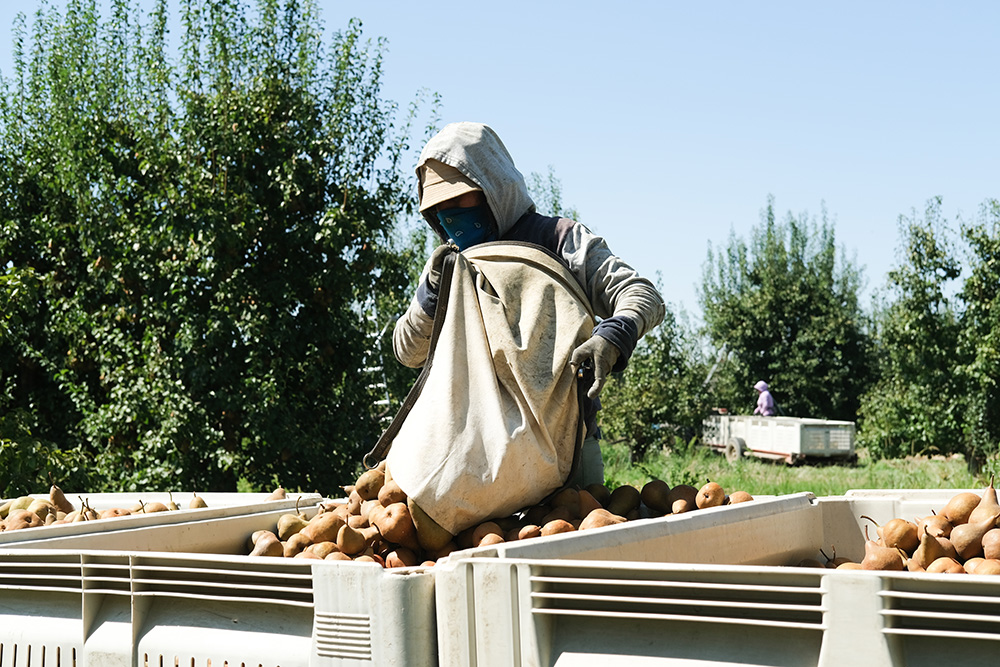
A harvest crew picks Bosc pears in the Sacramento River Delta town of Courtland in 2024. Rising labor costs have contributed to a decline in California’s fruit acreage during the past two decades.
Photo/Caleb Hampton


By Caleb Hampton
A bipartisan bill introduced last month by California state legislators would create a tax credit to offset the cost to farmers of paying overtime wages.
Senate Bill 921, authored by state Sen. Shannon Grove, R-Bakersfield, and state Sen. Melissa Hurtado, D-Sanger, aims to mitigate the impact that California’s agricultural overtime law has had on work opportunities for farmworkers.
In 2016, the state adopted Assembly Bill 1066, which beginning in 2019 phased in a requirement that farmworkers—like workers in most sectors—be paid time and a half when they work more than 40 hours a week or eight hours a day.
Previously, due to the seasonal nature of agriculture, farmers could employ workers for up to 60 hours a week without paying overtime.
AB 1066 was intended to boost earnings for farmworkers. But research indicates the law reduced farmworker income as employers cut hours to avoid paying overtime.
From 2012 to 2022, farmworker earnings, adjusted for inflation, declined by $120 per week, according to a working paper by Alexandra Hill, an assistant professor of Cooperative Extension at the University of California, Berkeley, who researches agricultural economics and farmworker well-being.
Earlier research by Hill showed that in the first two years the overtime law was phased in, during which the threshold for overtime was 50 hours a week, the number of farmworkers working more than that dropped by half.
By last year, when the law’s phase-in was complete, many farmworkers reported having lost a third of their income as employers slashed the typical workweek from 60 hours to 40 hours.
In a 2023 study, Hill said that according to available evidence the changes brought about by AB 1066 “may not be benefiting the workers they aim to protect.”
Grove, who authored a similar bill last year, described the proposed tax credit as a “win-win solution” for farms and workers.
“This means more overtime hours and better take-home pay for the folks who put food on America’s tables,” she said in a statement.
SB 921 is co-sponsored by the California Farm Bureau and the California Association of Winegrape Growers.
“Farmers warned the Legislature a decade ago that changes to the agricultural overtime law would reduce work hours and cost farmworkers wages, and those concerns have proven true,” California Farm Bureau President Shannon Douglass said in a statement. “This tax credit is a practical solution that puts money directly into the hands of farmworkers, helps farms remain viable employers and strengthens the rural communities that grow our food. It’s an investment in California’s food security and the people who make it possible.”
The tax credit would reimburse agricultural employers for the overtime premium paid to workers. Farmers would still be responsible for paying the base pay rate.
Grove’s 2025 bill proposing a similar agricultural overtime tax credit, SB 628, was rejected by the Senate Labor, Public Employment and Retirement Committee in a 4-1 vote along party lines, with the Democratic majority opposing the measure.
State Sen. Lola Smallwood-Cuevas, D-Los Angeles, who chairs the labor committee, characterized the proposed tax credit as transferring farmers’ cost of doing business onto the rest of California. She added that giving an overtime tax credit to farm employers could cause other sectors to demand the same support.
California’s agriculture sector faces significant challenges. From 2017 to 2022, the state lost 10% of its farms, according to the most recent Census of Agriculture released by the U.S. Department of Agriculture. Since then, headwinds have only mounted as growers struggle to cope with rising production costs, low commodity prices and other challenges.
During the past two decades, the amount of labor-intensive fruits and vegetables grown in California declined due in part to the rising cost of labor, with some production shifting to Mexico.
Hill, the UC Berkeley researcher, estimated the agricultural overtime tax credit proposed in SB 921, if adopted, would cost the state budget $336 million to $679 million per year. The figure does not factor in economic benefits to farm businesses and rural communities the bill may create, or state revenues that would derive from those benefits.
“If the goal of the law is to increase worker incomes, this is an obvious solution,” Hill said in her working paper.
She added that every dollar of the tax credit would go into the pockets of farmworkers.
About a third of U.S. farmworkers live in California, with an estimated 800,000 people working on the state’s farms and ranches at some point in the year.
Collectively, California farmworkers plant, tend and harvest more than a third of the nation’s vegetables and about three-quarters of its fruits and nuts.
“Behind every meal is a story of love, sacrifice and hard work in the fields,” Hurtado said in a statement. “SB 921 honors the sweat and sacrifice behind our food with a modern, fair approach to wages.”
The tax credit is modeled on overtime tax credits introduced in Democrat-controlled states such as Oregon and New York after those states shortened the agricultural workweek to 40 hours.
California offers a similar industry-focused tax credit, which was increased last year to $750 million per year, for film and television production.
“California invests in what it values,” Natalie Collins, president of the California Association of Winegrape Growers, said in a statement. “Agriculture is asking to be valued.”
Caleb Hampton is editor of Ag Alert. He can be reached at champton@cfbf.com.
The latest news from AgAlert.com
- Grape glut lessens as growers scrap vines
- Bill brings back ag overtime tax credit proposal
- Solving veterinary shortage is crucial for agriculture
- From the Fields: Laura Gutile, Madera County pistachio grower
- From the Fields: Jennifer Beretta, Sonoma County dairy farmer
- From the Fields: Frank Hilliker, San Diego County egg producer
- From the Fields: Bruce Fry, San Joaquin County winegrape grower
- 'Unrelenting' fog aids Central Valley fruits and nuts
- Strong beef prices keep milk replacement heifer count low
- Transplant nurseries celebrate seed improvements
- Advocacy in Action: Tricolored blackbird, government shutdown, farm bill, fumigation alternatives, air board workshop
- How California farms can reduce pumping power costs
- Award applicants sought for Leopold Conservation
- Section 179 deductions for farm machinery in 2026







.svg.png)
