


Rain Bird: Irrigation strategies protect crops from harsh cold snaps
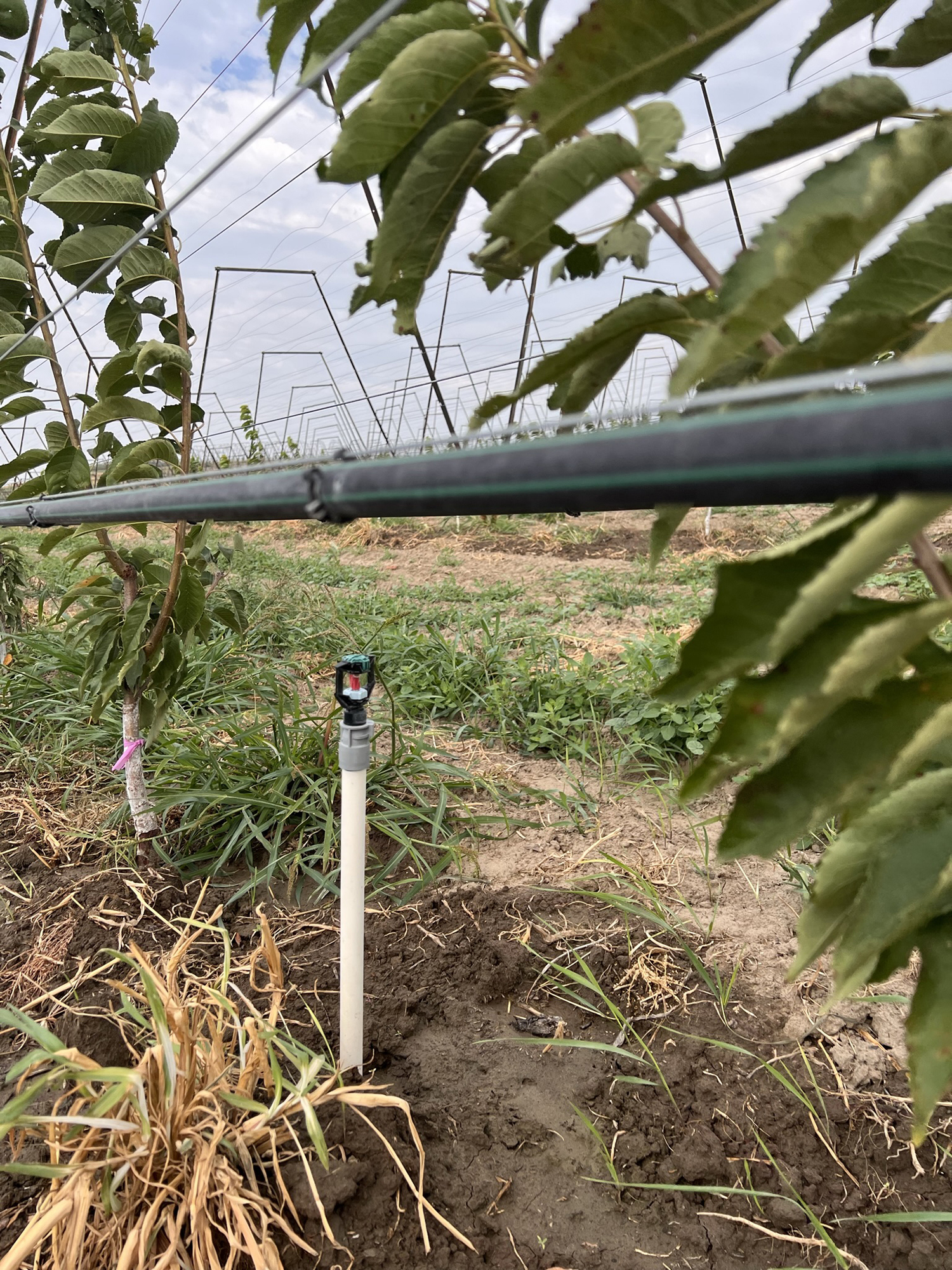
Undertree sprinklers distribute water evenly across an orchard floor, releasing heat to shield crops from radiant freezes in the Central Valley.
Photo/Courtesy of Rain Bird


By Charles Burt
It may seem a bit strange to read an article about cold weather after the heat this past summer and climate models predict less future freezing temperatures in the Central Valley. But it takes only one cold night to harm a crop.
First, a bit about frost and freezing. Frost appears on the plant—and the roof and car window surfaces—during radiant freezes because the temperatures of those surfaces drop below freezing, which cools the air. Specifically, frost occurs when surface temperatures drop to a dew point temperature, which is the temperature at which the air is saturated below 32 degrees Fahrenheit.
A variety of irrigation practices and hardware have been effective in preventing damage during radiant freezes if there is no wind.
 In contrast, advective freezes are caused by cold air, not by cold soil/plants. An advective freeze is much more severe than a radiant freeze. Wind removes heat from the field, and the wind brings in cold air from the surrounding area. It is very difficult and often impossible to protect against advective freezes with irrigation.
Practices that are commonly used with various irrigation systems include:
• Darken the soil to reduce solar radiation reflection during the day.
• Add relatively warm irrigation water to the soil.
• Take advantage of the release of heat from water as it freezes.
Historically, there were some mister or fogger systems intended to intercept long-wave radiation loss with the small droplets. But these were expensive and had variable results.
As a ballpark number, crop damage often starts to occur at temperatures lower than 28 to 29 degrees. There is no single temperature at which all buds or blossoms will experience damage, and plant varieties can have major differences in sensitivity. The University of California Almond Production Manual lists critical cold temperatures for a variety of almond varieties and growth stages, but it is about 40 years old.
A freshly disked, dry and fluffy orchard floor has been documented to be about 4 degrees colder than a bare, firm and moist soil surface. It is generally accepted that moist soil provides about 1 to 2 degrees protection above what would be obtained with a dry soil surface of the same condition.
“One degree protection” means that instead of the temperature dropping to 28 degrees, it drops only to 29 degrees, for example. Cover crops decrease the protection, but the frost control disadvantages of having a very strong cover crop must be weighed against benefits such as improved water infiltration rates, beneficial insect populations and cooler floor temperatures in the summer.
 The estimates of protection usually assume that the complete soil floor is moist. This is one reason many growers have invested in a combined system with undertree sprinklers, microsprayers or microsprinklers (or over-vine sprinklers) for freeze protection but use drip (with a limited wetted area) for regular irrigation.
Well water may be 60 degrees or warmer, so just spreading the water on a field can help. As the water cools, it releases heat into the field. About 0.6 calories of heat are released for each 1-degree drop in water temperature of a gram of water.
Undertree sprinklers can be used both during the day to darken the soil and at night to add heat, buffering the effects of longwave radiation heat loss during the night. The flow requirement for undertree sprinklers is about 35 gallons per minute per acre, and the protection can be 2 to 4 degrees. Keep in mind that these are not solid numbers.
The design of undertree sprinklers for frost protection is somewhat different from designs that focus on irrigation. For irrigation only, we focus on each plant receiving the same amount of water rather than each square inch of field receiving the same amount.
With undertree frost protection, it is desirable to wet as much of the soil surface as possible with the least amount of applied water possible. You do not want water to infiltrate 2 feet in one spot and only 1 inch in another spot. You need to consider the overlap uniformity of the undertree sprinklers just as you would if you were growing a field crop.
With over-vine or over-plant sprinkling for frost control, the continuous phase change on plant surfaces from liquid to ice provides most of the protection. This can be the most effective freeze protection. As water freezes, it releases the “latent heat of fusion,” which is equivalent to 79 calories for each gram of water at 32 degrees.
A general recommendation for over-plant freeze protection is to use sprinklers with a relatively quick rotation, such as twice per minute, although not so quick that the spinning reduces the radius of the sprinkler pattern trajectory.
My observation has been that although people follow general design rules, such as 60-70 gallons per minute per acre for over-plant sprinklers, they often do not invest in good sprinkler spacing, sprinkler models and proper pressures to obtain good overlap distribution uniformity of the sprinkler patterns. Having ice form on the ground but missing the plants is like standing next to an ice block—it has some impact on your comfort, but you notice it more if you sit down on the ice block.
Charles Burt is irrigation professor emeritus of Cal Poly, San Luis Obispo, and founder of the Irrigation Training and Research Center. He can be reached at charlesmburt@gmail.com.
See related news stories...
• Early sprinkler designs influence modern irrigation
• Irrigation News: Increase your bottom line with good irrigation
• Technical knowledge needed for state's water future





.svg.png)
