


CCAs can help farms maximize their water for crops
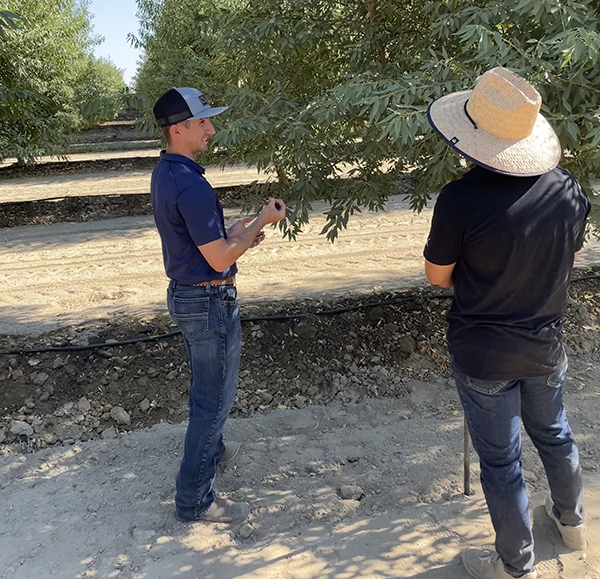
Certified Crop Adviser Cory Broad often consults on irrigation scheduling, such as at this Tulare County almond orchard.


By Cory Broad
With the effects of the Sustainable Groundwater Management Act now bearing down on California growers, irrigation management and efficiency are more important than ever. Producers are required to bring groundwater aquifers into balance.
Precipitation, plus any imported water via surface deliveries, help farmers balance water supply and demand to reduce groundwater pumping. Most farms have to install flow meters to report pumping totals, while satellite imagery and remote sensing are used to track how much transpiration crops produce.
With water and soil management being a pillar of the Certified Crop Adviser program, CCAs are equipped to help farmers maximize the value of the water being applied to their crops. Irrigation management requires two questions to be answered: How much water should be applied? And how often or at what interval should I apply it? Knowing application rates of irrigation systems and various crop evapotranspiration (ETc) and soil texture/structure characteristics allows a CCA to add instant value to the farmer.
The first step in irrigation management begins long before water starts flowing. Building a crop water budget—even for only one field—is a must. Determine how much water your crop will require each month. Then, by determining the irrigation method and application rate, we can understand how many hours a month that system needs to operate. By breaking this information down, a CCA can determine how many hours to irrigate and verify with soil tests or maps the available water-holding capacity of that soil. This will likely be a major factor in answering how often a grower should apply irrigation.
After a water budget is formed, CCAs can use this information to help schedule fertilizer recommendations, soil amendments and crop protection activities. Soil amendments are important to maximize the value of the irrigation system, as it is the medium that holds the water that is applied. Even the most efficient irrigation systems and best irrigation schedules can be undermined by soil health/performance issues. CCAs are trained to understand the relationship between soil, water and nutrients to produce the best outcome for each of those dynamics.
Lastly, when it comes to irrigation efficiency, the best soils and best ETc-based irrigation scheduling can easily be undermined by a poor performing irrigation system. Maintenance is imperative to long-term efficiency of the irrigation system, and CCAs are trained to help by understanding what your irrigation system should be capable of delivering and validating that result. If there is an issue related to irrigation, know that your Western Region Certified Crop Adviser needs to be part of the solution as your trusted adviser.
Cory Broad is a CCA, CA-NSp, PASp, CID, CAIS and agronomic sales manager for AvidWater in California. He can be reached at cbroad@avidwater.com.
See related news stories...
• CCA Today: How a Certified Crop Adviser approaches nitrogen management plans
• State water official says more work needed as SGMA evolves
• On the Record: Cecilia Aguiar-Curry talks policy priorities for 2025





.svg.png)
