


Organic seal helps boost 'phenomenal' date market
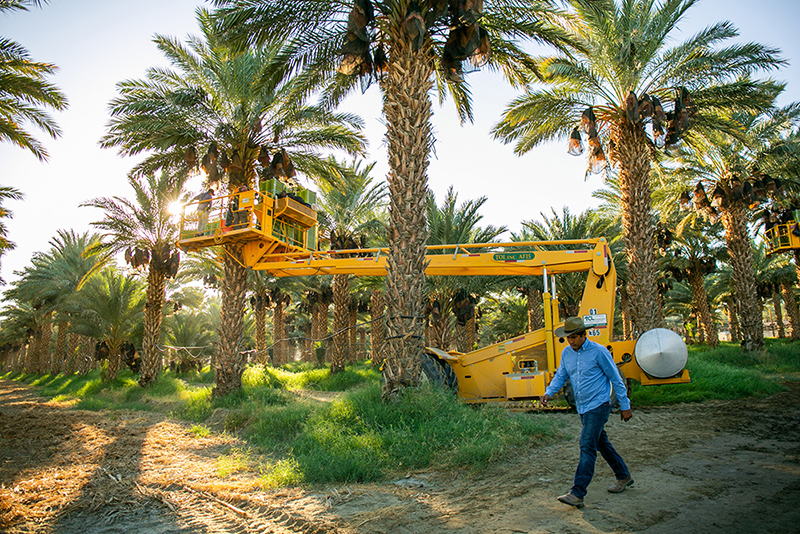
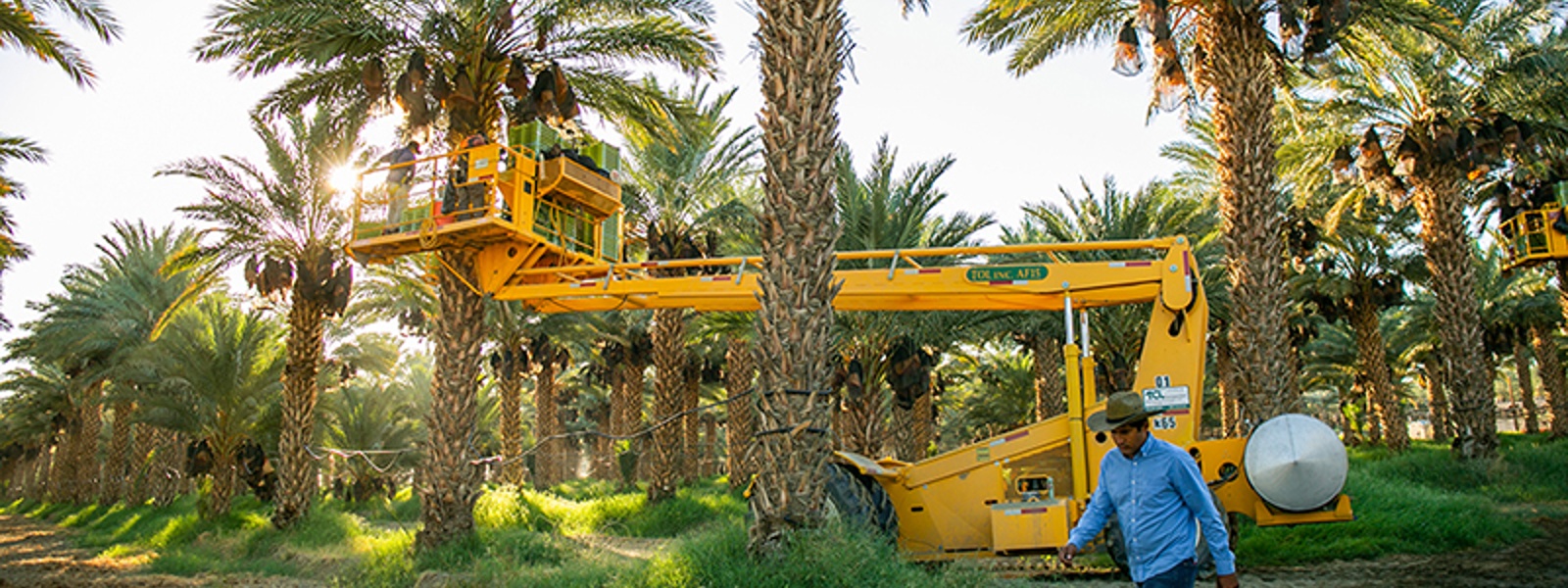
Workers stand on a picking tower platform as they harvest organic Medjool dates for farmer David Kohl at a Coachella Valley orchard in 2022. The vast majority of dates grown in Riverside County, which dominates U.S. production of the crop, are certified organic. Growers and marketers say organic certification has boosted sales of California dates, which have seen growing demand in recent years.
Photo/Faith Granger


By Caleb Hampton
Fresh California dates hit grocery store shelves last month after harvest for Medjool dates, the state’s top variety, began in the Coachella Valley in early September.
Dates are typically kept in cold storage and sold year-round, with fruit from one harvest lasting until the next begins. This year, handlers said surging demand depleted inventory heading into harvest.
 “Sales just skyrocketed,” said Albert Keck, president of Hadley Date Gardens, a grower, packer and shipper in Thermal. “There’s really no carryover.”
The value of U.S.-grown dates, most of which are produced in Riverside County, grew by more than 25% from 2022 to 2024, according to the most recent data from the U.S. Department of Agriculture. Last month, the private data firm SPINS reported date revenue in various retail channels continued to rise during the past year, growing by nearly a third.
“Dates are on fire,” said Amanda Sains, vice president of marketing at Joolies, a date company based in the Coachella Valley. “They are doing phenomenal right now.”
Marketers attributed the fruit’s recent popularity to the adoption several years ago of date paste as a base for energy bars and its reputation among health-conscious consumers as a “superfood.”
Dates contain fiber, vitamins and antioxidants, and despite being naturally sweet, they rank low on the glycemic index, meaning they provide an energy boost without spiking blood sugar levels, a trait lauded by famous athletes such as the tennis great Novak Djokovic.
Many of the dates grown in California possess an additional selling point: They’re grown using organic farming methods.
In 2023, about 78% of Riverside County’s 9,600 acres of dates were certified organic, according to data provided by Riverside County Agricultural Commissioner Delia Jimenez Cioc.
In comparison, in 2022, about 7% of the overall acreage used to grow crops and raise livestock in California was certified organic, according to the most recent data from the California Department of Food and Agriculture.
Growers said multiple factors, including market forces and the nature of date production, encouraged them to grow the fruit organically. The trend has proved successful, with the organic label appealing especially to some of the sector’s target demographics.
Among the likeliest groups to eat dates are “health-conscious consumers” and “well-traveled foodies,” according to market research Joolies commissioned before launching its brand in 2019.
The company, which was co-founded by longtime organic grower David Kohl, put its organic certification at the core of its marketing strategy, Sains said, because it knew these demographics were also likely to seek out organic foods.
“Our whole brand was built upon being organic,” she said, adding that Joolies prominently features the USDA organic seal on all of its packaging.
“We’ve grown very dramatically in just a short time,” she said, with Joolies dates sold this year by major retailers at 10,000 locations across North America.
Demand for organic dates has also boosted sales for small-scale growers.
Candelario Felix Jr., owner of Candy’s Dates, grows Medjool and Deglet Noor dates on 10 acres in Vista Santa Rosa. The family farm, which has been certified organic since 2016, sells about half its fruit to a local handler and half at farmers markets in Riverside and Los Angeles counties.
“They prefer organic dates compared to conventional,” Felix Jr. said of farmers marketgoers.
He said shifting more of his sales to farmers markets in recent years has been profitable. While he can move more volume through a handler, dates sell at the farmers markets for more than 10 times the packinghouse price of $1.30 per pound.
“We’re making more money,” he said.
By forgoing synthetic fertilizers and pesticides, organic farmers typically see smaller yields, making up for the losses by selling their products at a premium. That dynamic is true of dates, farmers said, but they added that some aspects of growing the fruit make it easier to transition from conventional to organic.
Photo/Faith Granger
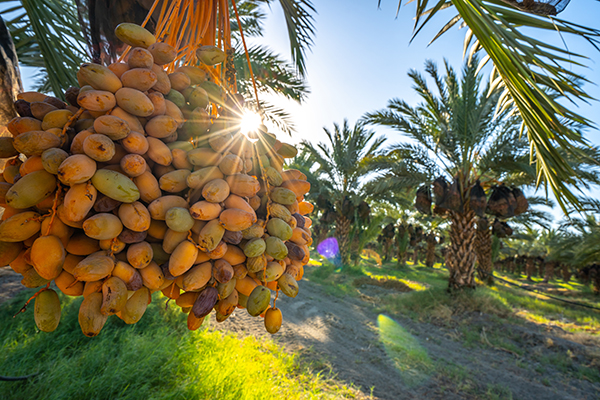
In May or June, as soon as dates begin to mature, the bunches are covered in mesh bags to protect the fruit from birds and moths. So, for conventional and organic growers alike, the primary form of pest control does not involve chemicals.
Growers added that the regulatory and cost burden to pesticide companies of registering pesticides for use in individual specialty crops disincentivizes the companies from making their products available for niche crops such as dates.
“The options available are very few and far between,” said Keck, who grows conventional and organic dates. “The risk of going organic is reduced as a result.”
The Hadley Date Gardens owner said he barely uses any pesticides on his conventional dates, with the primary differences being the use of synthetic fertilizers and weed control products.
“That’s why organic may be more feasible in dates than in crops that rely heavily on chemical fertilizers and pesticides,” Keck said.
While his organic orchards are “more cumbersome to manage,” he said, requiring higher labor costs and yielding less fruit, they have been more profitable than his conventional orchards.
During the past decade, Keck scaled up his organic acreage from about 5% of his operation to half of it.
“We’re seeing that demand out there for organic production,” he said. “It’s not a fad. It’s a major part of the industry now.”
Kristy Kneiding, manager of the California Date Commission, said cheap imports have made it hard for California growers to compete on price, but overall the sector has flourished.
“We are seeing a lot of increased consumer demand,” she said, adding that “people are looking more and more to organics.”
While California’s production of many labor-intensive fruits declined in recent years, bearing acreage for dates increased from 8,200 in 2013 to 12,300 in 2023, according to USDA, surpassing crops such as pears and apples.
With U.S. consumption of dates still relatively small per capita, growers were optimistic there is room for more growth.
“The general trend in our culture is healthy eating, and dates line up very well with that profile,” Keck said. “It gives me a lot of optimism.”
Date yields this year are unlikely to match last year’s bumper crop, growers said, especially after scattered showers last month damaged fruit in some Coachella Valley orchards. But losses were limited, they said, and the fruit quality in most orchards looked good.
Felix Jr. said last week he was beginning the second of three passes in his Medjool harvest, with the date season set to wrap up at the end of this month with the Deglet Noor variety.
“The crop looks real nice,” he said.
Caleb Hampton is assistant editor of Ag Alert. He can be reached at champton@cfbf.com.
See related news stories...
• Farm finds market niche growing 'polarizing' okra
• Farmer grows heirloom apples to preserve diversity
• State's fresh apples compete against old Washington fruit






.svg.png)
