


Leadership class travels out of state to widen perspective
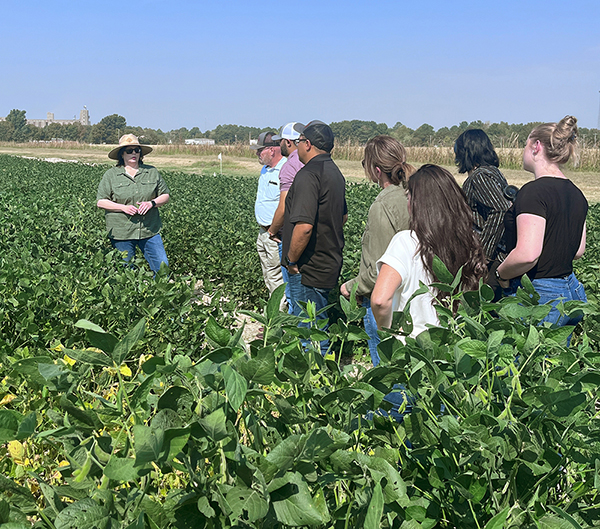
The Leadership Farm Bureau class visits Eagle Seeds LLC in Weiner, Arkansas, where geneticist and co-owner Joyce Doyle shows the group a research soybean field.
Photo/Ryan Amaral


By Tharvin Gill and John Tamayo
As part of the Leadership Farm Bureau program, our Leadership Farm Bureau class traveled to Arkansas and Tennessee last month as part of our out-of-state visit. The objective was to meet and interact with farmers, ranchers and Arkansas Farm Bureau members to get fresh insight into agriculture outside California. The three-day trip also allowed us to see how Farm Bureau plays a critical role in making a positive impact in our industry, whether through outreach, financing or advocacy.
During our first day, we visited Mike Freeze, owner of Keo Fish Farm in Keo, Arkansas. With 1,000 acres of hybrid striped bass and grass carp, Keo Fish Farm is one of the largest fish farms in Arkansas. Mike showed us around his facility and how they raise fish. It was interesting to hear that the water he uses for fish is transferred into a nearby canal so that rice farmers can use it for irrigation.
It was surprising to hear that Arkansas farmers have little to no water regulation and that they can use as much water as they like due to its abundance in the aquifer and that their only cost is in pumping the water.
We also met with Jennifer Craig at the Arkansas Farm Bureau headquarters in Little Rock. Jennifer, along with John McMinn and Rachel Tidwell, gave us an overview of Arkansas agriculture, the issues they face and financial opportunities for Arkansas Farm Bureau members.
It was great learning about the different commodities throughout the state and what Farm Bureau is doing on behalf of its members, including Farm Bureau Bank, which is available to members. It was fascinating to hear about the services that Farm Bureau Bank provides to farmers and the support it gives them to grow their operations.
We wrapped up the day with a visit to Flying C Ranch in Conway with owners Michael Lee and Leanna Clark. Flying C Ranch is one of the few ranches in Arkansas that show consumers where their food comes from and how important agritourism is for our industry.
Leanna and Michael said all their steers are raised comfortably on their ranch in a low-stress environment. This is a life-long passion for them, especially for Leanna, who wants to help maintain a positive image of beef production. We were awestruck seeing their operation, how they educate the public about the importance of agricultural production and their commitment to agriculture.
On Day 2, our LFB class began with a visit to Eagle Seeds LLC in Weiner, which grows and distributes a wide variety of grains and seeds, including soybeans, corn and rice. Some of the company’s major clients are familiar names such as Kellogg’s and Anheuser-Busch. It was fascinating to see the scale of its operation and hear about how the business began and grew to where it is today.
Following our trip to Eagle Seeds, we traveled to the Northeast Rice Research and Extension Center, or NERREC, in Poinsett County, near Fayetteville. We learned the center’s mission is to develop and promote innovative, efficient rice production practices using genetically diverse and adapted cultivars. Its goal is to maximize profitability for Arkansas rice producers while promoting sustainable agricultural practices.
Key research areas include improving water-use efficiency, evaluating practices related to soil health and carbon sequestration, and integrating advanced technologies such as artificial intelligence and robotics in rice production.
The center sits on 600 acres of Henry silt loam—known as “white soils”—making it the only Arkansas agricultural experiment station site focused specifically on unique soils found in the Arkansas Delta. It was especially interesting to compare the similarities and differences between agricultural practices in Arkansas and California. One major takeaway was the stark difference in irrigation methods and water availability between the two states.
Next, we met Jason McGee of HCM Farm Partners in Cherry Valley. McGee shared his journey as a first-generation farmer, discussing the challenges he’s overcome and the path he’s taken to achieve success. Hearing his story was incredibly motivating and offered a powerful example of resilience and innovation in modern agriculture.
We then visited Stiles Farms, a fourth-generation peanut and cotton operation in the Arkansas Delta. Owned and operated by Kerry and Ramey Stiles, the farm is part of a growing movement in Lee County where cotton producers are integrating peanuts into their crop rotations. This shift has been supported by Delta Peanut’s construction of a buying point in Marianna that serves local peanut growers.
The Stiles family offered their perspectives on the benefits of peanut production and discussed the future of peanuts and cotton in Arkansas. Touring their farm gave us an on-the-ground view of peanut cultivation, which is novel for those of us from the West, where peanut farming is far less common. It was rewarding to learn about new crops and production methods.
Later, we toured the McClendon, Mann and Felton Cotton Gin in Marianna. For many in our class, this was the first time seeing a cotton gin in operation. The facility runs 24/7 starting in October and pauses only for Christmas. We were amazed to learn that the gin was recognized by Bayer and Deltapine for ginning the most cotton in the U.S. during the 2024 season—an impressive 242,706 bales. The scale and efficiency of the operation were truly eye-opening. While cotton is grown in limited parts of California, few of us have seen the full cotton processing chain in person.
In Tennessee, we toured the Port of Memphis, one of the largest inland ports in the United States. Randy Richardson, vice president of port and industrial properties and executive director of the Memphis and Shelby County Port Commission, walked us through the history and economic importance of the port, which includes three major slack-water harbors: Pidgeon Industrial Harbor, McKellar Lake Harbor and Wolf River Harbor. These harbors serve two key industrial parks—Pidgeon Industrial Park and President’s Island—both essential for waterborne and multimodal transport operations.
The Port of Memphis generates an impressive $6.25 billion in total annual economic output, supports 5,361 direct jobs and 8,494 indirect jobs, and contributes approximately $71.7 million in annual tax revenue. The tour offered an incredible perspective on the role of infrastructure in agriculture and trade, especially in connecting regional products to national and global markets.
These experiences inspired us to return to the Golden State and be even stronger advocates for California farmers and ranchers.
Tharvin Gill is vice president and relationship manager for the Western region of Conterra Ag Capital. He also serves on the board of directors of the Ag Lenders Society of California. John Tamayo is an irrigation salesman for Rain for Rent in Imperial County. He is also on the California Farm Bureau Young Farmers & Ranchers state committee representing District 10.
See related news stories...
• Investment supports next generation of agriculture
• Leadership Farm Bureau: Meet the class of 2025
• Leaders make an impact on issues in Washington, D.C.







.svg.png)
