


Ventura County detects first infected Asian citrus psyllid
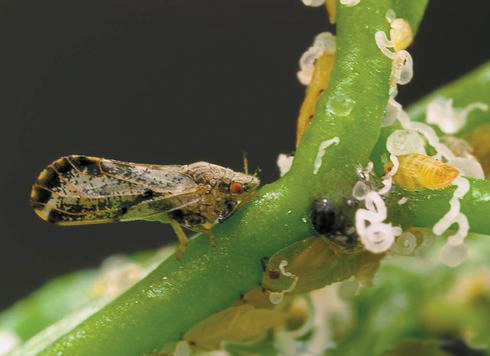
An adult Asian citrus psyllid, left, and yellow nymphs feed on a citrus tree’s leaves and stems, leaving behind a white, waxy substance. Psyllids carrying the huanglongbing bacteria can kill citrus trees.
Photo/Michael E. Rogers


By Ching Lee
Citrus growers in Ventura County remain vigilant after agricultural officials confirmed the region’s first finding of an insect pest carrying the huanglongbing bacteria, which kills citrus trees.
The discovery is a concern because Ventura County remains the state’s top producer of lemons and grows other citrus fruits.
The infected Asian citrus psyllid, which authorities confirmed on Sept. 19, was found in a residential citrus tree in the southwestern area of Santa Paula, according to the California Department of Food and Agriculture. It tested positive for Candidatus Liberibacter asiastius, the pathogen associated with huanglongbing, or HLB, also known as citrus greening disease.
Though the fatal disease has not been detected in any of the county’s citrus trees, finding an infected psyllid, which transmits the disease when it feeds on the plant, oftentimes is a precursor, “as it’s assumed the psyllid is actively feeding and/or breeding on nearby citrus plants,” said Keith Okasaki, CDFA regulatory manager for the Citrus Pest and Disease Prevention Division. HLB symptoms can often take a couple years to manifest after the tree is infected, he added.
“Hot trees are throughout San Diego, Orange and LA (counties), so it’s coming, if not already here,” said Ben Faber, University of California Cooperative Extension farm advisor for Ventura and Santa Barbara counties.
Not every infected psyllid finding has resulted in trees testing positive for the disease. Okasaki noted in early 2021, an infected psyllid was found in the Fallbrook area of San Diego County, and that immediate area has yet to see an HLB-positive plant sample. However, a positive plant sample showed up in the Oceanside area later that year.
“The frequency of this occurrence can vary and is not a sure thing for every case,” Okasaki said.
Confirmation of an HLB-infected tree would trigger a mandatory 5-mile quarantine around the find site.
There is no known cure for HLB, which can kill a citrus tree within five to eight years. All commonly grown citrus varieties are susceptible. The only way to protect citrus trees from the disease is to prevent spread of the HLB pathogen by controlling populations of the vector and destroying infected trees.
Since its discovery in Florida in 2005, HLB has decimated the Sunshine State’s citrus production, which has dropped by 90%, according to the U.S. Department of Agriculture.
Considering the pest is now well established in Southern California, Ventura County grower Will Pidduck said finding one carrying HLB in the region comes as no surprise.
“It’s not shocking by any means,” he said. “I’m surprised they hadn’t found one sooner. There’s just so many psyllids around. I think we’ve all been somewhat expecting it.”
For now, Pidduck said it has been business as usual on the farm, with lemon harvest completed for the year. As such, farms are not moving any fruit until winter harvest starts. He said growers continue to monitor their groves and apply foliar treatments to keep psyllid populations down, which have worked for years to prevent the disease from spreading to California commercial orchards.
California confirmed its first finding of the Asian citrus psyllid in 2008 in San Diego County. HLB was first detected in Los Angeles County in 2012 and has since been found in Orange, Riverside, San Bernardino and San Diego counties. All HLB-positive trees have so far been on residential properties.
Though treatment is not mandatory, Pidduck said many packinghouses already require it. He noted most growers mainly move fruit to packinghouses within the county during harvest.
Should a quarantine be triggered, Okasaki said growers who need to move fruit within or outside the quarantine zone would need to complete additional mitigation steps, and packers would need to ensure the mitigations are met before they can accept fruit from the quarantine area. Because the psyllid feeds on the leaves and stems of citrus trees, he said, the main concern is restricting transport of citrus plant material.
The additional expense of treatments comes at a difficult time for growers, who are earning lower prices for lemons, farm advisor Faber said. A potential quarantine and HLB detection would also affect field workers and packinghouses, he added.
“I’m not sure if we are ready for a quarantine, but it might be cheaper than spraying three times a year,” Faber said. “It’s wait and see what CDFA finds at this point.”
Meanwhile, CDFA said it continues to conduct surveys and collect samples from the residential property where the infected psyllid was found and from all host plants within a 250-meter radius around the find.
The department said it did not initially find any nymph psyllids during sampling but has since collected 15 on a different host plant from where they found the infected adult insect. Nymphs are significant because the immature insects feed directly on the trees, Faber said.
“If they find a hot nymph or tree, HLB is there for sure,” he said.
Not all psyllids carry the HLB bacteria. That the infected adult was found on a backyard tree not far from California State Route 126 suggests it could be a hitchhiker, Faber said.
Because of the mild spring and summer, Faber said there have been very few psyllids this year, though areawide fall sprays are scheduled soon. Organic growers, who have fewer organic-approved treatment options, “would have it tough,” he added.
That’s because organic treatments are not as effective as conventional, long-residual insecticides, Okasaki said. If an HLB-positive plant is detected, mandatory conventional treatments are required by law within 250 meters of the detection site.
Lemons remain a top crop in Ventura County, ranking third behind strawberries and avocados, and valued at more than $206 million in 2022, according to the county’s crop report. The citrus fruit is also an important agricultural export for the region, ranking sixth.
Ventura County also grows Valencia oranges, worth $26.6 million in 2022; mandarins and tangelos, valued at $18.5 million; and navel oranges, $4.2 million.
(Ching Lee is an assistant editor of Ag Alert. She may be contacted at clee@cfbf.com.)





.svg.png)
