


Ag business grad supervises automation for vegetables
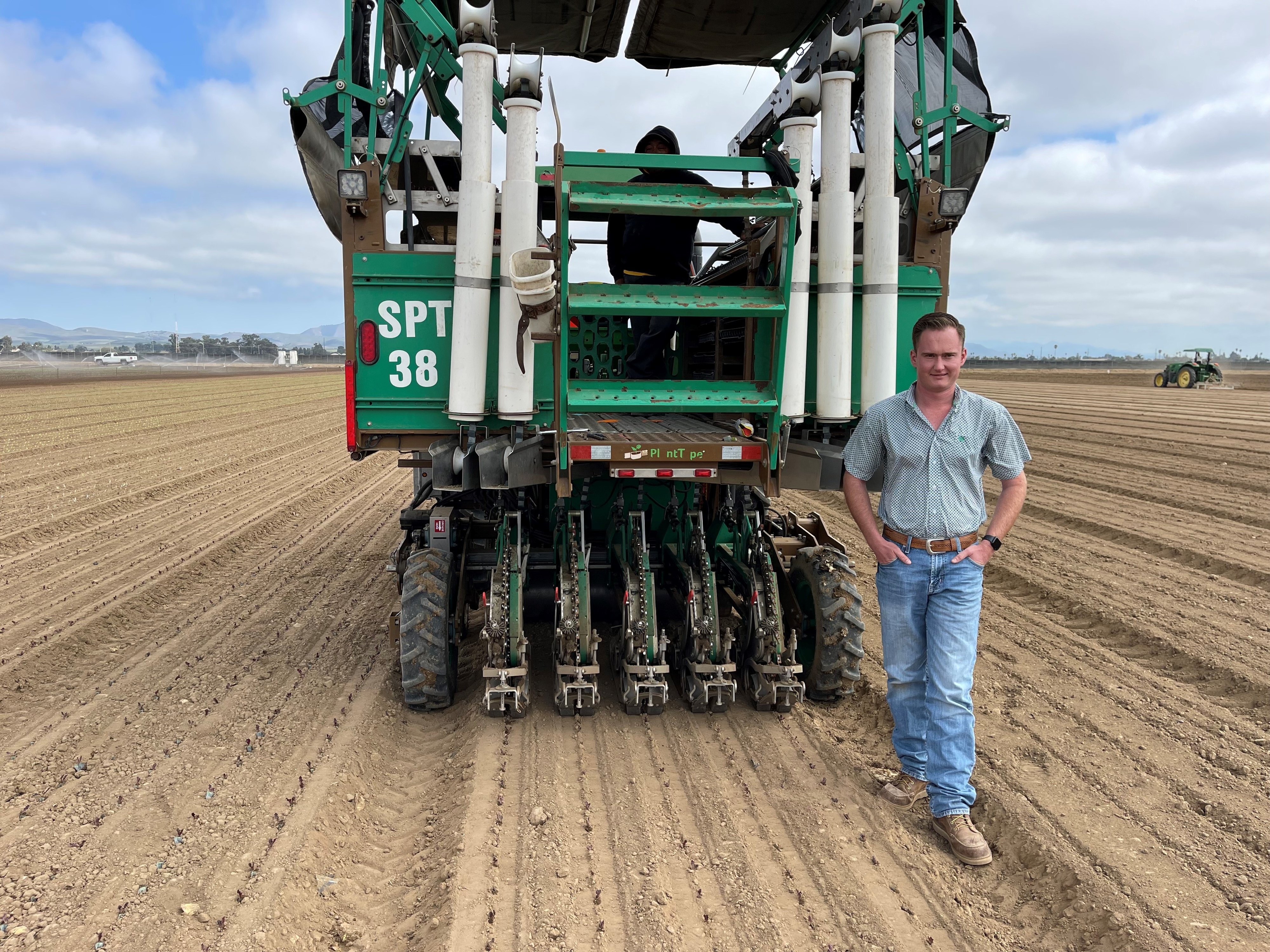


Santa Barbara County Young Farmer & Rancher Stephen Waldron oversees high-tech machinery for Plantel Nurseries. He takes care of 13 machines, troubleshoots to resolve mechanical issues and supervises crew members who make repairs. He is working to help the company fully automate its transplanting business.
By Caleb Hampton
(This is the third of a three-part series highlighting individuals in California Farm Bureau’s Young Farmers & Ranchers program.)
Stephen Waldron grew up around agriculture in the Santa Maria Valley, and farming “was always part of my life,” he said.
He participated in 4-H throughout elementary and high school. At 16, he began working in celery fields, picking up sprinkler pipe and doing basic maintenance. Then he later gravitated to the more technical trades, learning to weld and perform other mechanical jobs.
Ultimately, his love of working outdoors and the enjoyment he found in using technology to solve problems convinced Waldron that agriculture was the career field that fulfilled both his passions.
With widespread farm labor shortages and automation playing an increasingly important role, his interests were well suited to the needs of California produce growers.
Since graduating from California State University, Fresno, in 2018, with a degree in agriculture business, Waldron has worked as a field automation supervisor for the Santa Maria-based Plantel Nurseries, overseeing the company’s use of new technologies.
Plantel Nurseries produces vegetable seedlings, most commonly celery, broccoli, cauliflower, cabbage and lettuce, for customers all over the country who sell the produce to big-box retailers and food chains.
“They brought me on to oversee all of the automated machines,” said Waldron, who spent his final college summer at Plantel Nurseries as the company was first adopting automated transplanting machines and joined the company full-time in early 2019.
“With the labor issues and the general direction of the industry, they knew the direction they were going in was going to be automation,” he said.
Plantel Nurseries transplants crops for regional vegetable growers in the Santa Maria Valley. After receiving seeds from farmers, the company sows them into trays, lets them germinate for several days until they sprout, moves the sprouts to a greenhouse where they grow for 21 to 78 days, depending on the crop and the time of year, and then delivers the seedlings to local farms.
For the past few decades, farmers have used conventional transplanting machines that require crews of one or two dozen people to pull the plants out of trays and drop them down a shoot into the ground.
Plantel Nurseries uses two new machines to transplant crops: an Italian-made automated transplanter and an automated PlantTape machine that was developed in Spain and made in Hollister.
“This is where I come in,” Waldron said. “With these new automated machines, it’s a robot that’s removing the plants from the tray and dropping them down to put them in the ground.” It isn’t an entirely robotic process, but it requires much less human labor than the conventional machines.
The PlantTape company says its machine can double or triple output while cutting labor costs by up to 80%. At Plantel Nurseries, the automated machines are operated by crews of three to five people.
Since joining the company, Waldron has taken the lead in implementing the new technology. “My day-to-day role at Plantel is to oversee all things around the new robotic and automated equipment that is used to plant our seedlings,” he said.
That involves everything from operating the equipment to training and supervising crew members on it to making repairs, coordinating with customers, and scheduling when and where to plant.
“You’re not doing the same thing every single day,” he said. “It’s always something different.”
The automated technology brings its own challenges. Waldron takes care of 13 machines. With the help of a technician, he troubleshoots mechanical failures and computer issues and deals with broken-down components of the robots. “I have a guy at the shop full-time as well as a foreman in the field,” he said.
The robot-centered nature of his job hasn’t removed Waldron from the hands-on side of farming that first drew him in. “I’ll walk through the nursery with the customers to look at the plants and make sure everything’s ready,” Waldron said. “Then, once we’re in the field, I oversee the crews.”
Moving forward, Waldron aims to help Plantel Nurseries fully automate its transplanting business and phase out its use of the conventional machines. For now, the company uses the automated machines for celery, cauliflower and lettuce, but hasn’t expanded further due to the differing germination rates of various crops.
Solving these kinds of problems motivates Waldron. He said he values the opportunity to discuss the challenges other farmers are facing, something he’s gotten to do through the California Farm Bureau’s Young Farmers & Ranchers program.
“It’s been great getting the opportunity to network with individuals from across the state,” said Waldron, who serves on the Santa Barbara County Farm Bureau Board of Directors.
He said he enjoys his conversations with farmers, including talking “about the challenges they’re facing and how they’re adapting to them—the different ways they’re approaching problems, bringing new approaches to issues that have been around for many years.”
(Caleb Hampton is an assistant editor of Ag Alert. He may be contacted at champton@cfbf.com.)





.svg.png)
