


Bountiful harvest tests trucking capacity
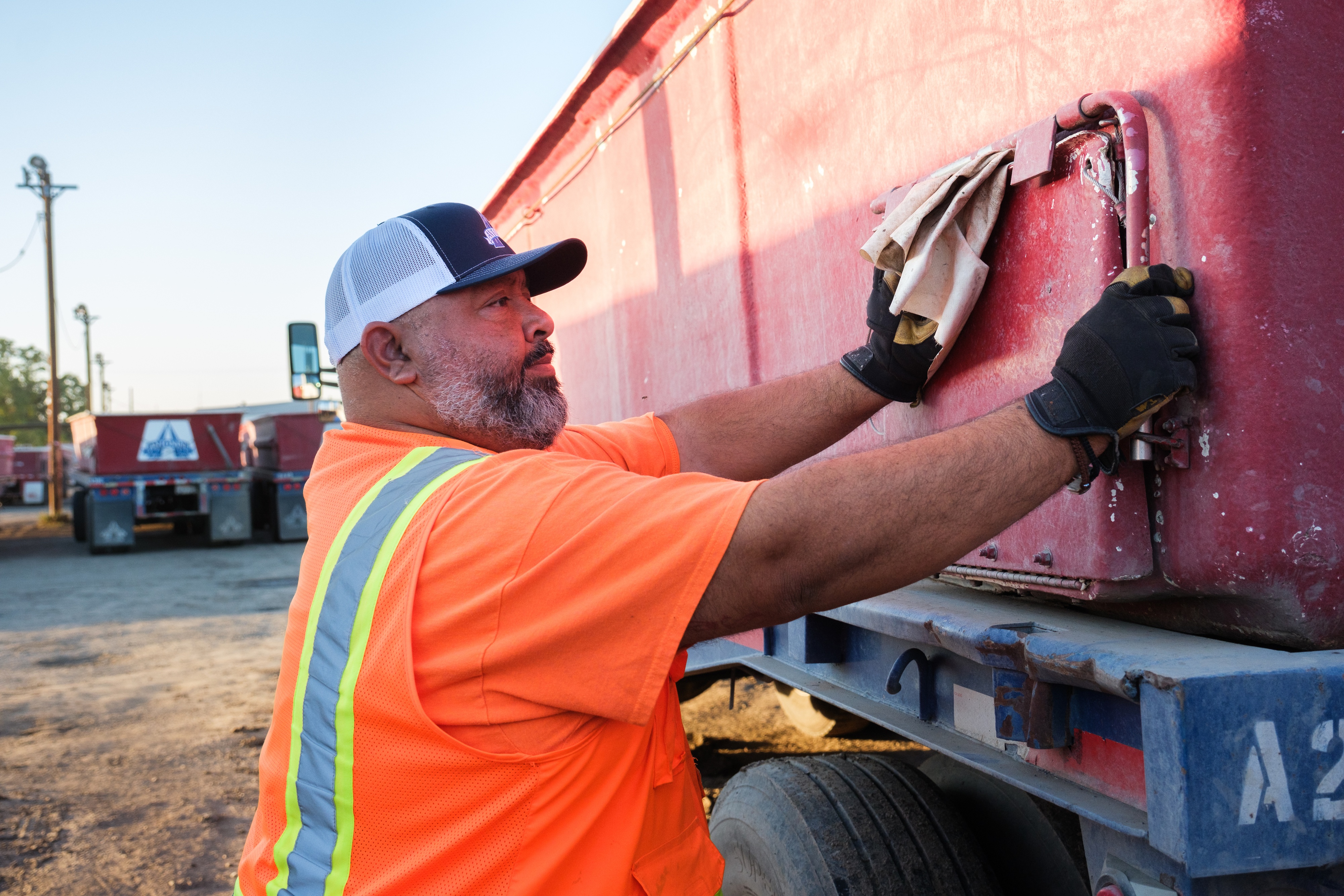
Alejandro Juarez, a seasonal driver for Antonini Fruit Express in Modesto, works on a trailer during processing tomato harvest. High yields in tomatoes, pistachios and other crops left some California farmers scrambling for hauling services as trucking companies were stretched thin.
Photo/Steve German


Photo/Caleb Hampton
By Caleb Hampton
After three years of drought, California’s abundant water supply this year resulted in larger yields for some crops.
Tomatoes, almonds, pistachios and winegrapes, all among the state’s top crops, were expected to outpace last year’s production, according to estimates from the U.S. Department of Agriculture.
With the bountiful harvest season comes renewed demand for some of the businesses that support the state’s agricultural sector. Trucking companies that haul crops from fields and orchards to processing facilities and transport packaged produce to ports and retailers have been especially busy over the past several weeks, even as many struggled to hire enough drivers.
Tom Barcellos farms field crops and pistachios in Tulare County and runs a trucking business that does custom hauling for harvest crews. He said his fleet of about two-dozen trucks was stretched thin by the San Joaquin Valley’s record-setting pistachio harvest.
“There were trailers sitting in the field loaded because the harvesters were loading eight to 10 trailers per day, whereas last year they were only loading three or four,” Barcellos said. “It was a real challenge.”
His fleet hauled pistachios for three harvest crews over the past six weeks, he said, and had to turn down additional work. “Other people were calling trying to get help because their harvesters were loading so quick,” he said. “They just couldn’t get things moved to the plant.”
Barcellos said a similar picture played out across the valley. “There were other trucking companies in the exact same scenario,” he said. “There was a better crop in many places, and they were just scrambling to keep up.”
Richard Matoian, president of American Pistachio Growers, reported that California growers expect to harvest 1.3 billion pounds of pistachios this year, up from the previous record of 1.1 billion pounds in 2021. Barcellos wrapped up pistachio harvest in his orchard last week.
During the past few years, trucking companies saw inconsistent demand from farms due to the drought’s impact on crop production. “Lack of water has been a big thing,” said Stefano Antonini, Modesto terminal supervisor for Antonini Fruit Express.
The Antonini family has operated a trucking business, headquartered in San Joaquin County, for nearly a century, running a seasonal company that hauls agricultural commodities from July through November and a year-round company called Antonini Freight Express.
This year, Antonini said that with reservoirs full after a wet winter, “things have looked better.” The company has seen strong demand from tomato growers. “We’re almost done” with tomatoes, he said last week. “And walnut season is looking to be pretty good-sized. That’s still ramping up.”
A cold and stormy spring delayed the planting and growth of some crops, pushing harvest later than usual. Farmers and trucking companies said that narrowed the window to get various commodities harvested and hauled off to processing plants.
“Everything is compressed,” said Joe Valente, who grows winegrapes and almonds in San Joaquin County. “The tomatoes are still going, and the walnuts started up, and the almonds are late. It’s been a crunch for everyone.”
Valente said he has been able to get his crops hauled but has had to seek help from more trucking companies than he typically uses.
“We’ve had to get extra help outside the (companies) we normally use,” he said. “It seems like the trucking firms are a little tighter because of the different commodities” peaking at the same time.
Barcellos said he thought the late tomato crop coming off vines in the central and west sides of the San Joaquin Valley contributed to the trucking crunch he saw in the pistachio harvest on the east side. “There’s a lot of demand going on there,” he said, adding that some of his own trucks “were tied up hauling almonds.”
While fall harvest gave a welcome boost to some trucking companies, the sector continues to face challenges.
Rachel Crusenberry, president of the San Joaquin County-based JSG Trucking, which transports coils of sheet metal for canned goods such as tomatoes, peaches and apricots, said profit margins have tightened since the high freight rates seen during the pandemic came down and demand faltered.
“Customers now are not willing to pay as much as in 2020 and 2021,” she said. “In order to be sustainable, you need to make smart choices on what loads you take and make sure you have some profit.”
Despite the strong harvest for some agricultural commodities in California this fall, overall nationwide freight tonnage remained down vs. last year, according to industry data. Some experts singled out damage from spring flooding to Central Coast leafy greens as a key reason.
Meanwhile, regulations adopted earlier this year by the California Air Resources Board will require most trucking companies in the state to sideline diesel trucks and convert their fleets to zero-emission vehicles over the next two decades.
A single electric big rig can cost hundreds of thousands of dollars. Companies with smaller fleets, such as JSG Trucking, have more time than others before they need to buy them. But the investment is so big that business owners are already accounting for it. “It’s coming our way,” Crusenberry said, referring to the diesel phaseout.
Trucking companies also continue to report labor challenges, especially for seasonal jobs that do not guarantee year-round work. “Most years, the biggest challenge is getting enough drivers to fill all our trucks so we can meet our customers’ needs,” Antonini said.
A first-of-its-kind report published last month by the University of California, Berkeley, Labor Center, titled “Ensuring the Supply of Agricultural Truck Drivers,” used California’s tomato harvest to illustrate why finding sufficient drivers can be so hard.
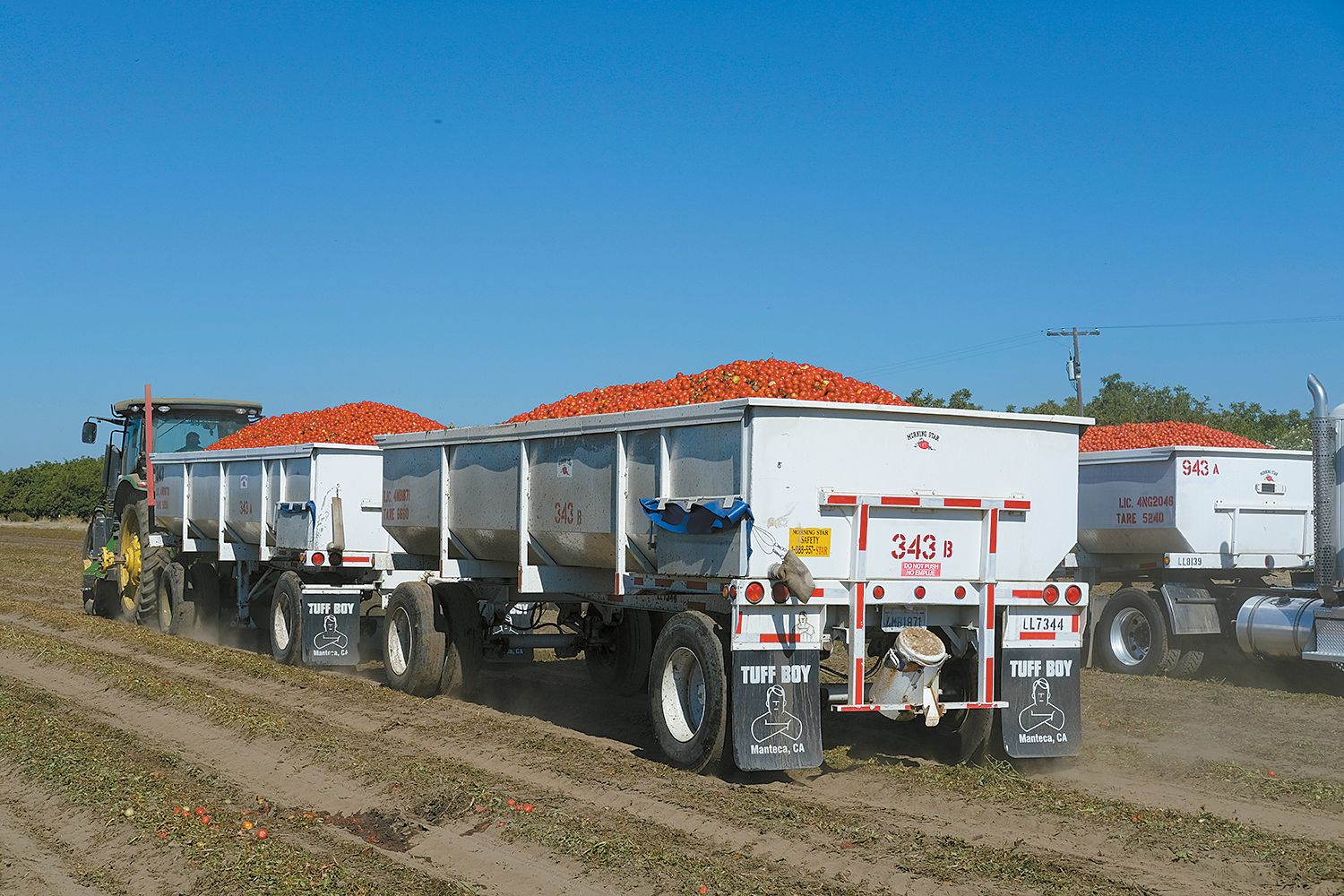
“At its peak, the harvest requires more than 40,000 truckloads of tomatoes a week to be moved out of fields to processing plants. Because of its four-month season, tomato haulers must hire hundreds of new drivers every year,” the study said. Essentially, it added, these “jobs have shortages at the start of every new season.”
Antonini added, “It’s challenging every year finding drivers to hire for a tomato season where we only employ them for around 90 days. It’s tough when there’s so many driving jobs out there that offer year-round work.”
Barcellos said he also struggled to hire drivers for harvest. “With the labor situation being what it is, not having a whole list of people looking for work, it got a little challenging,” he said, “but we got through it.”
(Caleb Hampton is an assistant editor of Ag Alert. He may be contacted at champton@cfbf.com.)





.svg.png)
