


Food trends boost pistachio market as production rises
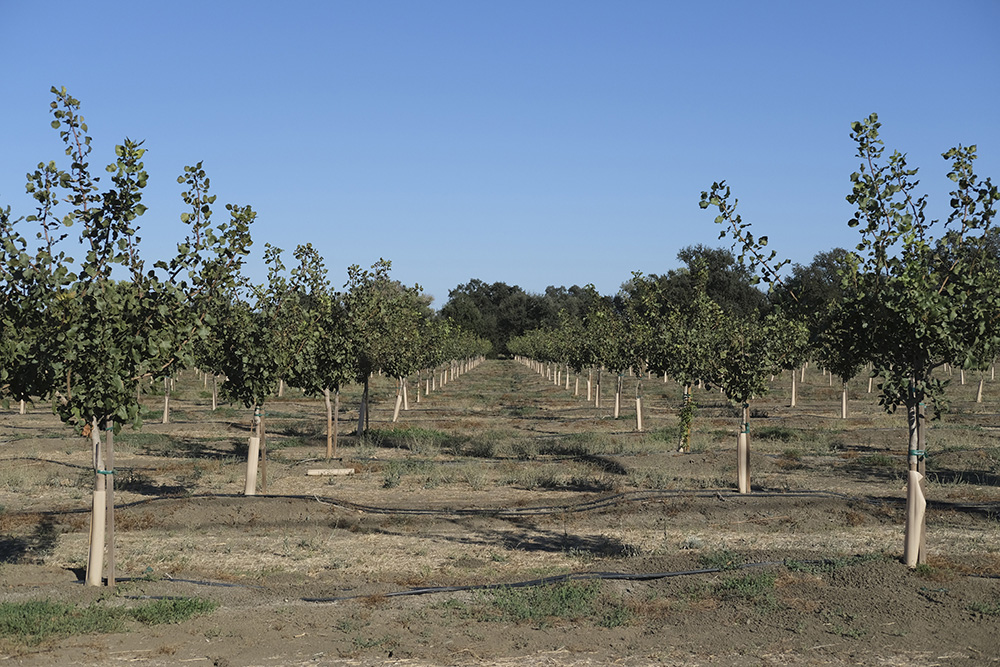
A young pistachio orchard pictured this year in Yolo County. California growers hope the global market can absorb more pistachios as the state’s bearing acreage continues to increase.
Photo/Caleb Hampton


By Hannah Johansson
With pistachio harvest wrapping up this month, California growers are expecting a potential record crop.
Initial projections of up to 1.8 billion pounds of in-shell pistachios diminished this fall as harvest progressed, though growers still expect yields to surpass the state’s 2023 record of 1.5 billion pounds, according to recent market reports.
From 2018 to 2022, the Central Valley saw a boom in new pistachio orchards, with growers planting more than 30,000 acres per year. Last year, the state’s bearing acreage increased to 488,000, more than double California’s pistachio acreage a decade prior.
As the wave of recent plantings begins coming into production, growers said they were hopeful the global market can absorb more of the state’s pistachios.
San Joaquin Valley farmer Aaron Barcellos, who grows for the Wonderful Co., a major pistachio brand, said he was optimistic that demand will keep pace with increased supply—up to a point.
Barcellos said he was earning the same base price this year as last year for his Golden Hills pistachio variety. He added, “ It’s going to be really hard to match that price next year just because we have more product to sell.”
For its part, the Wonderful Co. has gotten creative in an effort to sell more pistachios.
For several years, Wonderful Pistachios has marketed shelled pistachios, or kernels, as “unshelled,” which the company says helps consumers better understand what they’re buying. Wonderful Pistachios also launched new flavored pistachio kernels, including Dill Pickle as well as the company’s first-ever confectionery flavors, Chocolate Sea Salt and Chocolate Toffee.
The use of pistachios as a confectionery ingredient has trended worldwide, headlined by the popularity of Dubai chocolate. This year, global supplies of pistachio kernels reportedly ran short after the Emirati chocolate bar filled with pistachio-tahini paste became a viral trend on TikTok.
Major chocolate companies such as Läderach and Lindt recently began creating their own pistachio-based chocolate products to cash in on the trend, and pistachio paste is now sold in some grocery stores.
Last month, dessert makers in Turkey successfully lobbied their government to ease restrictions on pistachio imports to alleviate the shortage.
California growers said they were concerned about potential impacts from President Donald Trump’s tariffs and trade wars, which have targeted key export markets including India, China and the European Union.
However, exporters said the market was no longer reacting strongly to every U-turn imposing or rolling back new import duties.
“After several rounds, it’s like nobody cares,” said Ali Amin, owner of the Los Angeles-based export company Primex International Trading.
Amin added that “until it happens, you can’t count on” other countries imposing retaliatory tariffs on California nuts.
Thus far, nations hit with U.S. tariffs this year have, with the exception of China, not retaliated by imposing counter tariffs on U.S. pistachios.
Despite the ongoing trade war with China, Amin said California nuts, including pistachios, were still making their way to the Asian superpower through “workaround” countries such as Vietnam.
As long as a certain amount of value is added to the product, typically in the form of some type of processing and packaging, the nuts can be sold on to China as a Vietnamese product, thereby evading import taxes.
As of last year, the U.S. produced about 43% of the world’s pistachios, followed by Turkey at 33% and Iran at 17%, according to the U.S. Department of Agriculture.
Industry experts remain hopeful that the diversification of pistachio-based products is a sign of new and lasting consumer appetite for the tree nut.
“That high demand is there, and it seems like it’s there to stay,” Amin said. “It’s not a fad.”
Increased demand for kernels for use in confectionery products such as chocolate could provide a useful market outlet for California’s crop this year, which growers said has more shell stain than usual. Kernels sold without shells are not affected by staining.
Grower Mitchell Coit estimated that 10% to 20% of his crop this year had shell stain as a result of September rains in the San Joaquin Valley. The window to harvest pistachios is brief, with growers typically shaking trees within three to five days of the nuts beginning to crack open.
“I think we battled rain more than we ever have in a pistachio harvest,” Coit said. “It was a race to get them out of there.”
Besides the midharvest rain, many farmers experienced a favorable growing season.
Winter delivered adequate chilling hours, which pistachios need “to be able to develop the pollen, the fertility they need,” Barcellos said. Springtime did not bring intense heat spells, which can stress the trees, and temperatures remained relatively mild throughout the summer.
Despite pistachios’ recent success in the global market, growers said water challenges could deter further expansion of the nut crop.
“You cannot farm everywhere,” said Bikram Hundal, a pistachio grower and handler with orchards in Tulare, Kings and Madera counties.
Hundal said that because of groundwater pumping restrictions under California’s Sustainable Groundwater Management Act, he plans to remove 20% of his acreage within the next five years.
“There’s no water available, so that acreage cannot increase,” he said.
Hannah Johansson is a California water reporter. She can be reached at agalert@cfbf.com.
See related news stories...
• Researchers make headway on leaffooted bug fixes
• Abandoned crops bring pest plague to adjacent farms
• What are ways to keep NOW levels in check in pistachios?






.svg.png)
