


Cilantro trial tests herbicide to fight aggressive weed

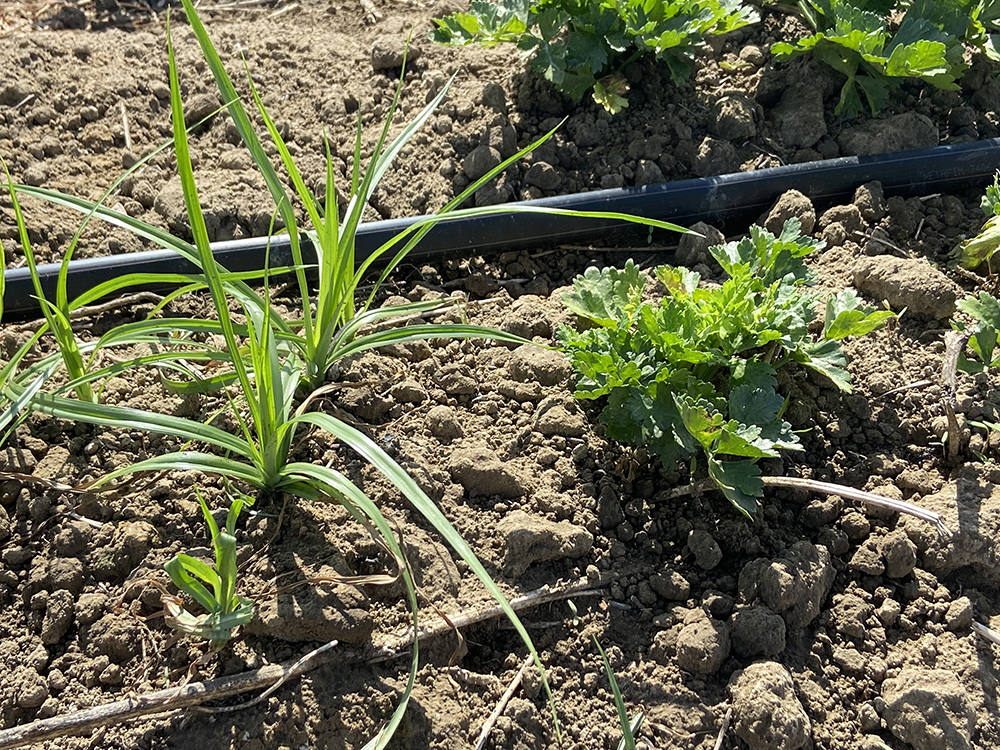
University of California Cooperative Extension farm adviser Oleg Daugovish checks on cilantro plantings in a trial looking at the effectiveness of the herbicide Dual Magnum against yellow nutsedge weed. The product is currently not registered for use in California on cilantro.
Photo/Rob McCarthy


By Rob McCarthy
The spread of an aggressive weed that thrives in coastal conditions has put a damper on an otherwise phenomenal period for California cilantro growers.
Yellow nutsedge is found in the major cilantro-growing regions of the state, including Ventura, Santa Barbara, San Luis Obispo and Monterey counties, according to University of California Cooperative Extension vegetable farm adviser Oleg Daugovish in Ventura County. He calls it one of the worst weeds in the world.
Nutsedge thrives in warm coastal areas such as King City in Monterey County. Because there is no herbicide labeled for use against nutsedge in cilantro, growers have few options aside from not planting the herb in areas with heavy nutsedge populatons, Daugovish said.
“Nutsedge competes for water, nutrients and can block out sunlight if it’s not removed before it spreads out in cilantro,” he said. “The only way to get rid of nutsedge currently is to pull it out by hand, which is cost-prohibitive in cilantro.”
With the cost of water, fertilizer and labor on the rise, cilantro growers in Ventura County approached Daugovish about doing an herbicide trial on the herb, which has expanded in acreage and value since 2020. He was wrapping up the two-year trial in October and said he expects to have data to report sometime this fall.
The goal is to submit data on Dual Magnum to the California Department of Pesticide Regulation so that the preemergent herbicide is registered for use in cilantro, Daugovish said.
 First- and second-year applications of Dual Magnum at the same rates on cilantro right after planting showed promising weed control results, he said. He ran the trial at the University of California Hansen Agricultural Research and Extension Center and at a grower field. Syngenta, which makes the herbicide, provided in-kind support, he said.
Ventura County leads the state in cilantro production, with 4,907 acres in 2024. Monterey County came in second with 3,090 acres. The crop was valued at nearly $35.2 million in Ventura County and more than $40.1 million in Monterey County last year, according to county crop reports.
“Without a good herbicide program, the weeding costs have become a huge issue,” Ventura County grower Edgar Terry said. “I know that Oleg is working on some herbicides for cilantro, and I hope he can get them approved by the state.”
Harvesting cilantro is slowed if nutsedge gets into the plants, Daugovish said, as harvest crews must cut around the weed to keep it out of the crop. Nutsedge shoots “become mixed within cilantro canopy and are very difficult and expensive to sort out,” he added.
The total cost to produce cilantro in 2025 at a yield of 1,200 cartons per acre is estimated at $7,316 per acre, according to the most recent UC cost analysis. The report, released in August, estimated grower profit at $3,480 per acre if the crop price is $9 per carton.
At 1,200 cartons, the break-even price would need to be $6 per carton for total costs, the study estimated.
Eta Takele, UCCE adviser on agricultural economics and farm management in Southern California and a contributor to the cost study, said the report offers a real-time snapshot of grower costs, which may vary by county.
The study is based on an 800-acre farm in the Oxnard Valley of Ventura County in which 280 acres were used for cilantro production. Researchers factored in expenses for land preparation, fertilizer, planting, water, and pest and disease management. Other production costs included labor, energy use, weed management and harvest.
Per-acre yields along the coast are lower than in the Coachella Valley of Riverside County, crop figures show. The average yield in Monterey County in 2024 was almost 6.2 tons per acre. That’s compared to nearly 9.2 tons per acre in Ventura County. The winter yields in Riverside County reach between 30 and 35 tons per acre, according to UC figures.
Photo/Rob McCarthy
Boskovich Family Farms in Oxnard relies on cultural practices in the summer to avoid nutsedge and two soil-borne diseases in the fusarium family, according to farm production manager Bryson Daniel.
The grower, shipper, packer moves its cilantro production to Lompoc in Santa Barbara County in the summer. Daniel said the company avoids fields where nutsedge and fusarium are present.
“You just try to stay away from those areas,” he said. “Sometimes it happens, and you just send a weeding crew to pull it out.”
Cilantro is a 50-day crop in the fall and a 38-day crop in the summer, he said. The summer crop is cut once because it can go to seed quickly due to the heat, while the winter crop is harvested twice.
Whereas most crops are susceptible to just one race of fusarium, two fusarium pathogens are known to infect cilantro, along with a bacteria that causes leaf spot.
“It likes free water on leaves, including dew or raindrops, to move and infest cilantro,” making infection hard to avoid with cultural practices alone, he said.
Due to increased demand, cilantro acreage in Ventura County nearly quadrupled between 2002 and 2022—from 1,257 acres to 4,065 acres.
“I think everyone jumped on the cilantro wagon,” said Ventura County Agricultural Commissioner Korinne Bell.
This led to an oversupply and lower prices in 2020, according to industry price data. It took several years and a supply shortage in 2024 and 2025 caused by severe weather in Mexico for demand to catch up with domestic production, Bell said.
California remains the nation’s No. 1 cilantro producer, according to the California Department of Food and Agriculture. Ventura, Monterey and San Luis Obispo counties were the top producing regions during the 2023-24 period with 41%, 21.7% and 19.3% of the state’s total yield, respectively.
“We love being the top dog in any commodity,” Bell said.
Rob McCarthy is a reporter in Ventura County. He can be reached at agalert@cfbf.com.
See related news stories...
• Urban farm's microgreens punch up plates, palates
• Ventura County raids alarm California farm community
• Refugees rekindle farming traditions at urban farm







.svg.png)
