


New Calrose rice variety has better milling quality
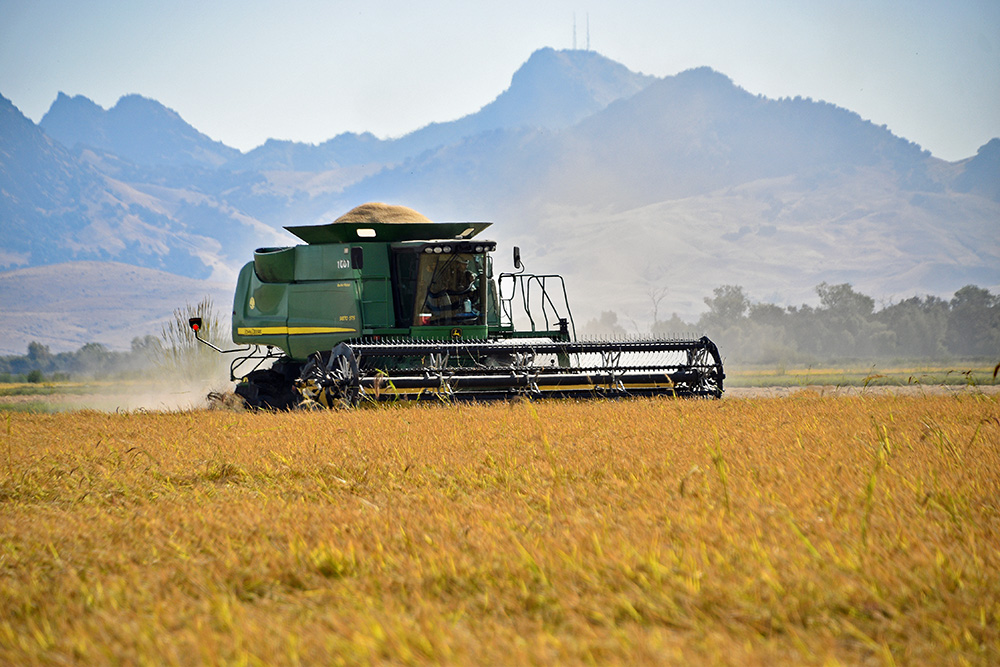
A field of M-105 rice is harvested in Colusa County.
Photo/Vicky Boyd


By Vicky Boyd
The California Cooperative Rice Research Foundation released the better-milling M-212 Calrose medium-grain rice variety this season to replace M-211, which has some agronomic challenges. At the same time, the foundation plans to retire the 23-year-old M-206 Calrose variety.
The goal is to limit the number of Calrose varieties grown in the state to five to minimize variability at mills, where medium-grain loads are frequently commingled, said Dustin Harrell, director of the Rice Experiment Station in Biggs.
Calrose is the most widely grown type in the state and occupies more than 95% of rice acres this season.
While all Calrose must meet a definition that includes grain length, kernel shape, starch content and cooking quality, each variety differs slightly. Having too many varieties with variations may complicate milling and processing, Harrell said.
“We don’t want to introduce a lot of variability into the end product,” he said. “We’re very focused on the quality of our Calrose market because we’ve earned notoriety around the world for our good product.”
Photo/Vicky Boyd
M-212 joins M-209, M-210, M-105 and M-521 as approved Calrose varieties. With M-206 and M-211 slated for retirement, 2026 is the last season that Harrell is growing foundation seed of the two at the Rice Experiment Station. Seeds for M-206 and M-211 will not be available after the 2029 season.
Released in 2020, M-211 quickly became popular because of its high yield potential. But the variety frequently had lower milling yields caused by fissuring or cracking, especially if growers harvested it below 18% moisture.
Milling yield refers to the ratio of whole kernels to the total amount of rice obtained from 100 pounds of rough rice straight out of the field. Whole kernels, which can go into consumer packaged rice, bring mills the most revenue. The less-valuable broken kernels typically go to other uses, such as pet food, rice flour or beer brewing.
M-211 also has had problems with chalk, a harmless but undesirable white kernel discoloration caused by high nighttime temperatures.
Alex Struckmeyer, who grows field crops in Colusa County, acknowledged he will miss M-211 because of its high yield potential. But he said he understood the industry’s need for a variety with more stable milling quality.
“211 is great, but it doesn’t help the other half of the industry if you can’t mill it and keep the quality up, so it affects everybody,” Struckmeyer said. “If it’s a variety that’s finicky and particular, you need to have it move along. You always have to keep trying to improve.”
Eric Willson, farm manager of a Yolo County family operation, said he was upset to hear the foundation was retiring M-206, which he described as “the best commercial” variety.
Harrell has heard similar comments since announcing the variety’s retirement, but he said M-210 offers an alternative because it is essentially M-206 with a gene resistant to blast.
Photo/Vicky Boyd
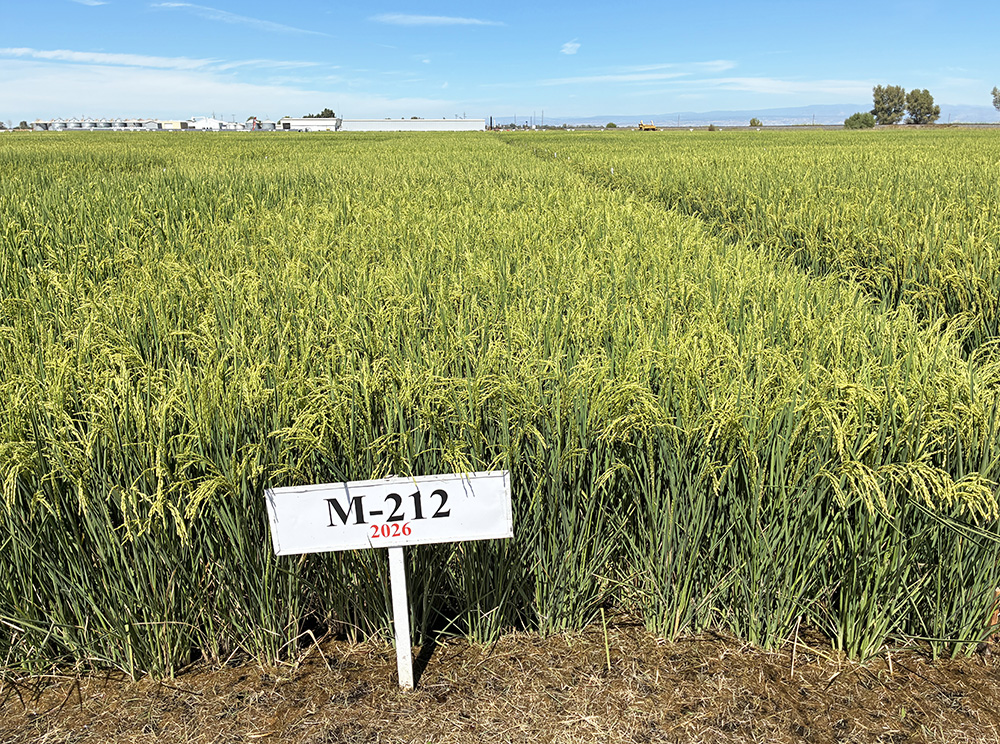
During the past two years, the Yolo County farm has hosted yield trials that included M-212, allowing Willson to see firsthand how it performs.
“It looked good last year and good again this year,” he said. “But remember, these are just 10-by-10 plots.”
The operation also commercially grows M-211 conventionally and organically.
“The milling was very disappointing on the conventional with cracking and brokens,” Willson said about the 2025 season.
Because the farm’s organic crop is sold as unmilled brown rice, it doesn’t undergo any processing after husking. As a result, he said he took advantage of M-211’s high yield potential without enduring low head rice issues in the farm’s organic fields.
From medium-grain breeder Teresa De Leon’s program, M-212 averaged 9,274 pounds per acre during a five-year statewide yield trial—similar to M-211 but about 4% more than M-210. The newcomer also has two blast-resistance genes, giving it stronger disease resistance than M-210, which has only one blast-resistance gene. Both traits were incorporated through traditional breeding.
M-212 takes longer to mature, averaging about four days later than M-210 but two days earlier than M-211, Harrell said. Much like M-210 and M-206, the newcomer is widely adapted and performs well in the cooler and warmer production areas.
Where M-212 excels is in milling, yielding 67% head rice and 70% total when harvested between 18% and 22% moisture. The data come from yield stability-moisture trials, where technicians take kernel samples ranging from 26% to 14% moisture and mill them. But Harrell cautioned about the limitations of their production data.
“Again, this is all small-plot research, and you never know what will happen until you get it out on more acres,” he said.
The Rice Experiment Station this season is growing 50 acres of M-212 foundation seed, which should produce about 4,000 100-pound sacks if everything goes according to plan, Harrell said. This will allow rice seed producers to grow about 2,500 acres of registered seed in 2027. By the 2028 season, he said there should be enough registered and certified seed to plant about 135,000 commercial acres.
De Leon isn’t stopping with M-212 and is looking at two very early-maturing lines as potential replacements for M-105. Released in 2011, M-105 is one to five days earlier than M-206, depending on where it’s grown.
Although M-105 has good yield potential, it is prone to lodging and susceptible to blast disease. Harrell said any potential replacement is still several years away.
The rice foundation this season also released Calamore-201, an arborio-type specialty rice used in dishes such as risotto. The new release has a significantly higher yield potential than the decades-old arborio variety grown in the state.
Although Calamore-201 can still lodge, Harrell said it has much stronger straw strength than traditional arborio. The newcomer also is glabrous, meaning the kernels and leaves are smooth and lack minute hairs that irritate and can complicate handling.
In addition, the foundation this season released Calamylow-202, a short grain with low amylose. A naturally occurring starch, amylose at low levels contributes to rice stickiness.
Harrell said Calamylow is intended for commercial uses, where it’s typically mixed 50-50 with Calrose for products kept in food service refrigerator cases or vending machines. The lower amylose maintains a glossier kernel appearance and slows the rice from drying out.
Vicky Boyd is a reporter in Modesto. She can be reached at agalert@cfbf.com.
Reprint with credit to California Farm Bureau. For image use, email agalert@cfbf.com.