


Growers harvest short pistachio crop as costs mount
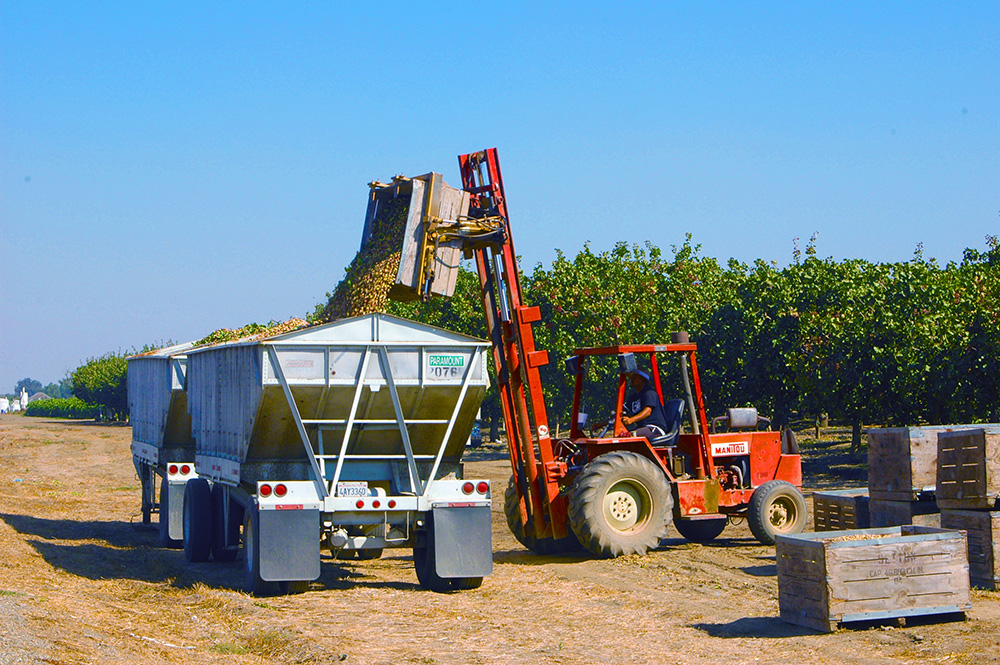
Pistachios are harvested at a Madera County orchard. The 2026 pistachio crop was already expected to be smaller because of an “off” year in the trees’ alternate-bearing production cycle. A March heat wave further reduced the crop by sterilizing much of the male-shed pollen and causing increased kernel blanking.
Photo/Vicky Boyd


By Vicky Boyd
A March heat wave and the natural tendency of pistachio trees to alternate-bear combined for a perfect storm that may reduce the 2026 harvest to less than half the record 2025 crop.
While the market has responded with higher grower prices, they may not make up for the short crop, said Jeff Nichols, vice president of supply chain and grower relations with Nichols Farms in Hanford.
“It’s a challenge for the industry overall because the crop is half of what was expected, but the (grower) price isn’t going to double,” he said. “Overall, the crop revenue to the grower is going to decrease.”
The family-owned Nichols Farms grows conventional and organic pistachios in the southern San Joaquin Valley and runs a hulling and processing facility in Hanford.
Describing the crop as “terrible,” Jason Giannelli, director of farming for R&G Fanucchi Inc. in Kern County, said the farm’s 150 acres of the Kerman pistachio variety yielded an average of 200 pounds per acre. Industrywide, yields can range from more than 3,000 pounds per acre during “on” years and about 2,000 pounds per acre during “off” years, according to American Pistachio Growers.
Giannelli said the farm shook the trees once compared to the industry standard of two times and plans to file a crop insurance claim.
“It’s not ideal, but it’s the only way we can survive,” he said.
Giannelli manages another 150 acres of the Golden Hills variety, and he said those trees averaged 2,800 pounds per acre, which he considered good this year. He blamed the Kerman variety’s poor set to timing of bloom during the heat wave. Regardless, Giannelli said the farm continues its normal cultural practices this season.
“We still have to grow a crop for next year, hoping that the crop is going to be better than this year,” he said.
The light crop comes as growers face mounting financial stress from crop inputs, including diesel, fertilizer and water, said Rich Krebs, a Madera-area pistachio grower who also works as a certified crop adviser and president of Ultra Gro, a fertilizer manufacturer in Madera.
“A lot of my growers—and they’re not huge growers—are going to lose a couple million dollars,” he said.
In January, pistachio industry members estimated a 1.2-billion-pound crop because 2026 is an “off” year in the trees’ alternate-bearing production cycle. During 2025’s “on” year, growers harvested a record 1.57 billion assessable pounds, according to receipts data from the Administrative Committee for Pistachios.
With harvest nearly finished, the 2026 crop appears to be about 655 million pounds, Nichols said, citing industry data. Pistachio quality looks good, with little insect damage or staining, although kernel size is smaller.
In response to the reduced crop, agricultural commissioners in Fresno, Kern and Tulare counties this past summer requested the state Office of Emergency Services seek a U.S. Department of Agriculture disaster declaration for pistachio growers in their areas. Together, the three counties estimated damage to more than 337,700 acres, amounting to more than $839 million in losses.
If approved, the declaration would also apply to adjacent counties and would allow pistachio growers to apply for low-interest loans and loan deferrals, among other benefits.
The industry attributes the short production to the 10 days of 90-plus-degree temperatures in March that led male pistachio trees to bloom early. The heat also sterilized the pollen shed by male trees and caused buds on female trees to drop.
This resulted in significant blanking, or missing nut kernels, more unsplit shells and much lighter yields.
“These were unprecedented weather conditions this year,” said Jeff Gibbons, director of grower relations with Setton Pistachio of Terra Bella in Tulare County.
The heat impacts were widespread throughout Arizona and areas south of Madera in California. Although nut fill was better in areas north of Madera, he said it was still generally weak.
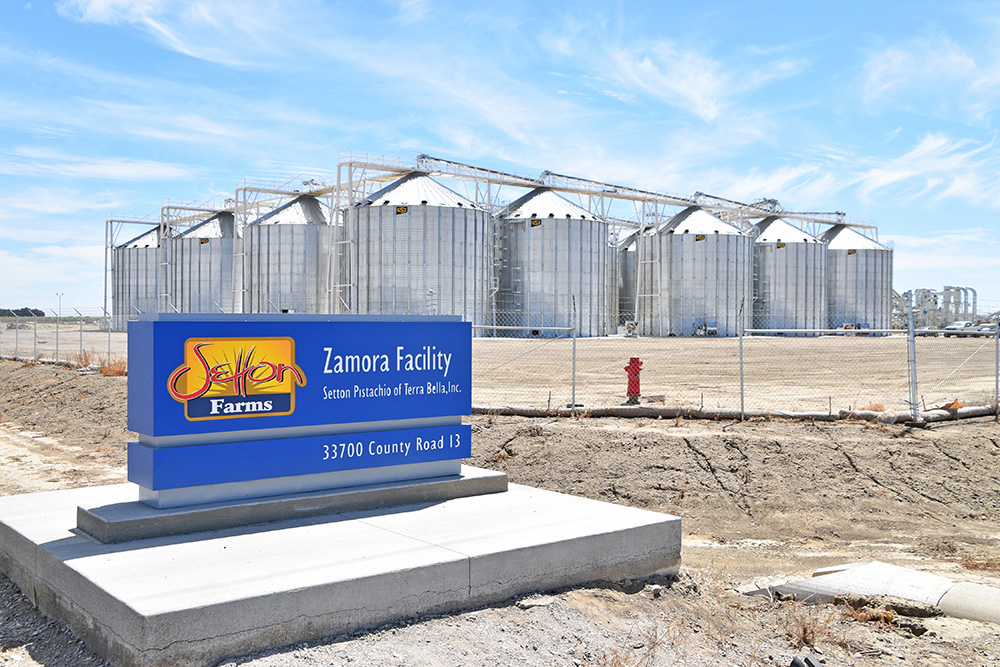
In anticipation of increased production in Northern California, Setton Pistachio years ago began planning a hulling and drying facility near Zamora north of Woodland, Gibbons said. Pistachios must be hulled within about 24 hours of harvest to avoid shell staining, and the Zamora facility would help Setton reduce travel time to the huller for the North State crop.
Photo/Vicky Boyd
Opened before the 2025 season, the facility hulls, dries and stores pistachios. After the first season, Setton Pistachio in Zamora doubled to 20 the number of stainless-steel storage silos and added a second receiving pit before the start of the 2026 harvest season. Gibbons said it should help handle future production increases.
Marketing this year’s small crop will be a balancing act as Nichols said buyers tend not to mind higher prices as much as volatile prices. Nichols Farms plans to allocate supplies for its longer-term customers because it won’t be able to meet all the demand.
“Obviously, we won’t take on any new customers,” he said. “Some of the demand is going to be reduced with the price increases.”
In August, Lost Hills-based Wonderful Pistachios announced it was raising prices, although the exact amount consumers pay will vary because it is set by individual retailers, said Michael Hohmann, Wonderful Pistachios executive vice president and chief financial officer.
“We do expect prices to increase because there are simply fewer pistachios coming out of California this year,” he said in a written statement. “But the impact consumers see at checkout will be much smaller than the impact growers are feeling from the reduced crop.”
Krebs, an American Pistachio Growers board member, said the small crop is disappointing because the industry has done a great job increasing worldwide demand by promoting the nut’s healthy nutritional profile. Iran and Turkey, the world’s second and third largest pistachio producers, respectively, also are expected to harvest smaller crops.
Retaining customer loyalty will be important because 2027 is expected to be an “on” year for U.S. producers, Nichols said. Depending on bloom and an industry average production of 3,200 pounds per bearing acre, he said growers have the potential to produce between 1.76 billion and 1.9 billion pounds next season.
Diana Salsa, Wonderful Pistachios vice president of marketing, agreed, saying marketing pistachios is a long-term business: “And you can’t turn consumer demand on and off based on the size of one year’s crop,” she said in a statement.
“In fact, it’s especially important that we maintain that visibility now,” she added. “We could be looking at a record crop in 2027, potentially exceeding 1.9 billion pounds, so we need consumers around the world thinking about pistachios and wanting pistachios when that supply comes to market.”
Vicky Boyd is a reporter in Modesto. She can be reached at agalert@cfbf.com.