


Past job prepares farmer for managing family business
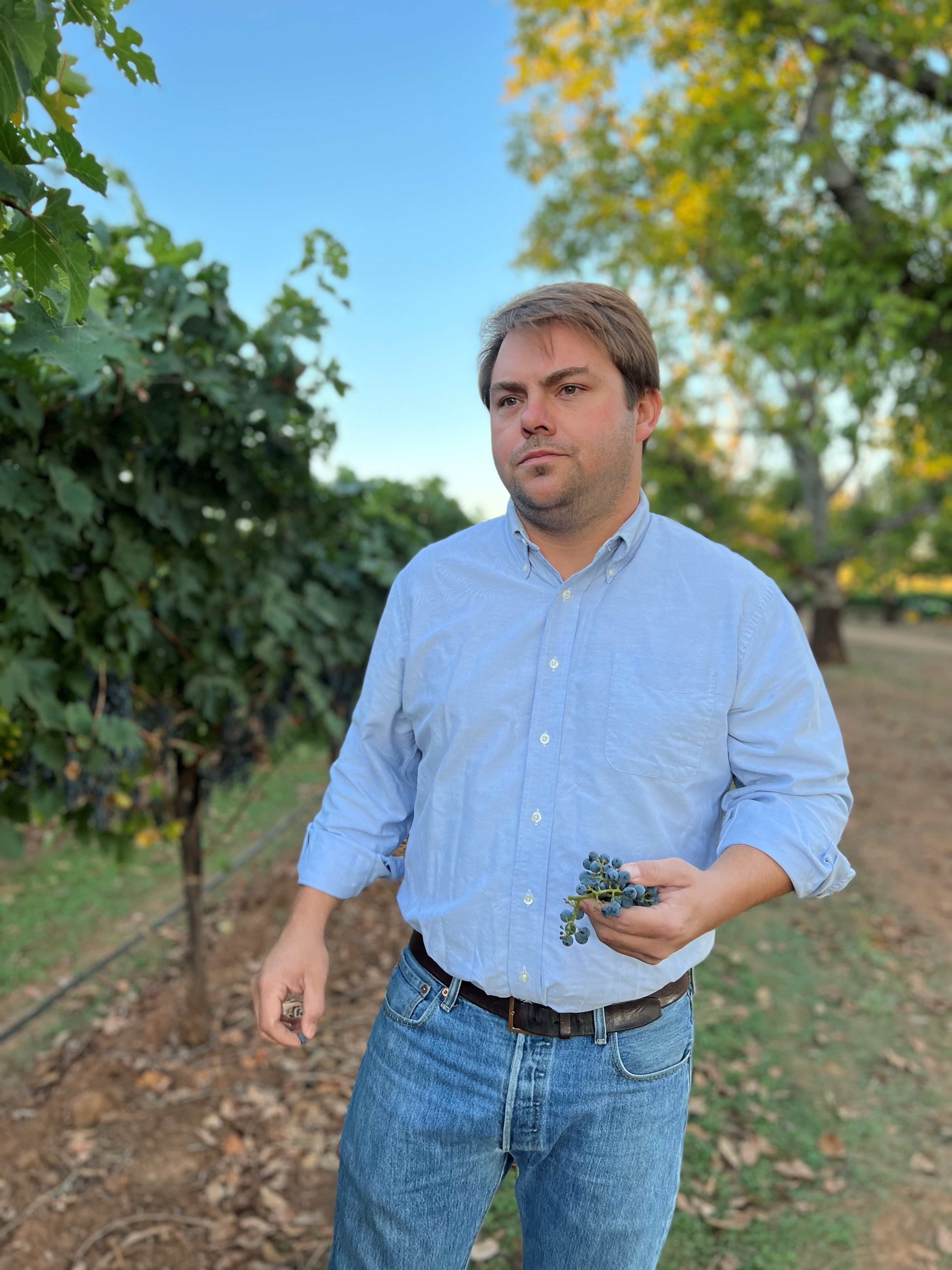
Will Weiss, assistant general manager of Bella Vista Farming Co. in Lake County, prepares to taste a winegrape to determine its brix and phenolic ripeness.


By Ching Lee
(This is the second of a three-part series highlighting individuals in California Farm Bureau’s Young Farmers & Ranchers program.)
With the labor-intensive crops his family grows—pears and winegrapes—Lake County farmer Will Weiss manages people as much as he manages trees and vines.
As assistant general manager of his family’s business, Bella Vista Farming Co. in Kelseyville, Weiss works with 50 year-round employees. During pear harvest in August, his crew swells to 150 to 200 people, relying on seasonal workers to get through the crunch.
In addition to its own farming, the company develops vineyards for other clients and does custom harvesting and trucking. It was one of the first vineyard management companies in Lake County to offer nighttime harvest by hand.
To secure the workforce it needs, Bella Vista works with labor contractors and is a labor contractor itself, so that it can navigate the complex H-2A temporary agricultural workers program. With this expertise, the company now supplies labor to its own farms and to other farms.
That part of the business, Weiss said, has “all been an evolution.” As the company considers its future in pears and winegrapes, labor remains top of mind.
“I think it would be silly to say that we do not think about the availability and ability of our labor force at Bella Vista Farming within the context of almost every business decision,” Weiss said.
From decisions about whether or how the business should grow to adding or removing clients to whether it should add a mechanical harvester, Weiss said they are all “tied to the folks we have available to do the work.”
This year, as the company moved into its pruning season for pears and winegrapes, Weiss said there was “a larger number of individuals” applying for work on the farm than there had been during the past two years. He pointed to the ongoing drought as a reason for the reduced crop acreages in the state, which reduced competition for agricultural workers.
Also, with the decline in value of the region’s cannabis crop, some growers planted fewer acres or did not plant at all, leaving “sufficient local workers to fill our needs,” he said. As a result, Bella Vista did not need to use the H-2A program, which in past years brought in two dozen employees for about 10 weeks to help with pruning or vineyard development.
Even before Weiss returned to the family farm more than two years ago, people management had become “the principal focus” of his work. Weiss worked for more than seven years as a journalist at CQ Roll Call, a trade publication that reports primarily on Congress with “heavy policy analysis.” There, he worked first as a reporter, then editor before assuming a director-level role in which he managed a team in India that followed U.S. regulatory and legislative information.
He got his start in journalism at the University of California, Los Angeles, where he worked as a student reporter while studying English literature. After college, he returned briefly to his family’s farm before moving to Washington, D.C., in 2011. He spent two years working on Capitol Hill for Congressman Mike Thompson, D- St. Helena.
“There was a period there where I was content with, if not eager to, build a life on the East Coast,” Weiss said.
But he did move back to California in the fall of 2019, working remotely for CQ Roll Call. By March 2020, he made the switch back to the family farm.
Since returning to farming, Weiss said he’s been “doing my best” to brush up on his Spanish, the language of many of his employees. The family business has “adjusted with the times,” working with clients who want their vineyards machine harvested and/or are making the switch to a more mechanical approach in the vineyard, including pruning.
Even though the family’s own vineyards are not mechanically pruned, he said, the company during the past few years has developed other vineyards that allow for mechanical pruning. The family does use mechanical grape harvesters, Weiss noted, adding if the farm were to do everything by hand, “we would need a considerably larger workforce than even what we have.”
“When growing winegrapes, your biggest costs throughout the year are absolutely harvesting and pruning,” he said.
As a board member of the Lake County Farm Bureau, Weiss said he and a couple of friends are trying to restart the county Farm Bureau Young Farmers & Ranchers chapter. The program comprises active agriculturists between the ages of 18 and 35.
Weiss said he attended the YF&R summer conference in San Luis Obispo, which he described as “useful and fascinating in all the ways that meeting other farmers from around the state always is.”
Having been to other trade-association meetings through the years, he said he appreciates being able to connect with a broad network of farmers and would like his local YF&R to serve as an opportunity for young farmers in the region to gather and share ideas.
“I hope to use YF&R as one more forum or avenue toward creating a community of hopefully cooperative and generally productive peers in the ag industry here in Lake County,” Weiss said.
(Ching Lee is an assistant editor of Ag Alert. She may be contacted at clee@cfbf.com.)





.svg.png)
