


Commentary: Ag Innovation competitors showcase farm solutions
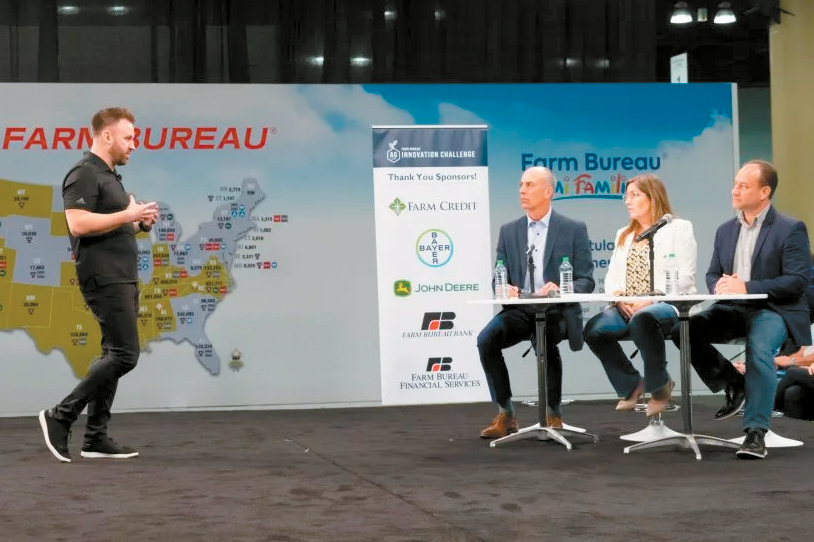
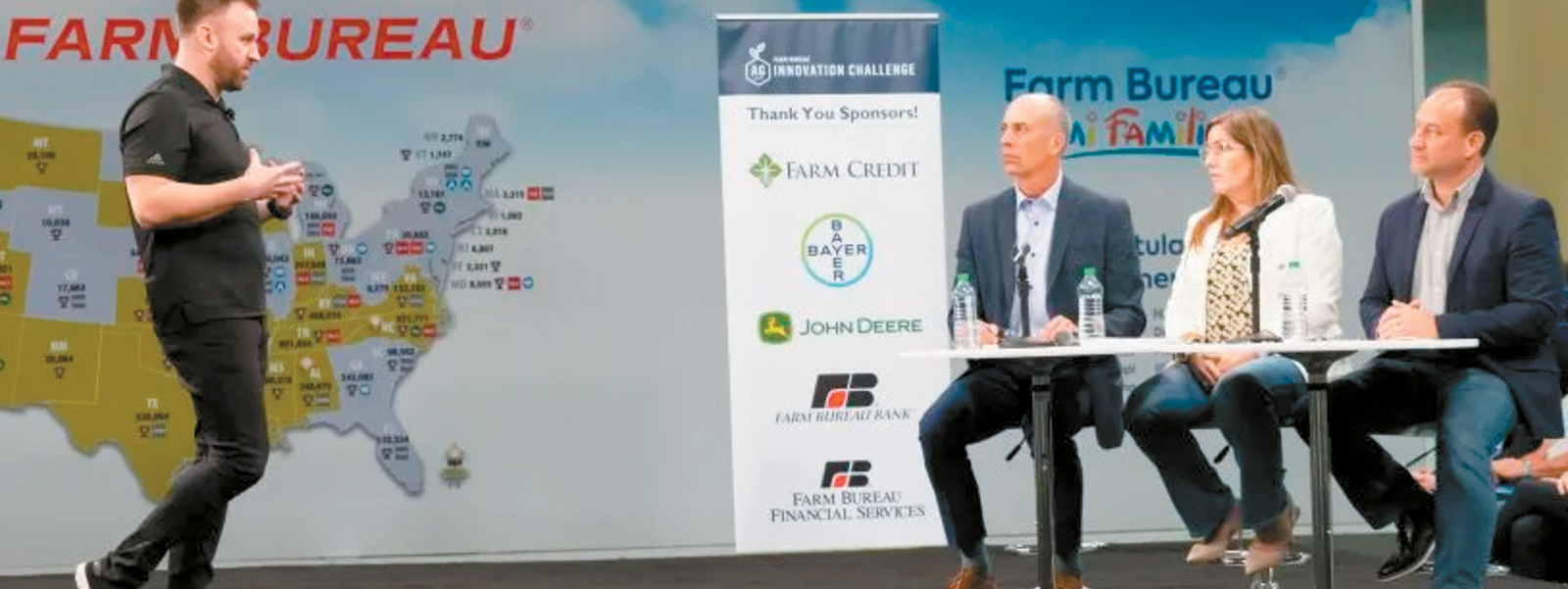
Austin Hausmann pitches to judges in the 2023 Ag Innovation Challenge. The Kansas Farm Bureau member’s team won top prize for technology to produce diesel exhaust fluid at the point of use.
Photo/Michael LoBiondo/American Farm Bureau Federation



By Zippy Duvall
One of the most rewarding aspects of my role in the American Farm Bureau Federation is the chance to see, firsthand, how farmers and ranchers across the country are developing and implementing new innovative solutions as we work together to feed, fuel and clothe the world.
These solutions are the driving force behind the resilience of American agriculture, and it’s important to recognize and celebrate the agricultural businesses that help get us there. Just as the businesses in our communities rely on us, we must also rely on them, working hand in hand toward one common mission.
That is why nearly a decade ago, Farm Bureau created the Ag Innovation Challenge, a national business competition that showcases startups and their innovative solutions to meet challenges on the farm. Launched in 2014, this competition was the first of its kind to focus on rural entrepreneurs. Now, thanks to a strategic partnership with Farm Credit and the support of our sponsors, we’ve been able to invest more than $1.3 million in agricultural businesses over the past 10 years.
Recently, we announced the top 10 teams in the 2024 Ag Innovation Challenge. They represent various regions of the country and will now advance in the Challenge. Each of these businesses focuses on helping farmers and ranchers solve the challenges we’re facing both today and tomorrow.
Many of the companies selected this year are working toward advancements in farm safety and efficiency. For instance, in California, UAV-IQ Precision Agriculture has designed a drone system for precise aerial releases of beneficial insects and mites to combat harmful pests.
In Iowa, Appanoose Manufactured Products found a solution to reduce on-the-farm fires by designing a portable device that provides on-the-ground fire suppression resources. In Nebraska, Idem Irrigation is developing a precision irrigation system for targeted water, fertilizer and pesticide delivery to improve water management.
Others are working in the field of animal agriculture to promote animal health and well-being. In Indiana, ReproHealth Technologies is enhancing bovine reproduction efficiency with a device for advanced continuous embryo culture media.
Udder Ways LLC, in New York, is improving sanitization for dairy cows with a new system to sanitize and prepare udders for milking. And in Texas, Smooth Ag is improving overall pasture management with autonomous robots that monitor livestock and alert farmers when health problems arise.
Lastly, several competitors have developed solutions for small and beginning farmers to grow their businesses. Anu, in Indiana, designed a Keurig-style device enabling consumers to grow their own produce at home. In Washington state, Share Farms has established a platform connecting minority, women and veteran farmers directly with potential buyers.
In Colorado, Barn Owl Precision Agriculture is supporting small and midsize farms with its autonomous robot that assists in planting, soil sampling, weed control and spraying. Lastly, in North Carolina, Secret Garden Bees is boosting the pollinator population and providing reintegration opportunities for veterans through their bee and honey operation.
These semifinalists can now take their innovations to the next level as they advance through the competition and build their networks. Next, they will participate in pitch training from Cornell’s SC Johnson College of Business and work directly with representatives of the U.S. Department of Agriculture Rural Business Investment Companies.
Then, in January, they will join us at the AFBF Convention in Salt Lake City, Utah, to compete in the final rounds of the Challenge on our trade show floor.
Farm Bureau will award $165,000 to support these 10 businesses. The Ag Innovation Challenge winner will earn $50,000 in startup funds provided by our sponsors, with $20,000 going to the runner-up, $15,000 going to two finalist teams and $10,000 awarded to the other six finalists to invest in their ventures. An additional $5,000 will go to the “People’s Choice Team”—with any of the 10 finalists eligible for the bonus prize chosen by public vote.
The final four teams will compete live in front of Farm Bureau members, investors and industry representatives. I hope you will join me there to cheer them on!
No matter who ends up taking home the top prize, we are excited for how these hard-working entrepreneurs are shaping the future. Their innovations, like many we have seen over the past decade, will help strengthen agriculture and lead us into new frontiers.
(Vincent “Zippy” Duvall, a poultry, cattle and hay producer from Georgia, is president of the American Farm Bureau Federation. This article is adapted from the Sept. 13 edition of his column, The Zipline, which appears online at fb.org/viewpoints. Some additional details were added on the Ag Innovation Challenge.)





.svg.png)
