


Young executive maps out solutions for desert farms
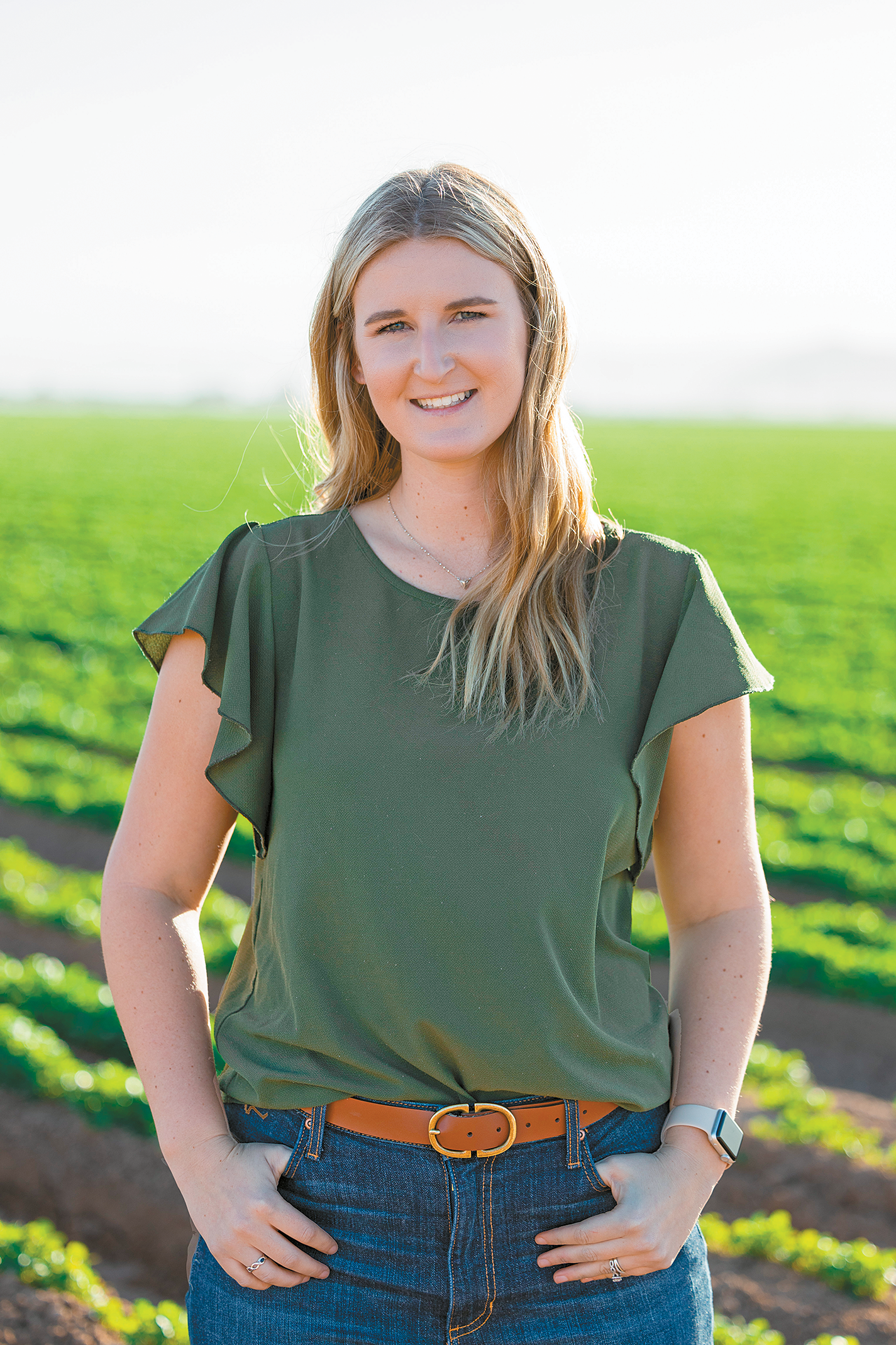
Shelby Trimm, executive director of the Imperial Valley Vegetable Growers Association and two other farm groups, works to solve problems for farmers and ranchers in her home county.
Photo/Courtesy Shelby Trimm



By Caleb Hampton
(This is the second of a three-part series highlighting individuals in California Farm Bureau’s Young Farmers & Ranchers program.)
Growing up in the Imperial Valley, Shelby Trimm always imagined a career for herself working in agriculture, perhaps following in the footsteps of her grandparents, who managed a cattle feed yard.
Trimm participated in 4-H and Future Farmers of America. When she started college, she planned to study agricultural business, eyeing a future in the cattle sector.
During her time at Oklahoma State University, she said she realized she “wanted something different” from running her own cattle business. After graduating in 2020 with a degree in agricultural education, Trimm moved back to the Imperial Valley and interned for the Imperial Valley Vegetable Growers Association, which had given her scholarships during college.
Soon after, Trimm became the association’s executive director. She is also the executive director of two other groups: the California Beet Growers Association and the Coalition of Labor, Agriculture & Business, or COLAB.
In these roles, Trimm advocates for farmers who drive the Imperial Valley’s economy and produce most of the nation’s winter vegetables.
“It feels so good to be able to represent the vegetable industry,” she said, referencing the wealth of knowledge of the region’s vegetable farmers and their central role in supplying the country with fresh produce in the winter. “To be considered the voice of it is incredible.”
Trimm’s day-to-day work as a director of three agricultural associations involves planning events, coordinating with members of the press, attending local government and irrigation district meetings, and communicating with farmers.
“I keep our members informed and work to keep elected officials familiar with the struggles our farmers are facing,” she said. “It’s a lot of advocacy and communication.”
While she works to make government officials aware of farmers’ challenges, Trimm isn’t afraid to step in and solve a problem herself when she sees a possible solution.
One of the biggest challenges Imperial Valley vegetable growers face involves ensuring food safety in a region where vast vegetable acreage coexists with a large number of livestock, from cattle ranches to flocks of sheep that graze the stubble of forage crops after the hay is harvested.
“A lot of forage growers (use) sheep (on) their fields, which is a huge food safety issue because sheep walk across the roads, and then tractors drive on those roads and get into vegetable fields,” Trimm explained. “That requires vegetable growers to be very careful of where they have their vegetable fields due to different regulations and requirements.”
Depending on the shipper a grower is working with, vegetable fields are required to be a certain distance, such as 1 or 2 miles, from the nearest feed yard in order to prevent contamination. Coordinating those distances in a landscape where crop rotations mean vegetable and forage-crop fields change location “has been an issue for decades,” Trimm said.
After learning about the problem, Trimm brought everyone involved to the table. “We sat down with everyone and tried to figure out the best solution,” she said. “The sheep herder said, ‘If I knew where the produce field was and I knew who to call, I would call them.’”
That gave Trimm an idea. In 2021, she created a Google map called the Produce Pinning Map. It plots all of the Imperial Valley’s vegetable fields,along with contact information for the manager of each field, so that farmers and ranchers could work together to ensure food safety. The map has more recently been updated to include feed yards.
“Vegetable growers pin their fields, so if a sheep herder is planning on putting sheep near a field, they will look at the map and say, ‘OK, the field that I want to sheep is within a mile of a vegetable field, so I’m going to look elsewhere,’” Trimm said. “It has really helped.”
The map’s success in helping farmers solve a difficult challenge has been a highlight of Trimm’s tenure leading the association.
“I’m really proud of the Produce Pinning Map,” she said. “That’s not to pat myself on the back. It’s really to pat all of the farmers on the back because the reason the map is successful is everyone is working together. The vegetable grower has to pin their field, the sheep herder has to look at the map and communicate, and the forage guy has to do the same. Seeing everyone work together to make it work is what I love most about it.”
She added that “growing the safest, freshest produce for the nation in the winter months is our absolute No. 1 priority.”
As the executive director of COLAB, Trimm works with board members from the labor and business communities, including construction companies, geothermal companies, labor unions and farmers.
“Any issue that a member has, we try to help with,” she said, adding that the association often acts as a third-party mediator to resolve problems for members. “For example, if one of our members thinks they are being unfairly targeted by regulators or inspected every single day, they could call me instead of having to go head to head with the regulating agency. I will do that for them.”
It’s another forum in which she can work collaboratively to find solutions. That the coalition brings together people from various sectors makes it even more rewarding, she said. “It’s pretty rare that you sit in a room with so many different people from different industries,” she said.
Given her passion for collaboration, Trimm has also cherished her experience with California Young Farmers & Ranchers, where she represents Imperial and San Diego counties on the program’s State Committee.
“Just knowing I have friends throughout the state of California because of the program is pretty cool,” she said. “The fact that everyone is already interested in agriculture means you have common ground. I’ve really loved my experience so far.”
Going forward, Trimm said she hopes to get more involved in her local community. She said she values the opportunities her director roles give her to make a difference for farmers.
“I don’t like just sitting around and waiting,” she said. “I like to be proactive.”
(Caleb Hampton is an assistant editor of Ag Alert. He may be contacted at champton@cfbf.com.)





.svg.png)
