


What are important winter sanitation steps for tree nuts?
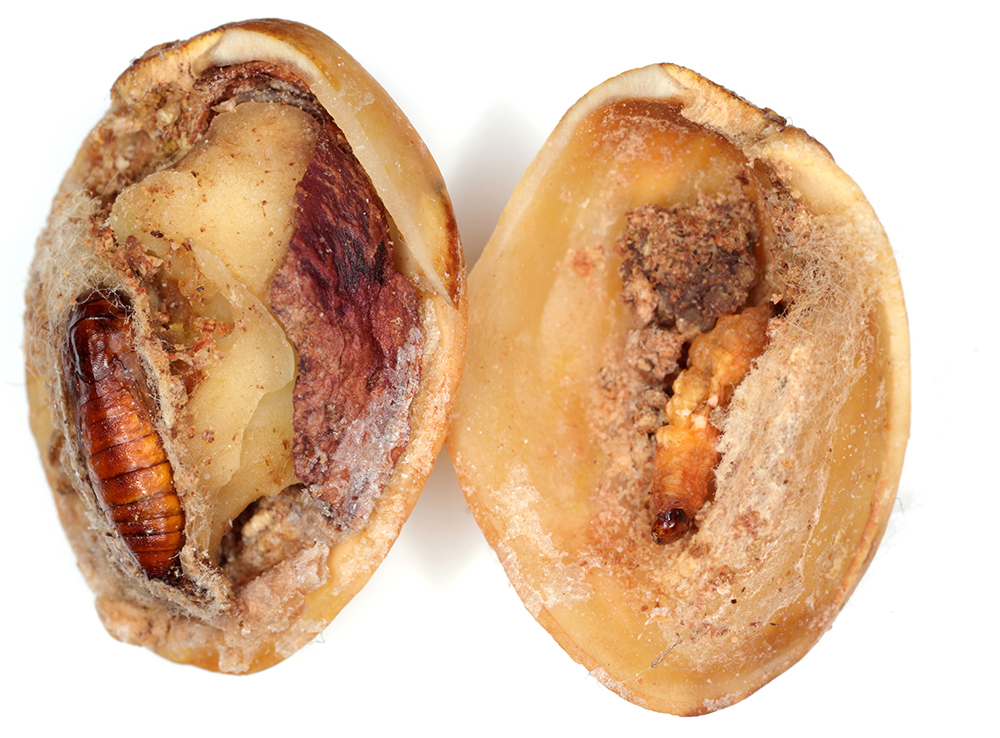
Orangeworm in pistachios
Photo/Licensed image


Justin Nay
Integral Ag Services, Durham
Winter sanitation remains one of the most critical steps in managing navel orangeworm in almonds, pistachios and walnuts. It forms the foundation of an effective program.
Reducing mummy nuts to two or fewer per tree is usually sufficient to make a single hull split spray effective—provided neighboring orchards are also practicing good sanitation.

Effective sanitation goes beyond tree shaking. It also involves sweeping, blowing and destroying the mummy nuts before the end of March. Almond growers are resistant to hand poling, which entails removing mummy nuts by using a long pole to knock mummified nuts off trees, because it is labor-intensive, costly and difficult to ensure quality work. But it still pays to sanitize with poles.
For pistachios, it’s a little different because most of the mummies with nut meats drop on their own by the end of January. That means growers can focus on blowing the berms, then chopping and shredding the mummies. If heavy rain has left nuts jammed into the soil or if a hump has formed in the middle of the aisle after years without leveling or smoothing the orchard floor, then blowing alone is usually not sufficient.
Winter sanitation is more complicated in walnuts. For navel orangeworms to infest walnuts, they need an access point—from sunburn or damage caused by husk fly or codling moth—that allows entrance into the nut. Once inside, the pest will build populations.
The Carpophilus truncatus beetle has become an issue for almonds and pistachios, making it even more important to remove mummy nuts by sweeping, blowing and destroying them. Doing so effectively helps limit the beetle and navel orangeworm.
Despite its high cost, sanitation remains the single most effective step against navel orangeworm. Without it, insecticide applications—ranging from $60 to $100 an acre—are not enough to achieve the low damage levels to meet market quality standards.
Bottom line: No spray program will replace effective winter sanitation.
See related news stories...
• Ask Your PCA: When and how should Ethephon be applied in walnuts?
• Ask Your PCA: What progress has been made to eradicate citrus greening?
• Ask Your PCA: What are ways to keep NOW levels in check in pistachios?





.svg.png)
