


Natural wine trend revives old-fashioned methods
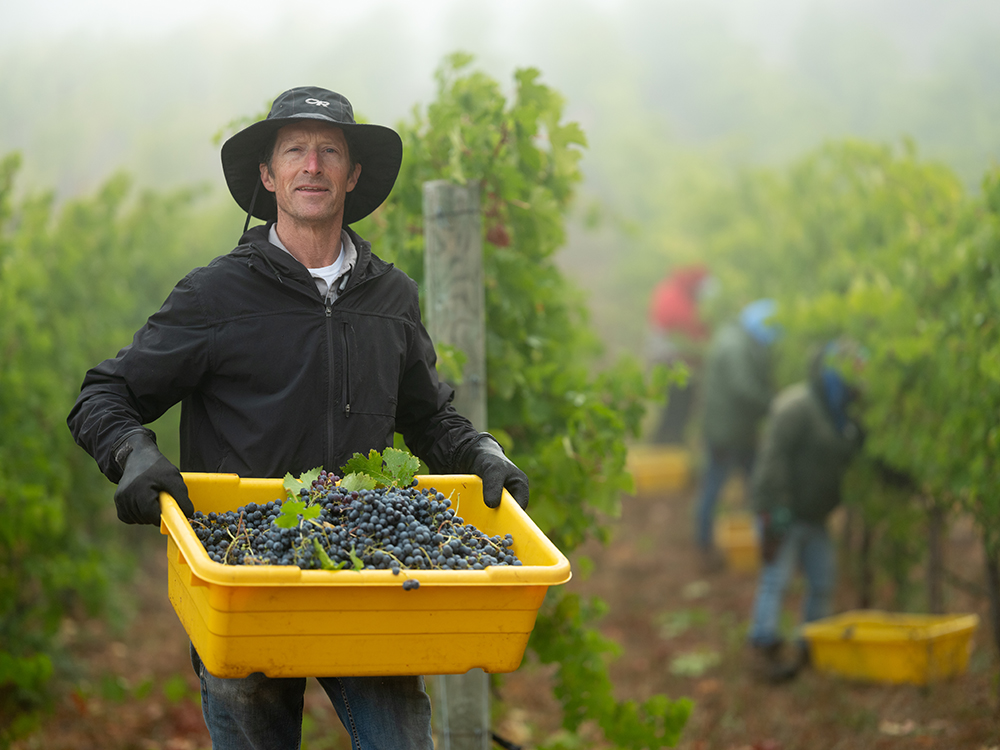
Darek Trowbridge of Old World Winery in Sonoma County makes wine the way it was done hundreds of years ago, growing the grapes on vines planted by his great-grandfather.
Photo/Paige Green


By Stacey Vreeken
Sometimes you need to go backward to move forward. The natural wine movement is a prime example of this philosophy.
A cadre of grape growers and winemakers—including Darek Trowbridge of Old World Winery in Sonoma County’s Russian River Valley—crafts wine as it was made hundreds if not thousands of years ago. No filtering, no fining, no additives. Just grapes, wild yeast, a barrel and time.
Trowbridge’s passion for simple living is evident at his Fulton home, where a small vineyard, winemaking space and tasting room welcome curious customers. He shares his philosophy with visitors and in the documentary “Living Wine,” which explores how natural wine is made the old, old-fashioned way.
For Trowbridge, it begins with 85-year-old Abouriou vines planted by his great-grandfather, Giuseppe Martinelli, in a nearby family-owned vineyard.
“Abouriou came from the Basque region,” he said of the heavy-bodied red varietal.
Trowbridge farms biodynamically—an organic practice that treats the vineyard as a living system in which soil, microorganisms, water and climate are all connected.
In contrast to most modern-day methods, he uses a practice called head training, which allows vines to grow freely from the trunk without a trellis. He also mows rather than tills the soil and spreads composted mulch of his own design at the base of the vines to conserve water, boost nutrients and increase yield, he said.
“This is a beautiful way to grow a vine on its own,” Trowbridge said. “Just let it be. Let it do its thing, organically. And it works.”
He applies these methods, which he describes as regenerative farming, across several properties, including his home vineyard, private-client sites and a 120-year-old vineyard also planted by his great-grandfather.
Old World Winery takes its name not only from its methods but from the legacy of the vines and Trowbridge’s winemaking ancestry.
And while this may be your great-grandfather’s wine in terms of history, it’s nothing like the wine you’ll find on a supermarket shelf or, for that matter, in a typical tasting room. A hazy chardonnay that tastes tart and fruity? You might even say it’s an acquired taste.
“In wine, those flavors have come to be out of fashion,” said Trowbridge, who has a bachelor’s degree in viticulture from Cal Poly, San Luis Obispo, and a master’s in winemaking from California State University, Fresno. “There’s 8,000 years of proved natural wine history, so that’s just the same methodology we’re using now.”
In crafting what are called low-intervention wines, Trowbridge aims to “use the least amount of machinery as possible, doing as much by hand as we can and then using just the native (wild) yeast and no additives, just sulfur,” he said.
He explained that early organic wines in the 1980s paved the way, but without sulfur, they often turned to vinegar. Natural winemakers have since refined their methods to create more stable results.
“You could call me an early adopter,” he said. “I started this winery in 1998, and at that time, there was no such term as natural wine. Nobody knew what that was.”
Still, these higher acid wines don’t fit the mass-market mold.
Natural wines that use wild yeasts—already present in the vineyard and not added to the winemaking process—take time to ferment and have a lot of variability. This makes them unsuited to a manufacturing process, which uses specific commercial yeasts and other additives to regulate flavor, speed processing and stabilize the wine.
Photo/Paige Green
“Natural wine is basically saying we don’t want (to use) those compounds,” Trowbridge said.
When Trowbridge first tasted a wine using wild yeast, his palate “came home,” he said, because it reminded him of the homemade wines he grew up with.
He’s also noticed that low-intervention wines are gentler on his health—and wine lovers who sometimes have adverse reactions may find natural wines do not trigger them. That includes Megumi Cusick, Old World Winery’s special events coordinator.
“I myself have a severe allergy to red wine,” she said. “My entire body would break out in rashes, and my doctor even told me to give up drinking my beloved wine. At that time, I saw a sign for natural wine and stopped by Darek’s winery. At first, I was puzzled because the taste was completely different from other wines. Even after drinking it several times, I didn’t get a rash. This is how I encountered natural wine.”
At Old World Winery, the winemaking process is about as traditional as it gets.
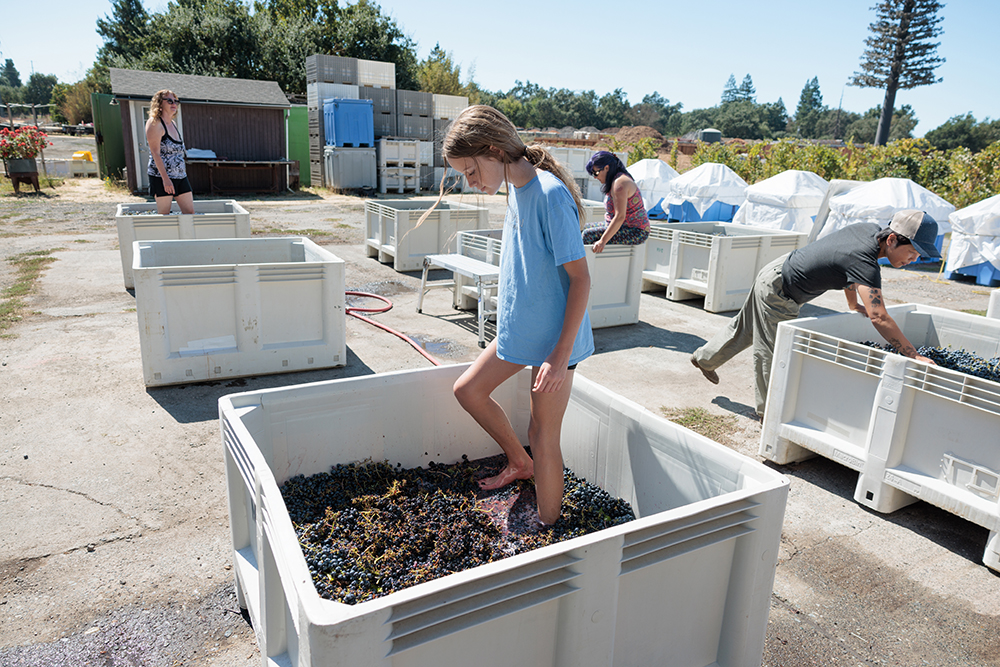
After harvest, the grapes are turned into juice by the power of feet—from a group of supporters who show up to stomp the grapes in bins. Depending on the type of wine made, stems and grape skin may remain with the juice during fermentation. Then it’s pressed and poured into different vessels for aging. The sulfur is added at the end, and that’s about it.
“Some part of natural wine is … people liking lower-alcohol, higher-acidity wines. That is what the majority of natural wines tend to be: brighter flavors, fruit juicy, high acid, low alcohol,” Trowbridge said. “It can be summed up in that category, if you will, but there’s so much more that’s possible.”
These small-batch wines pair well with food, he pointed out, and their unique flavor profiles attract devoted followers. That’s where the new comes in. Trowbridge describes his customer base as “really young.”
“They say millennials don’t drink wine. Well, that’s not true. They just don’t drink conventional wine, and they want low-alcohol natural wines,” he said. “Here we are building a unique market.”
While the natural wine trend is still emerging in California, Trowbridge noted it’s been established for years in New York and Quebec.
In France, “they’ve had a continuous never-broken period of natural winemaking,” he said. “Before 1918, all wine was natural.”
In the United States, according to Trowbridge, the traditional wine culture has been cleaved by Prohibition and modernization.
“Natural wine has to recover in a way that makes it look like this new kid on the block, this new thing, when there’s absolutely nothing new about it,” he said.
Stacey Vreeken is a reporter from Santa Cruz County. She can be reached at agalert@cfbf.com. This story originally appeared in the Fall 2025 issue of California Bountiful magazine.
See related news stories...
• Napa vineyards helped douse Pickett Fire
• Low prices, other woes put squeeze on farm economy
• Abandoned crops bring pest plague to adjacent farms






.svg.png)
