


State proposal to require reporting on treated seeds
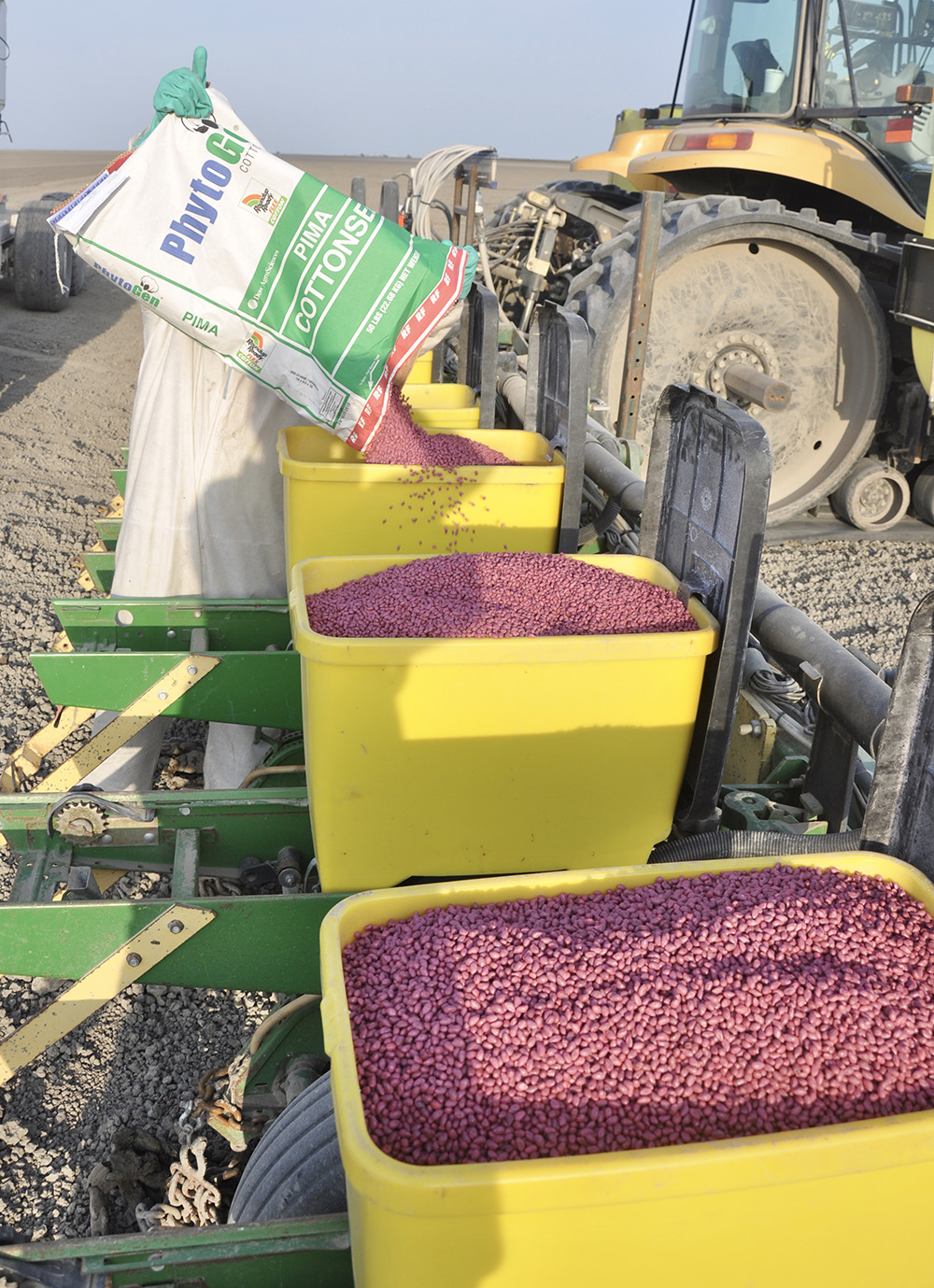
Seed companies color seeds to remind employees they are handling a pesticide-treated product and should use proper safety steps. The coloring also distinguishes between seed types and alerts end users that the seeds have been treated and cannot be used as feed.
Photo/Fred Rehrman


By Vicky Boyd
The California Department of Pesticide Regulation plans to add pesticide-treated seeds to the monthly use reports growers already must file with county agricultural commissioners.
As part of the proposal, the state would also limit seed treatments to those products registered both federally and by the state, said Jill Townzen, DPR Pesticide Evaluation Branch chief, during an informal online workshop last month.
Under a lawsuit settlement between DPR and environmental groups, the state must develop and finalize a rule to label and track pesticide-treated seed use by Jan. 1, 2027. The webinar marked an initial step of developing the rule.
The state’s efforts do not cover seeds treated solely with micronutrients, coatings that increase planting efficiency or other nonpesticide products.
Under the draft proposal, pesticide-treated seed would be considered pesticides exempt from registration. They would be managed like any application of an exempt pesticide product, except that DPR will require monthly pesticide use reporting.
In addition, the fields where pesticide-treated seeds are planted would be considered treated fields, and pesticide handler training would be required, according to DPR. The rule is expected to take effect Jan. 1, 2027.
Paul Sanguinetti, who farms tree and row crops with his sons near Stockton, said not all the row crops they plant carry pesticide seed treatments. For example, the wheat and barley he was planting this year were not treated.
But for years they’ve relied on pesticide treatments on corn seed to control soil-borne pests such as wireworms. Should the proposal be adopted as written, Sanguinetti said it would add more recordkeeping at times to an already cumbersome task.
“It’s a job that somebody has to make sure gets done,” he said. “We have to be sure to write it all down. It’s another reporting job when you’re trying to plant.”
Adding pesticide safety training won’t be a big burden, Sanguinetti said, because he already conducts it for all his workers.
The California Agricultural Commissioners and Sealers Association has met with DPR to discuss the treated-seed proposal, said Fresno County Agricultural Commissioner and CACASA President Melissa Cregan. Based on their conversations, she said she believed the group opened the state’s eyes to some unintended consequences.
“I’m anticipating some changes,” Cregan said. “If we don’t, I’d actually be surprised.”
Once the rule goes into effect, she said she and fellow agricultural commissioners will likely see increased paperwork, as not all growers submit pesticide use reports electronically. Should a seed treatment not be registered in California, she said agricultural commissioners would have to spend additional time investigating and determining possible enforcement actions.
Overall, Cregan said she and fellow agricultural commissioners rarely receive health-related reports about treated seeds or complaints about their use. Nevertheless, she said the treated-seed data DPR will collect through pesticide use reports will provide real-world data on which it can make more informed decisions in the future.
“I think we’ll be able to validate if treated seeds are having a positive or negative effect, because we’ll be able to look at the amount and from that determine how many pounds of pesticides are being applied. I think that will be the value,” she said.
DPR continues to receive public pressure to ban certain pesticide-treated seeds. Without data showing how much pesticide enters the environment through treated seed, Townzen said they’d be flying blindly if they tried to develop mitigation measures.
Pesticide seed treatments have been used extensively on many crops to protect seeds and germinating seedlings from soil-borne and foliage-feeding pests, giving plants a strong start. Typically, the amount of pesticide applied to seeds is significantly less per acre than if the same product were applied as a foliar spray to the crop. Many seeds are sold pretreated with the products applied by seed companies, although some agricultural chemical dealers or other businesses offer custom applications.
While treated seeds are not registered, the pesticides used on them need federal and DPR registration under the proposal. Currently, 253 pesticides are approved as seed treatments in California, with fungicides accounting for about 75% of those.
DPR first began exploring pesticide-treated seeds in 2021 to determine how widespread use was, the crops on which they were used and the counties in which they were most common. It received more than 8,000 comments from an online workshop on the issue, Townzen said.
In the meantime, several environmental groups petitioned the U.S. Environmental Protection Agency to amend its treated article exemption to exclude treated seeds. The exemption regulates pesticides used to treat products such as wooden power poles or seeds and not the actual items themselves.
The EPA denied the petition in 2022, finding that the exemption was appropriately applied. The environmentalists then filed suit in the U.S. District Court for the Northern District of California, which upheld the EPA ruling.
In February 2023, the groups filed suit against DPR, seeking to close what they claimed was a loophole allowing treated seeds to avoid regulation. The treated-seed proposal is the result of a court settlement with DPR in October 2024.
The proposed rule is paired with Assembly Bill 1042, introduced by Assemblymember Rebecca Bauer-Kahan, D-San Ramon, and signed into law by the governor earlier this year. Starting in 2027, the legislation requires all bags of treated seed sold in the state to be labeled with the pesticides used, quantity applied by weight or amount of seed and EPA reference numbers. The bill also mandates all pesticides used on treated seeds be registered by the state.
DPR is taking written public comment on its treated-seed proposal through Dec. 1 at https://cdpr.commentinput.com/?id=S9PiY8KeN.
Vicky Boyd is a reporter in Modesto. She can be reached at agalert@cfbf.com.
See related news stories...
• UC students breed new crop varieties for organic farms
• Cilantro trial tests herbicide to fight aggressive weed
• Fumigant study shows difficulty finding alternatives







.svg.png)
