


Filtration practices help to avoid costly irrigation issues
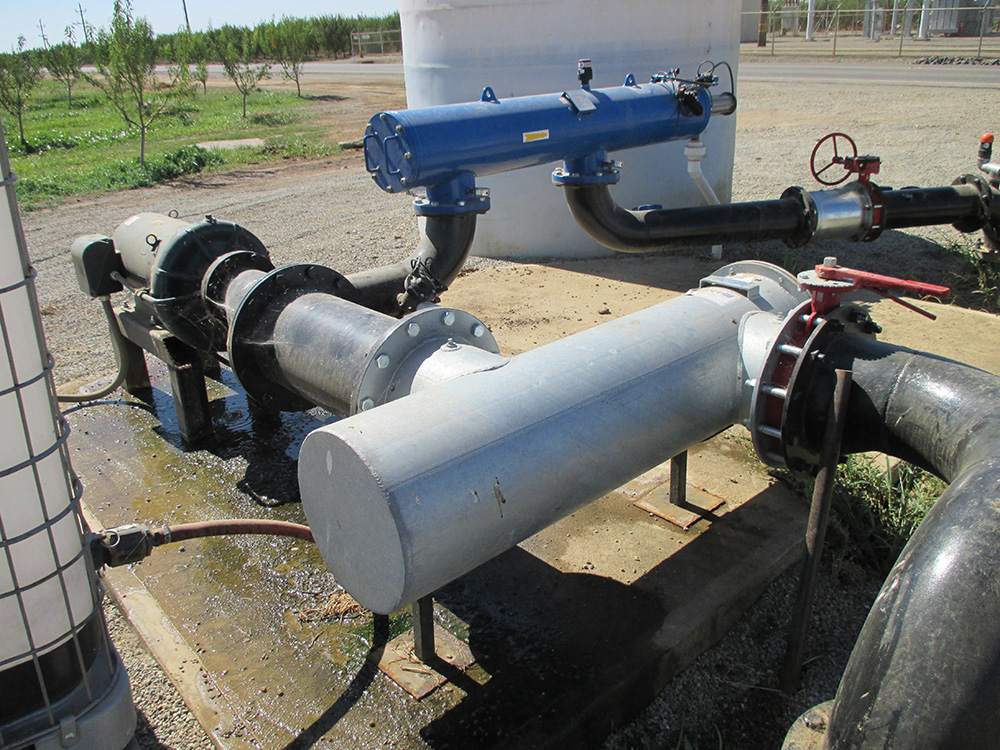
At a farm near Westley, a blue filter uses rotating wands to clean a fine screen during back flushing. A coarse screen protects the booster pump, requiring about 10 psi pressure.
Photo/Courtesy of Cal Poly, Irrigation Training & Research Center


By Charles Burt
To maintain top performance from your drip and microirrigation systems, start with excellent filtration.
If your water has a heavy sand or vegetation load, you usually need some type of pre-filtration, such as an overflow screen, sand separator etc. before filling your final polishing filtration by conventional filters such as sand media tanks. Otherwise, your conventional filters will be overloaded and backflush too much.
At least twice a year, open the filters and examine them. Also, check the backflush flow rate. Ask your dealer for information about how to do this, including adjustments for duration and frequency of the backflush. Install large flush out valves along the mainlines and laterals on new systems. On day 1, flush several times before connecting hoses and after any mainline break. Flush individual hoses as often as necessary. Lots of sediment means more flushing is needed, without opening too many hoses at once.
 Before injecting chemicals to treat or prevent plugging, make sure you know what you are treating. Different minerals require different solutions. People using the wrong chemicals is one of the biggest problems I encounter. Solutions for biological versus chemical, or mineral plugging are quite different.
For the diagnosis do the following:
• Get a water quality/chemical analysis from each well and canal for calcium, magnesium, pH, carbonates, bicarbonates, manganese and iron. For iron, take a separate sample and add a few drops of acid.
• Cut open the internal flow pathways on plugged emitters and see what is filling them. You may need to scrape some material out of the plugged passageways and send it to a lab for analysis. If a drop of acid on the passageway fizzes, this indicates a carbonate/bicarbonate problem.
• Check the locations of chemical injection ports. Anything that might plug the emitters, such as gypsum for example, should be injected upstream of the filters. Backflush controllers are available which will temporarily stop chemical injections before and during backflushing.
• Good luck if injecting liquid organic fertilizers, most of which have very high percentages of particulates, and some of which contain oils that accumulate silt and clay particles which always pass through filters and would otherwise flow freely out of emitters.
• Chemical problems should be addressed by prevention rather than occasional cleaning. Prevention requires continuous water treatment. Iron and manganese bacteria are often extremely problematic. These usually occur with well water, and if they do, your well may suffer from increased drawdown, lower flow rates and more sand pumping. Start by cleaning your well with excellent hydrojetting plus chemicals to kill as much iron and manganese bacteria as possible.
To minimize iron plugging problems, iron can be quickly oxidized between a well and the booster pump by aerating the water, plus adding chlorine to water before it enters a reservoir. Some long-chain polyphosphates and polymaleic acids can sequester iron and manganese. Since each commercial product is different, experiment with different compounds and concentrations. Sulfurous acid has been successfully used for iron bacteria.
Two general solutions are used to address calcium or magnesium carbonate precipitation, which is similar to scale on showerheads. Some special chemicals (such as long-chain linear polyphosphates) are sold by numerous companies to keep calcium and magnesium in solution- similar to iron and manganese solutions. You must experiment due to a lack of independent testing.
Acidifying the water down to a pH of 6.5 should remove all the carbonates and most of the bicarbonates, which combine with calcium and magnesium to form the crusts. If you use sulfuric acid, I recommend that the injection equipment be set up, calibrated and maintained by a competent company that specializes in this. The injector needs a feedback loop to keep the pH at 6.5. Sulfur dioxide generators, or sulfur burners, which burn elemental sulfur pellets, are also used to drop the pH. They generate sulfur dioxide gas, which when mixed with water, forms a weak but effective sulfurous acid. Sulfurous acid is sometimes injected into a reservoir to also help control algae that would otherwise plug filters.
For slimy bacteria problems:
• General slimy bacteria problems are sometimes treated with commercially available solutions containing a variety of compounds, such as copper sulfate pentahydrate, peroxyacetic acid and hydrogen peroxide. Independent verification/comparison tests are scarce even after all these years.
• Treatment can also be gas chlorine, chlorine tablets or special equipment to generate chlorine dioxide. Check the residual chlorine level at the ends of the hoses. Five to 10 parts per million at the pump may be needed to get 0.5 ppm at hose ends. The effectiveness of chlorine is very dependent upon the water pH. A pH of 6.5 is the target. Do not use sulfur dioxide and chlorine together as it will make chlorine ineffective.
If the system has serious plugging problems, do the following:
• Systematically flush out all the hoses.
• Fill the hoses with chemically treated water. If the hoses were already full of untreated water, it could take an hour or more for the chemically treated water to reach the hose ends, and all that time the chemical will be wasted at the first emitters.
• Turn off the water and let the hoses sit. Then, flush and drain the hoses, and repeat.
• Be careful with strong acids if your soil is sandy or has no free lime. You can kill your plants.
Charles Burt is professor emeritus of irrigation and founder of the Irrigation Training and Research Center at California Polytechnic State University, San Luis Obispo. He can be reached at charlesmburt@gmail.com.





.svg.png)
