


Early, late navel oranges spread out market window

The M7, an early-season navel orange variety, produces smaller trees, which allow harvest without the use of ladders.
Photo/Cecilia Parsons


By Cecilia Parsons
California’s iconic navel orange—a signature citrus fruit for the fresh market—arrived in produce aisles right on time this year. Growers and citrus industry leaders had predicted a quality crop with highly marketable sizing.
“As expected, absence of a late summer heat wave and cooler October weather helped the crop reach maturity at the normal time,” said Matt Watkins of Bee Sweet Citrus, a grower, packer and shipper in Fresno County.
In Kern County, historically the first region to begin navel orange harvest, strategic picking began Oct. 9, said Michelle San Soucie, deputy director of the Kern County Department of Agriculture and Measurement Standards. As fruit color and maturity develop, harvest will accelerate and move north to other navel orange-producing counties.
This year’s smaller fruit set contributed to larger fruit sizes.
“We are excited about the sizes this year, more 72-56 size fruit, which is the preferred range in size for packing,” Watkins said.
At 80 million 30-pound cartons, this year’s crop is up 6% from last year, according to the U.S. Department of Agriculture’s 2025-26 California Navel Orange Objective Measurement Report released in September.
Statewide, fruit set was at 375 pieces per tree compared to last year’s set of 414 oranges per tree, which produced smaller fruit. In Tulare County, one of the largest citrus-producing regions, fruit set was at 375 pieces of fruit per tree. In Kern County, fruit set topped the state average at 425 pieces per tree.
This information is important to the industry, said Casey Creamer, president and CEO of the citrus grower organization California Citrus Mutual, because “we get an early estimate of supply and understanding that helps us maximize the market.”
Total crop size influences the citrus market, and individual fruit sizes can be aimed at specific markets. Knowing the size structure helps month-to-month marketing efforts for early, midseason and late navel varieties, bringing better returns for growers.
Navel oranges are harvested from fall through spring and may continue into the summer, depending on markets and fruit quality. Early and late navel varieties help spread out the harvest season, giving growers an opportunity to hit markets when prices are good. A harvest window of six months or more is considered good.
“It would be a disaster if all the navels hit the market in February and March,” Creamer said. “We need a diverse portfolio.”
Development of early navel varieties has expanded the harvest window. One of the “ultra-early” navel varieties is the M7. First planted in the U.S. in 2012, the M7 achieves color earlier than most other early-maturing varieties.
The early market is attractive, Creamer said, as there is a limited supply of fresh navel oranges on the market then. There’s also little competition from imports, with most of it coming from the southern hemisphere and Morocco.
California has 109,000 bearing acres of navel oranges, down from 110,000 acres last year, USDA reported.
Older, less productive navel orange orchards have been pulled, and some of that acreage has been diverted to mandarin orange production or other crops, Watkins said. Orchards that were replanted to navels likely went with earlier or later varieties to avoid the peak harvest window in December and January.
Photo/Cecilia Parsons
Watkins said the Sustainable Groundwater Management Act has played a part in citrus tree removal. Growers who do not have access to surface water deliveries are the most affected by groundwater pumping restrictions. They may choose to remove less productive trees and divert their water to better producers.
“With the cost of production in California, unproductive trees have to be pulled and replaced with higher value varieties,” he said.
Specialty varieties such as the pink-fleshed Cara Cara are gaining market share. This year, an estimated 10 million cartons of Cara Caras are expected to be harvested. Fruit set in that variety is down 4%, at 290 pieces of fruit per tree.
Even though navel orange harvest started on time, Creamer said early varieties must still meet the standards for quality and color. San Soucie said Kern County agricultural inspectors test all early fruit to ensure it meets the California standard, which has been in place since 2011. They test the fruit at packinghouses and evaluate peel color, which must be orange. A brix-minus-acid formula is used to predict taste. Brix is a measure of sugar concentration in fruit.
Fruit destined for packinghouses outside Kern County is tested in the field, San Soucie said. Inspectors also do courtesy checks in the orchard prior to harvest to test fruit development so growers can make harvest decisions and have confidence the fruit delivered to the packinghouse meets maturity standards.
The Asian citrus psyllid and the disease the pest can vector, huanglongbing, remain a concern for citrus growers. Creamer said no cases of the disease have been detected in commercial citrus in California. The state has expanded the quarantine zones in Southern California, where the psyllid is widespread. Creamer said growers continue to be vigilant to protect commercial citrus production. Citrus loads headed to packinghouses must be tarped to prevent hitchhiking psyllids.
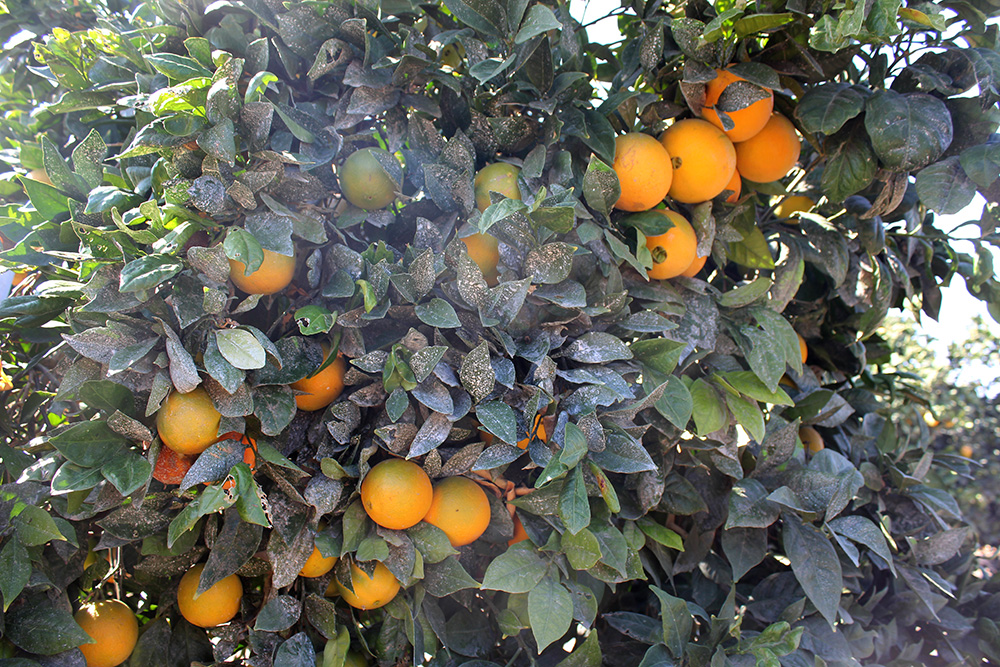
Another citrus pest that has become more worrisome is the citrus mealybug. Sandipa Gautam, a University of California Cooperative Extension citrus integrated pest management adviser at the Lindcove Research and Extension Center in Exeter, said citrus mealybug infestations are spreading. Growers lost the use of chlorpyrifos, an effective control material, in 2020, she said, and that has contributed to mealybug infestations. The pest feeds on tree sap, causing fruit drop and sooty mold on fruit, lowering quality.
Gautam said there is work being done on an IPM program. Ants in orchards exacerbate the problem as they move mealybugs from tree to tree. Both ants and citrus mealybugs must be controlled to protect fruit quality, she added.
Cecilia Parsons is a reporter in Tulare County. She can be reached at agalert@cfbf.com.
See related news stories...
• Smaller-sized navel oranges find use in juice plants
• Citrus greening a top priority of breeding programs
• Fruit flies are eradicated in California, officials declare






.svg.png)
