


Research looks to optimize pollination in avocados
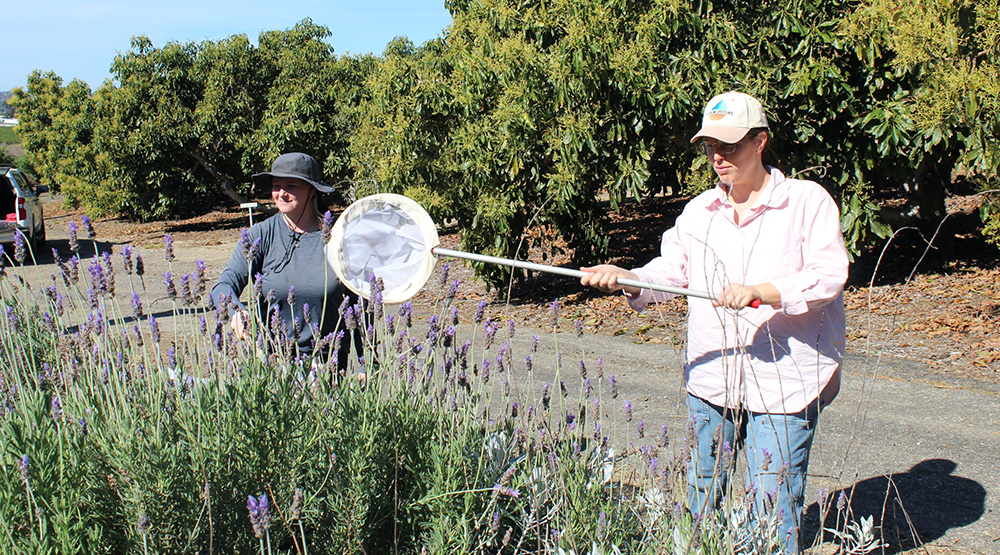
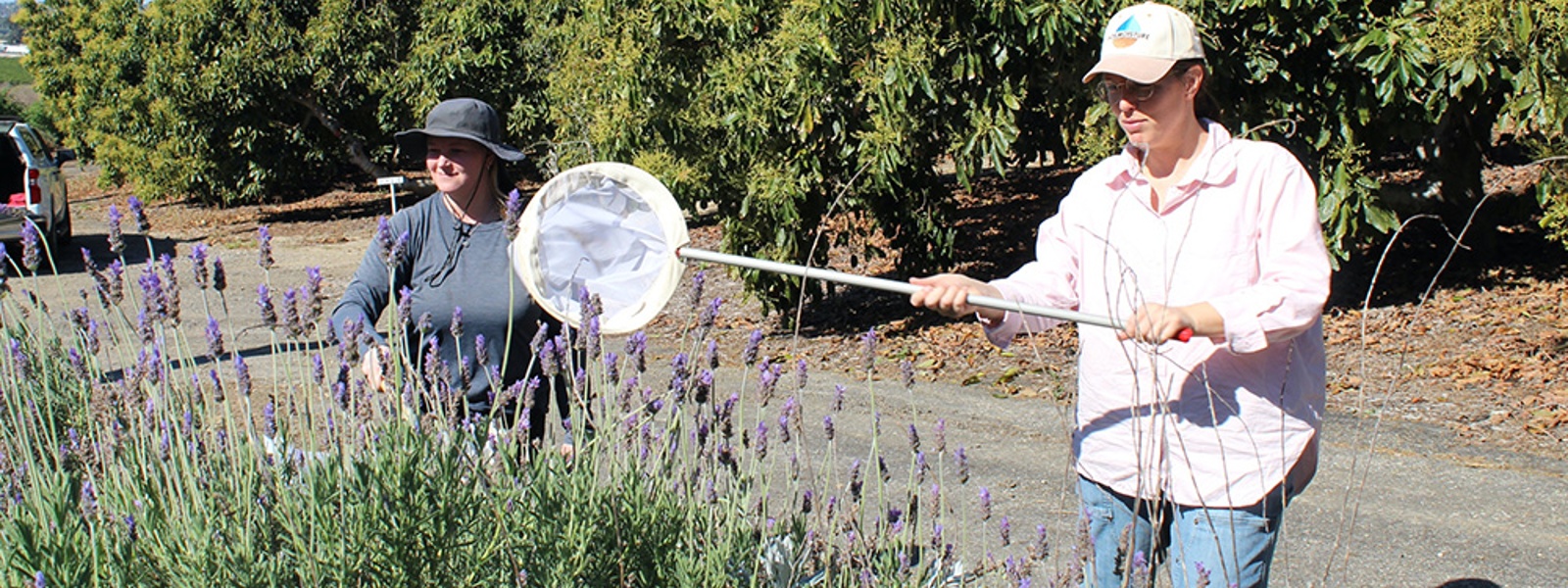
Hamutahl Cohen, right, entomology adviser at the University of California Cooperative Extension in Ventura County, and lab assistant Abigail Brondos collect visitors to a lavender bush in a block of Hass avocado trees in Somis. Cohen is working on a three-year study of the types of pollinators of the Hass variety, which doesn’t attract honeybees and bumblebees the way other tree crops do.
Photo/Rob McCarthy


By Rob McCarthy
New findings about avocado pollination traits could unlock more production of commercially popular varieties and reduce the industry’s heavy reliance on rented honeybees in favor of other pollen-carrying insects.
A Feb. 10 program in Oxnard featured talks about avocado flowers and how they behave, known pollinators in blocks of Hass trees, and the quality and limitations of avocado pollen. Researchers in Israel and at the University of California, Davis, are collecting pollination data and comparing the results to understand if Hass avocado trees behave similarly during bloom in California and Israel.
Spanish researcher Inaki Hormaza said honeybees exhibit odd behavior for being the leading pollinator of the Hass variety. They’ll go to almost every other plant in the orchard before visiting blocks of Hass, he said. Another mystery is why trees in North and South America and Europe don’t bear more fruit.
“For every 1,000 flowers, only one or two will produce fruit. That’s normal,” he said. “That’s what happens everywhere.”
The answer may lie in the complex biology of avocado trees during bloom. The flowers appear in the spring and open for two days. The female flowers open in the afternoon, then close and reopen as males the next morning, he explained. The window for a bee, wasp or fly to pollinate a ready flower is about 24 hours, though the timing varies based on weather and other conditions that aren’t yet fully understood.
When Hormaza applied pollen to receptive Fuerte flowers, the fruit set improved to 28 per 1,000 flowers, he said. Pollen was stored at 39 degrees Fahrenheit for five days before application and applied to the stigma.
His research uncovered a correlation between starch content and flower drop. Growers who manage their trees’ energy levels—influenced by carbohydrates, water and nutrients at bloom—get less flower drop than growers whose trees are distressed, he said. Boron and calcium inputs before flowering might increase fruit quality, he added.
UC Cooperative Extension avocado adviser Ben Faber, who was not a presenter at the February meeting, has conducted pollination research in the past that zeroed in on one thing growers can’t control at bloom: the weather.
“It takes something like 10 to 20 pollen grains to set fruit that must arrive at the same time when the temperatures are ideal,” he said. “Then the fruit has to go through wind, heat and cold to make it through to harvest.”
The best practices a grower can do to improve pollen quality and fruit set is to irrigate, fertilize, prune and adopt good insect, mite and disease control, Faber advised.
With bee colonies dying and many bumblebee species endangered, the California Department of Food and Agriculture is investing research dollars in climate-change studies aimed at delivering adaptive practices to the state’s farmers and ranchers. The original pollinators of avocados were not honeybees, so researchers are looking at other pollen-carrying insects to help the struggling honeybee.
One recommendation is for avocado producers to create habitats for nonbee pollinators—including flies, butterflies and beetles—to move around pollen when flowers are receptive. UCCE entomologist Hamutahl Cohen has spent the past two years observing the visitors at the Lloyd-Butler Ranch in Somis and examining specimens under a microscope to see if they’re carrying pollen.
Syrphid flies, also known as flower flies, carry some pollen, she found. So do green and blue bottle flies. Even though flies carry pollen on their bodies, they’re not necessarily good pollinators, she added. Studying fly behavior in avocados is a logical next step. However, it’s not part of her current project.
There’s still a lot that researchers don’t know, including whether higher pollen counts result in more fruit set. What they do know is farms with hedgerows see more visits from bees, flies and wasps in deep orchard interiors.
Cohen’s first two years were spent catching and identifying insects on avocado properties with hedgerows. The diversity of potential pollinators was much higher on those avocado properties compared to ones without native and non-native plants along the edge of an orchard or at the head, she learned. Through her current three-year project, “we influence their (pollinators’) populations and what they are doing on our crops,” she said.
Michael Sullivan, manager of Lloyd-Butler Ranch, said the farm expanded hedgerows in the orchard three years ago and has since seen strong fruit production.
“However, so many factors go into fruit set that it is not possible to fully attribute the set to the hedgerows, but a number of studies suggest that it helps,” he said.
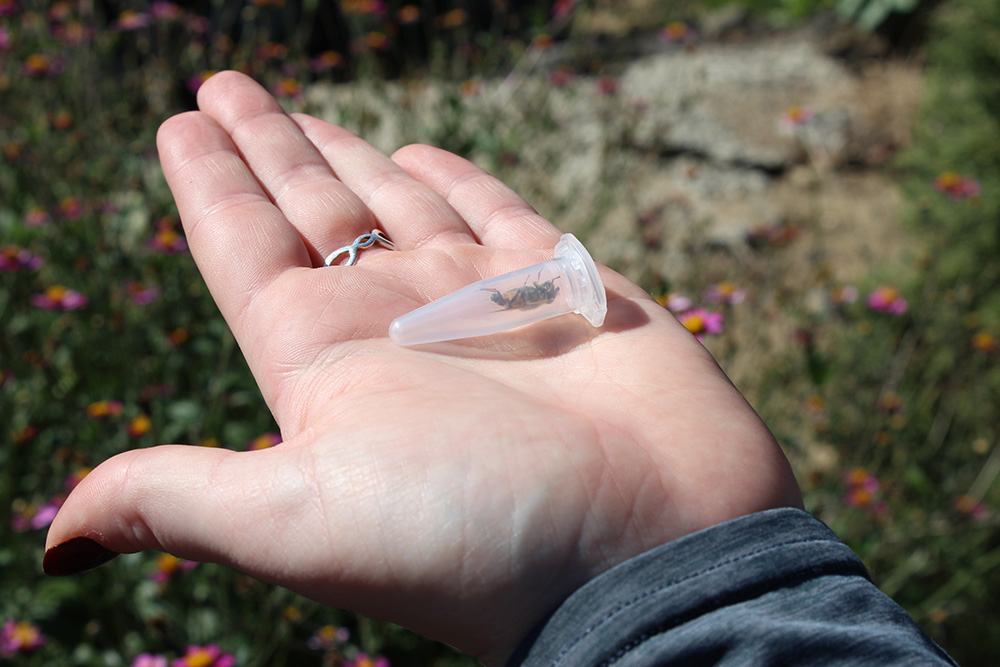
Photo/Rob McCarthy
His advice to other growers is to include salvia in the mix because of low water usage after it’s established. The Xerces Society is an excellent resource for hedgerow plantings and pollinators, he said.
The society recommends drought-tolerant native plants that provide nectar and pollen-rich forage for bees. It also recommends plants for hedgerows that do well in the Central Valley, Central Coast and Southern California growing zones.
Hedgerows are not expensive to maintain, and starter plants cost as little as $2 apiece, Sullivan said. It’s important to irrigate them so they produce pollen and nectar throughout the year, he added.
“Growers pay for honeybees and now more and more for bumblebees,” he said. “Creating some space and resources for native pollinators is another good way for growers to improve the likelihood of pollination.”
Wasps also move pollen grains within an orchard, though they are no match for the European honeybee, Cohen said. Bees have specialized branching hairs that give them electrostatic power. Honeybees eat pollen and carry it on their bodies. They’re also excellent fliers, able to travel up to 14 miles at a time.
“Pollen gets stuck to the hairs, and when they move between flowers, they move pollen around,” she said.
California avocado plantings increased nearly 1,800 acres last year, with total acres at 55,483, according to the California Avocado Commission. Bearing acres stood at 50,830. Ventura County remains the state’s leading region for avocado production, with 41% of the acreage, followed by San Diego County with 26%, Santa Barbara County with 12%, Riverside County with 9% and San Luis Obispo County with 8%.
The Golden State sent 325.6 million pounds of the fruit to market during the 2024-25 season, the commission reported. That’s down from 363.6 million pounds in 2023-24.
Rob McCarthy is a reporter in Ventura County. He can be reached at agalert@cfbf.com.

In this issue:
- Farm Bureau leaders advocate at Capitol
- Iran war strands California farm exports
- Mentorship program grows next-generation farmers
- Vision tech allows dairies to identify lameness early
- Research looks to optimize pollination in avocados
- Advocacy in Action: Fire insurance, farm workforce, market relief and water infrastructure
- California farmer finishes AFBF leadership program
- State treasurer honored for being agriculture 'champion'
- In Brief: Pesticide labeling, H-2A wage rate and "Captive Audience" law
- What is needed to protect against walnut blight?
- California's top exports to China fell by 64% in 2025
- CDFA takes steps to stop spread of cotton leafhopper
- Low-cost ways small farms can lean into technology
- Pest control innovator shares take on biopesticides





.svg.png)
