


Mentorship program grows next-generation farmers
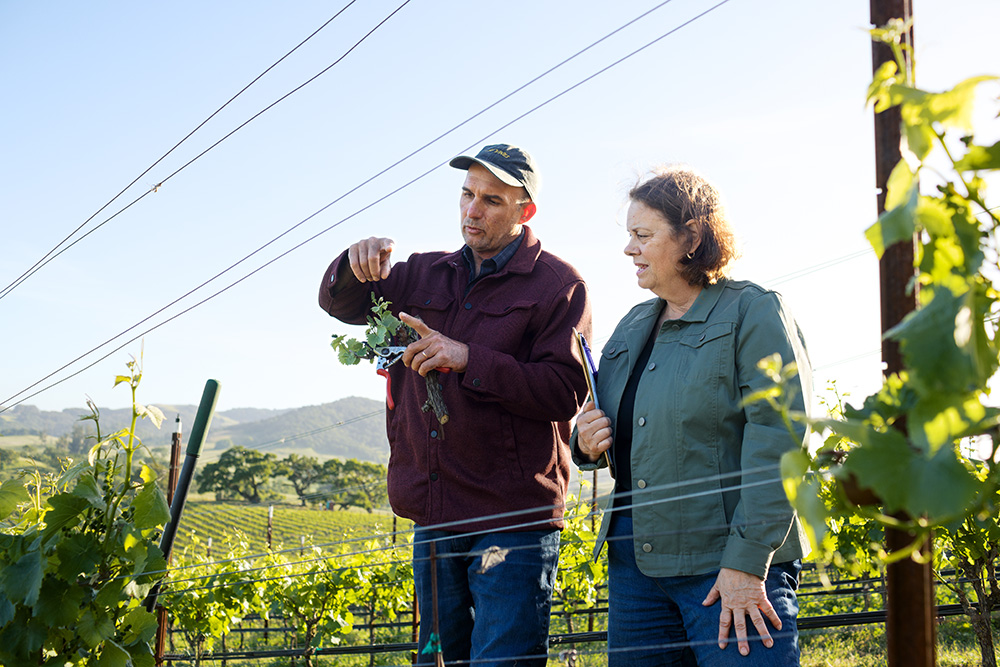
Sonoma County winegrape grower Andrew Forchini, left, a mentor for the Expanding Our Roots program, works with grower and mentee Bea Charles at her vineyard in Petaluma.
Photo/Paige Green


By Margaret Honig
Agriculture has always been built on shared knowledge. For generations, farmers and ranchers have learned through experience, observation and conversations with friends and neighbors. Lessons shared between growers often carried more weight than anything found in a manual or classroom. Advice on crop management, soil conditions, water use, budgeting or marketing strategies traditionally came from someone who faced the same challenges. That exchange of knowledge helps agriculture remain resilient.

Today, beginning farmers face a much different landscape. Entering agriculture requires navigating rising costs, regulatory complexity and evolving markets. For many new producers, the early years can feel overwhelming. Yet California agriculture depends on their success. The future of the state’s food system rests on the next generation building viable businesses.
Ensuring farmers have the support they need is essential to maintain California’s leadership in agriculture. Recognizing this need, the California Bountiful Foundation, a 501(c)(3) nonprofit research and education arm of the California Farm Bureau, created the Expanding Our Roots mentorship program, designed to connect beginning farmers and ranchers with experienced producers who share practical, real-world knowledge.
The idea behind the program is simple: Farmers learn best from other farmers. The program pairs beginning farmers with experienced producers across California. Beginning farmers typically have one to 10 years of farming experience, while mentors have 10 or more years in production.
The goal is to strengthen California agriculture by facilitating peer learning and knowledge transfer across all farm commodities, including specialty crops and livestock. Through one-on-one mentorship, participants discuss real challenges growers face in their operations. These conversations often provide insights that cannot be learned through books or formal courses.
Why does mentorship matter? For beginning farmers, mentorship can make the difference between struggling through trial and error and gaining guidance that can help them succeed.
Farming requires a wide range of skills. Growers must understand crop production, soil health, water management, labor planning, financial management, marketing and regulatory compliance.
Through the program, mentors and mentees work through topics such as production planning, business management, market access, navigating regulations, managing risk, adopting climate-smart practices, and accessing resources and grants.
The impact shows in how mentee farmers apply what they learn. Nicholas Atchley of Ventura County said he gained a “much better understanding of water hydraulics and irrigation management,” which directly affects efficiency and crop health in the field. Carol Thong of Sonoma County said working with her mentor, Andrew Forchini, a winegrape grower in Sonoma County, helped her better understand vineyard operations and identify ways to reduce costs, helping her make more informed decisions on her operation.
Mentors see the impact as well. Solano County farmer Ben Lyons described the program as “a lifeline for those who may feel overwhelmed by this new endeavor.” Forchini worked with his mentee to develop strategies to reduce expenses during the current winegrape market downturn while maintaining vine health and improving overall farm efficiency.
For Michael O’Gorman of Humboldt County, a longtime leader in agriculture mentorship and former executive director of the Farmer Veteran Coalition, the connection between experienced farmers and new producers is essential.
“Working with California Farm Bureau and the Expanding Our Roots program has been a natural fit for me,” he said. “I met so many veterans eager to jump into farming and ranching from my years of managing the Farmer Veteran Coalition, and now I can help them get some real guidance in the state where I was able to launch my own farming career.”
In addition to one-on-one mentorship, the program hosts educational workshops where mentors and mentees can come together with other farmers for focused discussions on key topics facing agriculture. These workshops bring in experts from across the agriculture sector to share practical guidance and answers from participants.
The program continues to grow as more farmers participate across the state. Its impact includes: 246 total farmers and ranchers enrolled; 46 counties represented across coastal, central, northern and southern regions of the state; and four educational workshops held.
Additional participants include farmers from diverse backgrounds, with 69% based in rural communities and 31% in urban and suburban areas. The program also serves a diverse group of producers, including 62 participants who speak a language other than English, 82 producers from historically underserved communities and 29 veterans or active-duty service members.
Farmers and ranchers with more than 10 years of experience are encouraged to join as mentors, while beginning farmers with one to 10 years of experience are invited to apply as mentees. Agriculture has always relied on farmers helping farmers. When that knowledge is shared, the future of California agriculture grows stronger.
For more information, visit www.californiabountifulfoundation.com/programs-and-services/beginning-farmer-and-rancher-mentorship-program.
Margaret Honig is the administrative lead for the California Bountiful Foundation, an affiliate 501(c)(3) of the California Farm Bureau. She can be reached at mhonig@cfbf.com.
In this issue:
- Farm Bureau leaders advocate at Capitol
- Iran war strands California farm exports
- Mentorship program grows next-generation farmers
- Vision tech allows dairies to identify lameness early
- Research looks to optimize pollination in avocados
- Advocacy in Action: Fire insurance, farm workforce, market relief and water infrastructure
- California farmer finishes AFBF leadership program
- State treasurer honored for being agriculture 'champion'
- In Brief: Pesticide labeling, H-2A wage rate and "Captive Audience" law
- What is needed to protect against walnut blight?
- California's top exports to China fell by 64% in 2025
- CDFA takes steps to stop spread of cotton leafhopper
- Low-cost ways small farms can lean into technology
- Pest control innovator shares take on biopesticides





.svg.png)
