


Farm Bureau leaders advocate at Capitol
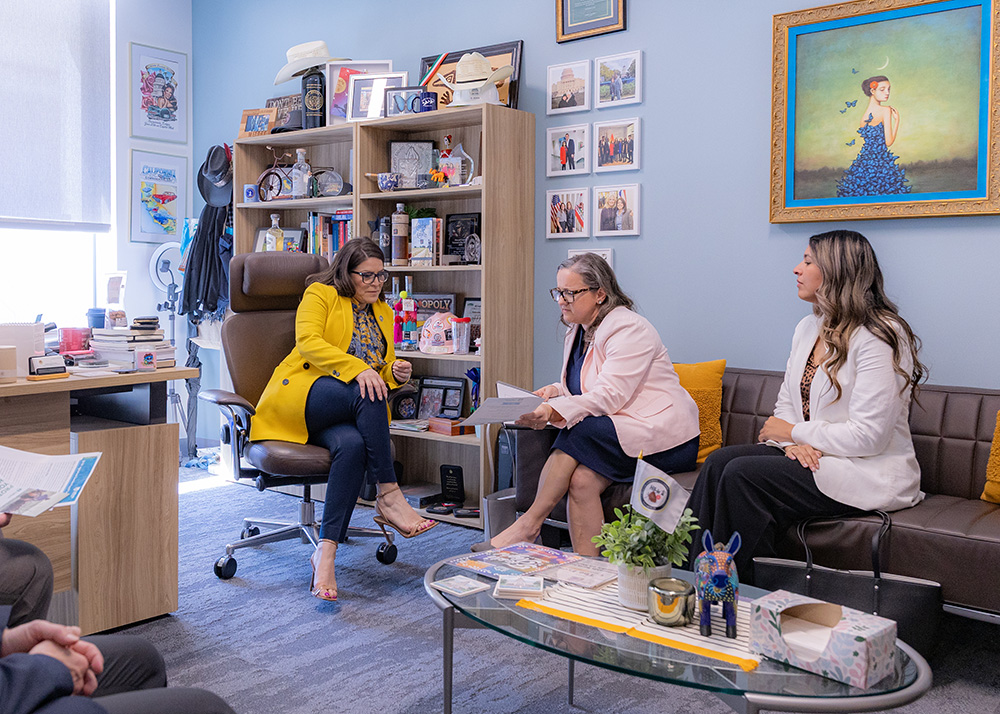
California Farm Bureau President Shannon Douglass, center, talks with Assemblymember Esmeralda Soria, who chairs the Assembly Committee on Agriculture, during the Calling on the Capitol legislative visits last week. At right is student Brianna McCrady, a member of Yolo County Farm Bureau.
Photo/Cheryl Durheim


By Manola Secaira
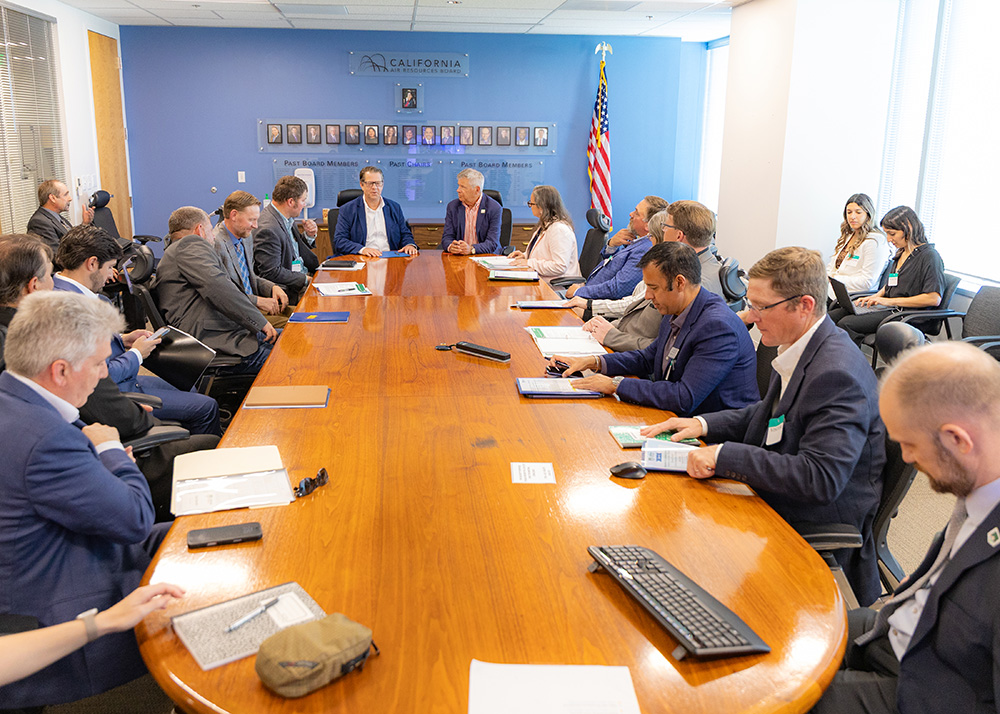
Farmers who serve on the California Farm Bureau Board of Directors gathered in Sacramento last week to meet with legislators and regulatory officials to advocate on key issues that affect agriculture.
The event represents the first of the Calling on the Capitol series, designed to give Farm Bureau members access to policymakers so they can have meaningful discussions about issues important to them.
Roger Everett, a Tulare County beekeeper and citrus farmer, said he has participated at least a couple times before. He described the Capitol visits as a good opportunity for farmers to highlight agricultural issues that legislators from urban areas might not be aware of.
“The majority of these people don’t engage in agriculture,” Everett said. “It’s on us to provide them with the information of our operations and what affects us, and how we’re going to survive in the world they’re trying to create for us.”
Among the issues Farm Bureau board members spoke to lawmakers and their staff about were wolf-livestock conflicts. As wolf populations have grown, farmers have reported more attacks on livestock that complicate their work and lead to financial losses.
Joe Fischer, a Placer County rancher, said his family lost livestock in Sierra Valley to wolf attacks as recently as last fall. Alongside those attacks, he said he’s heard from more of his peers that they’re experiencing the same.
“Producers need more tools,” Fischer said. “We need the opportunity to protect our assets, and we need to make sure that, first and foremost, the threats are thwarted in the beginning.”
California Farm Bureau asked lawmakers to support an increase in funding to boost the Wolf-Livestock Compensation program. That would include compensation for ranchers experiencing livestock losses, as well as support for monitoring wolf locations and rapid response efforts. The fund would also cover indirect impacts to livestock stemming from the presence of wolves, such as reduced fertility or weight loss that impacts farmers’ bottom line.
“I am hopeful that a budgetary ask allows the Department of Fish and Wildlife to become more engaged in protecting producers’ assets,” Fischer said.
Another piece of legislation Farm Bureau supports, Assembly Bill 1585, would require wine labeled as “American” to be completely made from grapes grown in the U.S. Currently, federal standards allow up to 25% of wine labeled as “American” to be sourced from imported bulk wine made outside the country.
Assemblymember Rhodesia Ransom, D-Tracy, introduced the bill alongside Assemblymember Damon Connolly, D-San Rafael. Ransom spoke with Farm Bureau board members about her bill, saying it would better serve state producers.
“Right now, people can label wine ‘American,’ and part of the grapes could be from Italy,” she said. “How does that serve California?”
Photo/Cheryl Durheim
She said the requirement would help growers and wineries compete against cheaper, imported bulk wine and better inform customers as they make their purchasing choices.
“We know that California and America have higher standards and that there are people who only want to drink 100% of what is labeled as American wine,” Ransom said.
Members also spoke to lawmakers about Senate Bill 921, which would create a tax credit to help agricultural employers offer overtime pay for employees.
Many farmworkers reported the loss of overtime hours after the passage of a 2016 California law meant to raise their wages by requiring overtime benefits. Advocates of SB 921 say it would help farmers who can’t afford to pay for overtime while also aiding farmworkers seeking the hours they had before the 2016 law’s passage.
“If you don’t have to bear the cost of the overtime premiums, you might be able to afford the cost of the underlying hourly rate and be able to offer them the opportunity to earn both the hourly rate and the overtime premium,” said Bryan Little, senior director of policy advocacy for the California Farm Bureau and chief operating officer of the affiliated Farm Employers Labor Service, in a meeting with a legislative aide.
Everett, the Tulare County farmer, said making overtime pay more available would help him pay workers whose hours often vary with the seasons. During some parts of the year, he said overtime work can be inevitable in his industry.
“We’ve got long distances to travel to do jobs that require a lot of hours in a day, and it’s just hard to pack it into an eight-hour day, 40-hour week,” Everett said.
Farm Bureau board members and staff voiced opposition to Assembly Bill 2447, which seeks to limit nitrate contamination in California’s water supply by establishing limits on nitrogen discharges from agricultural lands.
Photo/Cheryl Durheim
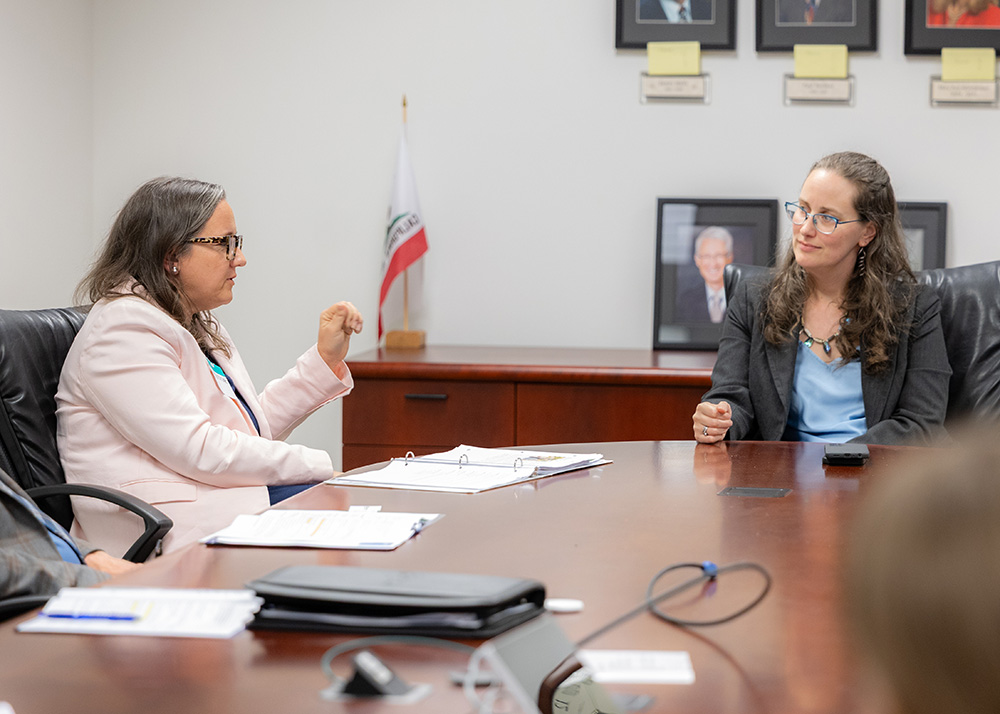
Alex Biering, a director of policy advocacy on water issues for the California Farm Bureau, described the bill’s approach to limiting contamination as one that would place unachievable limits on fertilizer application. She said there are already existing avenues through which California regulates nitrates in drinking water, such as the California State Water Resources Control Board’s Irrigated Lands Regulatory Program and the agricultural expert panel convened by the agency.
“This bill would undercut both of those,” Biering said. “It’s inappropriate to ask (the Legislature) to set limits on fertilizer use in order to control nitrates when it’s frankly something that is not in their wheelhouse and is actually better left to the regulators.”
Another looming issue board members discussed concerns autonomous agricultural equipment. Current state regulations require operators to be physically stationed at the vehicle’s controls, which members said is an outdated rule that prevents them from implementing autonomous equipment that could make their work more efficient.
Fischer, the Placer County rancher, noted in a meeting with a legislative aide that agricultural tech company John Deere isn’t selling its self-driving tools in California due to these regulations.
“This is an opportunity for us,” said Fischer. “It’s really sad to see that agriculture in California isn’t leading the way.”
Chris Reardon, California Farm Bureau vice president of policy advocacy, said the organization and its members will continue to have conversations with lawmakers about options to address the issue.
Manola Secaira is a staff writer for Ag Alert. She can be reached at msecaira@cfbf.com.

In this issue:
- Farm Bureau leaders advocate at Capitol
- Iran war strands California farm exports
- Mentorship program grows next-generation farmers
- Vision tech allows dairies to identify lameness early
- Research looks to optimize pollination in avocados
- Advocacy in Action: Fire insurance, farm workforce, market relief and water infrastructure
- California farmer finishes AFBF leadership program
- State treasurer honored for being agriculture 'champion'
- In Brief: Pesticide labeling, H-2A wage rate and "Captive Audience" law
- What is needed to protect against walnut blight?
- California's top exports to China fell by 64% in 2025
- CDFA takes steps to stop spread of cotton leafhopper
- Low-cost ways small farms can lean into technology
- Pest control innovator shares take on biopesticides





.svg.png)
