


Tomato agreement aims to manage parasitic weed
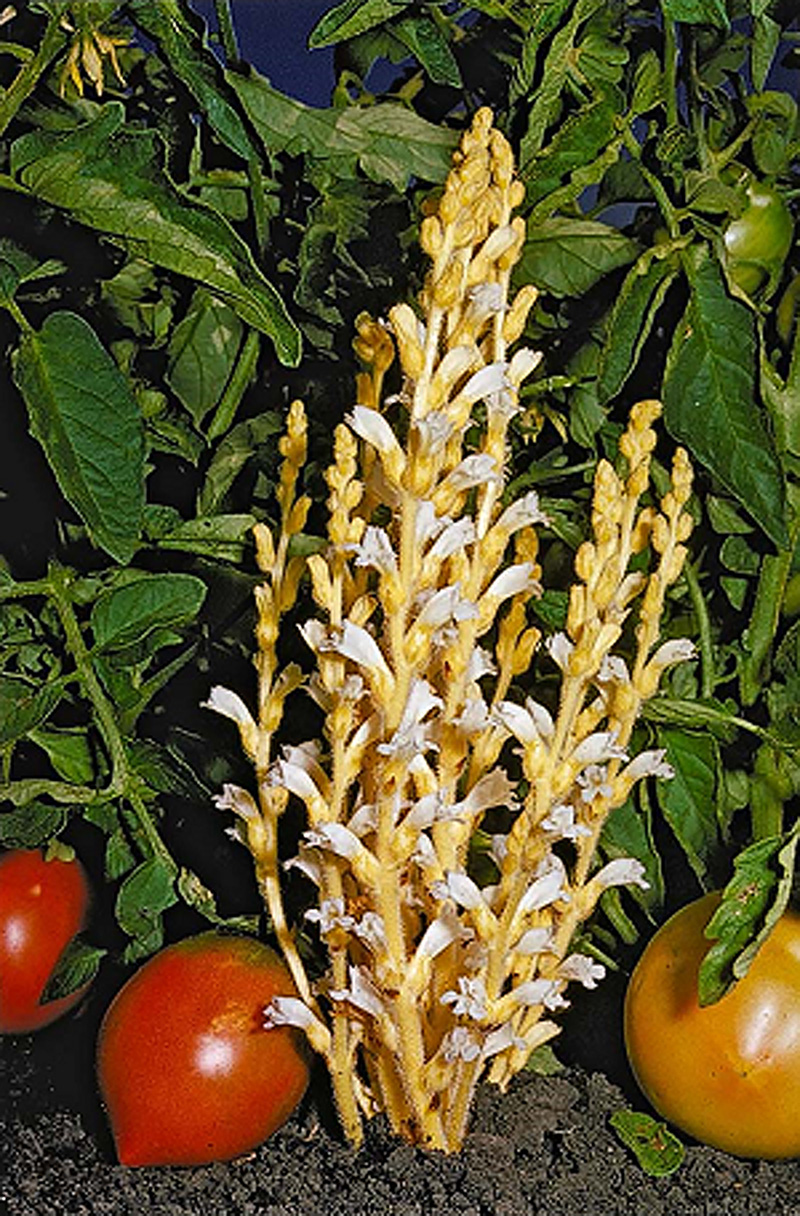
Branched broomrape, a parasitic weed, remains a significant threat in California, particularly to tomato fields.
Photo/Courtesy of University of California, Davis


By Vicky Boyd
Beginning this season, processing tomato growers, haulers and harvesters will come under mandatory state compliance agreements designed to contain and manage the parasitic weed broomrape.
The California Department of Food and Agriculture introduced the agreements, which spell out equipment sanitation and broomrape risks, just before the 2025 season as part of a soft launch. About 97% of growers, haulers and harvesters signed the voluntary documents, said Michelle Dennis, CDFA Integrated Pest Control Branch chief.
This season, the agreements will be required to be signed by all parties before tomatoes are moved from a field, she said.
The reason for the tough stance is the potential economic impact the weed poses to the state’s processing tomato industry, said Brad Hanson, a University of California Cooperative Extension weed specialist.
“It means you can go from a pretty small problem to a pretty big problem in short order,” he said.
So far, branched broomrape infestations are centered in Yolo County. In 2025, Egyptian broomrape, a close relative with a wider host range, was found in a Solano County field.
Broomrape are obligate parasites, meaning they depend entirely on their hosts for survival. Several species are found worldwide, but branched broomrape—known scientifically as Orobanche ramosa—is the one currently causing the biggest headaches in California.
Although literature lists a number of hosts for branched broomrape, Hanson said he’s seen it only on tomatoes and nightshade, a weed in the same botanical family as tomatoes.
In the spring, tan to brownish broomrape seeds smaller than grains of sand germinate in the soil. When the parasitic weeds contact tomato roots, they typically latch on, sucking water and nutrients. After purplish flowers emerge from the soil, they may produce more than 100,000 seeds that are easily spread and can remain viable in the soil for years.
Hanson said he has visited with colleagues and tomato growers in Chile and seen what can happen if branched broomrape isn’t contained. In severe cases, he said, growers may opt not to harvest a field because infestations were so dense.
When broomrape infestations become too severe, Hanson said Chilean growers just move to new ground. But California producers don’t have that option.
Branched broomrape was eradicated from California about 40 years ago. When it reappeared in Yolo County tomato fields in 2017, eradication began anew but along a different path than strict quarantine.
Past pest eradication programs were guided by CDFA’s Pest Detection/Emergency Projects Branch, Dennis said. But the current effort is directed by the 12-member Broomrape Program Advisory Board comprising growers and one public member. It also falls under the Integrated Pest Control Branch.
Assembly Bill 402, signed into law in 2023, created the board and a funding mechanism, which requires processing tomato growers and processors to each contribute 7 cents per ton. The program also is designed to contain and possibly eradicate the parasite while allowing growers and processors to harvest a crop following specific safety guidelines.
“We’re attempting to soften the blow to an individual grower whose field is infested,” said Gene Miyao, a retired UCCE farm adviser for Yolo and Solano counties and the broomrape board’s public member. “And we’re trying to minimize the spread primarily with sanitation.”
Daniel Bays, who grows a mix of row and permanent crops with his family near Westley, said he remains concerned about broomrape even though he doesn’t farm in a high-risk county.
“As I’ve learned more about it, especially being on the board, it’s a bigger concern,” said Bays, also a broomrape advisory board member. “Just look at the economic impact it’s had on the tomato industry in Chile and Israel and other places around the world.”
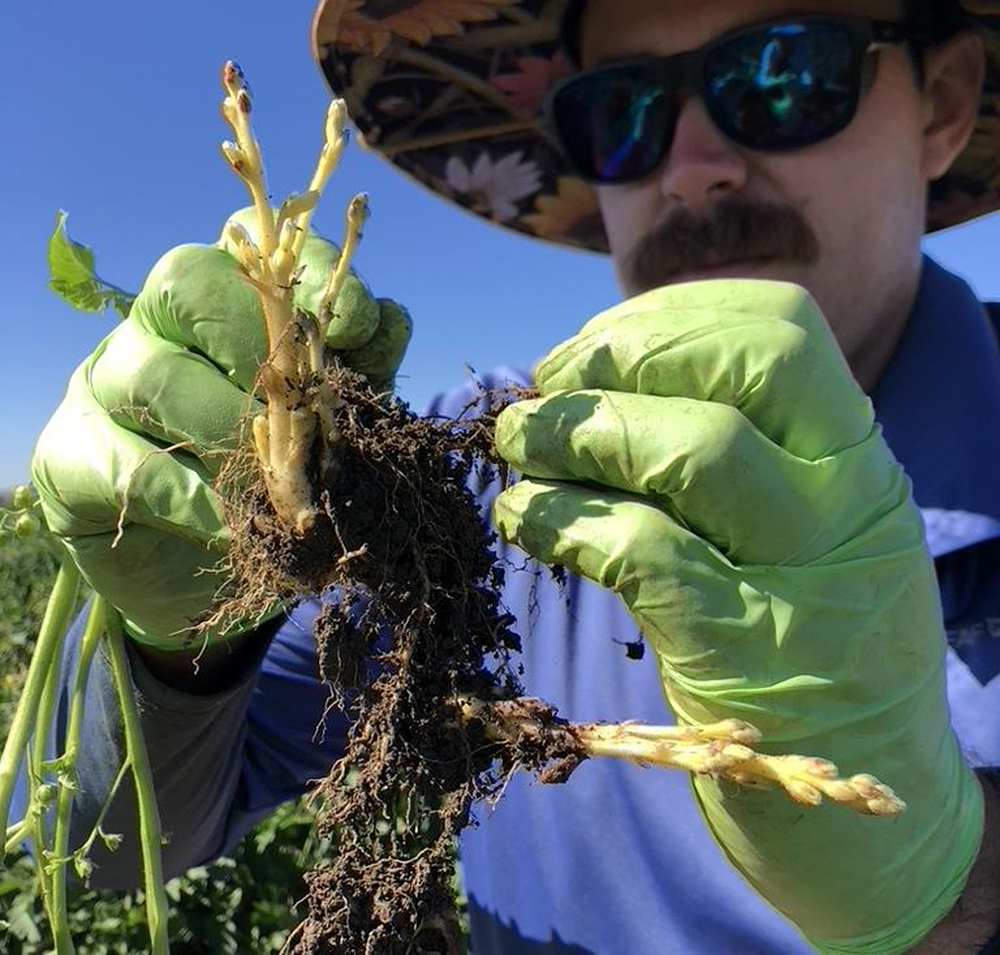
Photo/Courtesy of University of California, Davis
Based on field trials by Matt Fatino, a UC doctoral student in Hanson’s group, Matrix SG herbicide applied through drip irrigation 30, 50 and 70 days after tomato transplanting reduced broomrape emergence by about 85%. It also did not affect tomato yields. As a result, the California Tomato Research Institute requested and obtained a 24(c) Special Local Needs label for the rimsulfuron herbicide in 2023.
Matrix doesn’t directly kill broomrape seed already in the soil, and it isn’t considered an eradication treatment, Hanson said. Based on trials, he said transplanting as late as possible into May helps reduce broomrape pressure compared to an earlier planting date of April 9-10.
As the planting season progresses, soil temperatures increase to a point where the seeds go dormant. The exact temperature cutoff is a topic of current research.
The broomrape board has recommended that growers or workers hand rogue any broomrape escapes before they go to seed and put them in clear plastic bags to solarize them in the fields.
The broomrape program includes recommended equipment cleaning and sanitation procedures developed by UC Extension plant pathologist Cassandra Swett and her laboratory. The extent of cleaning depends on whether the equipment has been in fields considered high risk—counties with an active infestation or abutting an infested county—or low risk.
The broomrape board met recently in Woodland and Lodi to hear comments about last year’s compliance agreements and take suggestions for this season. One of the major issues was who would have access to maps of the infestations.
Some audience members were concerned that if a government entity held the maps, the public could file a Freedom of Information Act request to learn the exact locations.
Bays said board members walk a fine line between wanting to respect growers’ privacy while also managing the pest to protect the industry.
“Once someone files a Freedom of Information Act (request), then all of a sudden that information becomes public, and it could be used possibly in a way that’s negative to growers, and we want to be sure that doesn’t happen,” he said.
At the same time, Bays said some individuals such as county agricultural commissioners and researchers need access to the information to do their jobs.
CDFA’s Dennis said the department plans to have compliance agreements finalized by June in time for harvest.
Vicky Boyd is a reporter in Modesto. She can be reached at agalert@cfbf.com.






.svg.png)
