


Delaying harvest has helped blackbird populations
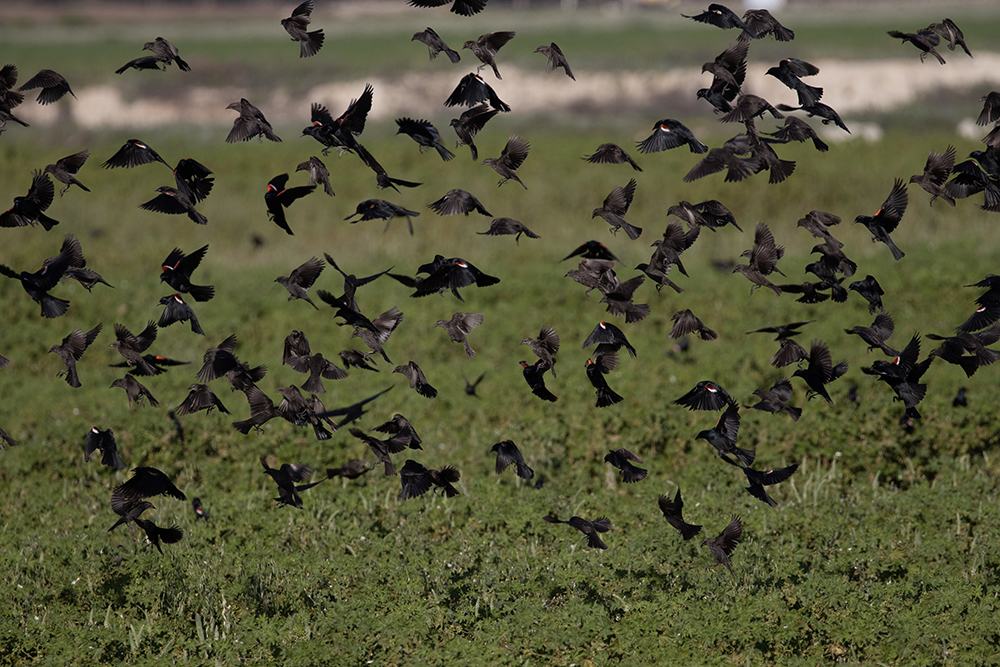
A flock of tricolored blackbirds takes flight in a weedy silage field where they are nesting. The bird’s protected status has complicated harvest for farmers, who must postpone their work until the birds leave. The delay can make the crop unusable as feed. A federal program compensates farmers for their losses and has helped boost blackbird populations.
Photo/Ian Souza-Cole


By Manola Secaira
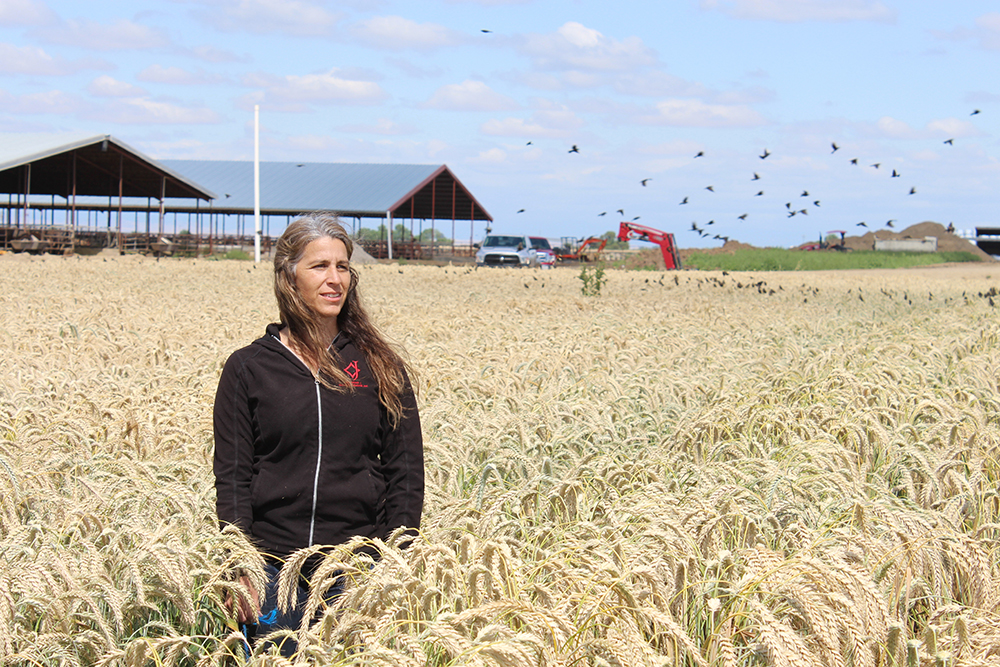
Merced County farmer Luciana Jonkman first saw the signs of tricolored blackbirds returning to her farm in late February.
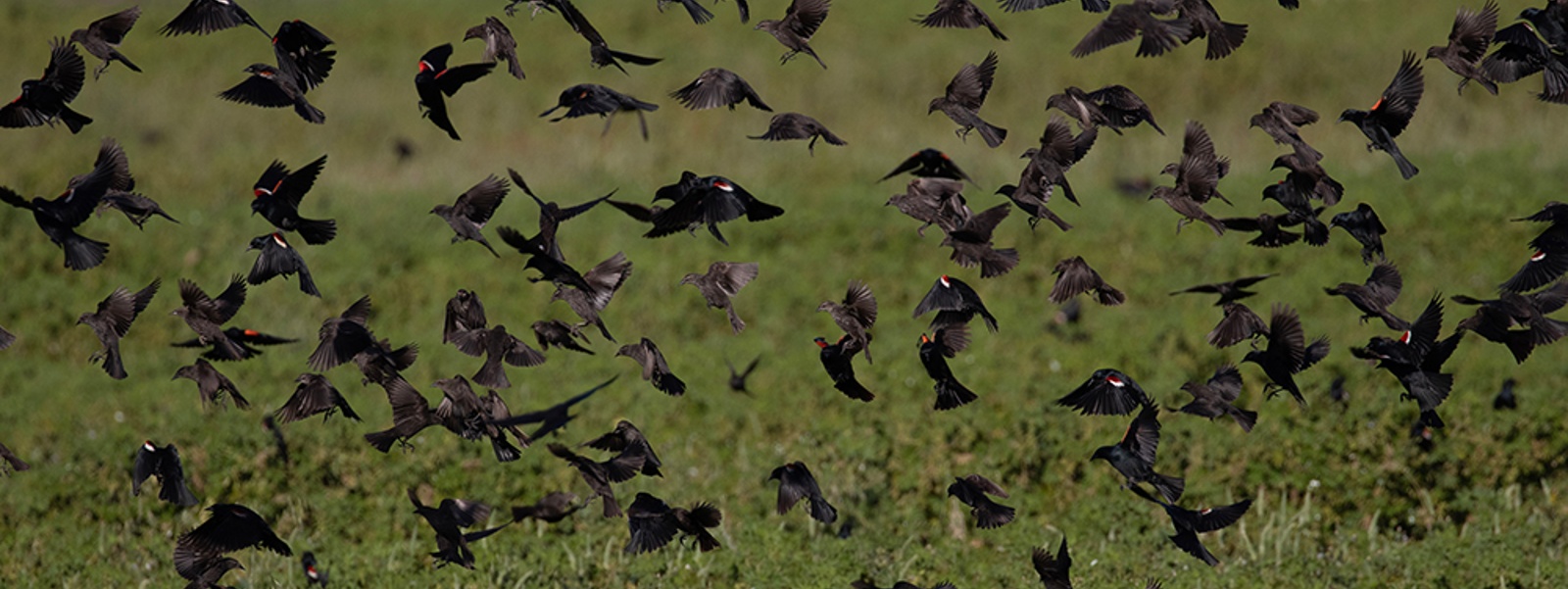
She’d already noticed a few carrying nesting materials as they flew overhead. Her crops—mostly wheat, corn and oats grown as feed for livestock—were just beginning to dry out and mature, creating perfect nesting grounds for the species.
Tricolored blackbirds once thrived in California’s wetlands. But as the state developed, those ecosystems began to disappear, causing the species’ population to decline and seek new breeding grounds.
Ian Souza-Cole, Audubon California’s working lands program manager, said the birds now often gather during the spring to breed in Central Valley grain fields, which provide a strong substrate for them to build their nest and form colonies that can be up to 30,000 or 40,000 birds.
“They’re also right next to the dairy barns, which have exposed grains, so they’ll feed on whatever the cows are being fed,” he said.
Jonkman said tens of thousands of tricolored blackbirds have flocked to her farm to make colonies and have their chicks in recent years. She’s seen them stick around until April or May.
While the sight of the birds is beautiful, she said, they also create a big dilemma. Feed crops grown as silage are harvested green during a specific timeframe, when they’re around 35% to 40% dry matter.
But she can’t harvest while the birds are there. Since 2019, the tricolored blackbird has been listed as threatened under California’s Endangered Species Act, which offers it certain protections.
“Harvesting crops at an optimal time is already difficult enough,” Jonkman said. “The birds add an extremely more difficult layer of complexity.”
Along with other farmers, Jonkman participates in a federally funded program that provides financial assistance to farmers who lose crops as they wait for the birds to leave.
Robert Meese, a retired University of California, Davis, researcher who has studied tricolored blackbirds for more than 20 years, said the bird’s threatened status bars anyone from harming or hazing it while it’s breeding. Farmers can attempt to deter flocks from arriving in the first place, but they can’t disturb the birds once they’re settled.
“They have to be left alone,” Meese said. “If you’re disturbing the birds, irrespective of how you’re disturbing the birds, that is prevented by the listing.”
So, farmers have to wait them out. Jonkman said she can’t harvest her crops as silage once they’re more than 40% dry matter. In that case, she said she’d assess if there’s enough left in the field to recoup the cost of a harvest. If there is, it would most likely be harvested as feed-grade grain. If not, it could be harvested as straw for bedding. Either way, even if the birds are present for only a month or two, she said it leaves a longer-term impact.
“It delays the next crop, which pushes the crop’s optimal growing season into the hotter months, which in turn negatively impacts the growing periods of that next crop and the quality of that next crop,” Jonkman said.
Breanne Vandenberg, executive director of the Merced County Farm Bureau, said the protected birds most often impact dairy farmers growing feed crops, and for those impacted, it can be stressful.
“That’s pretty hard news to handle,” Vandenberg said. “Any funding that can come their way to help offset those costs of providing habitat in this case is welcomed.”
Conservation groups had worked with farmers for more than two decades on a voluntary basis to get farmers to delay harvest in order to avoid harming the bird colonies. In 2015, those efforts culminated in the creation of the Regional Conservation Partnership Program, which formalized the process of compensating impacted farmers with the goal of protecting at-risk colonies.
This year’s rate, which is set by the U.S. Department of Agriculture Natural Resources Conservation Service, is a flat rate of $945.70 an acre across all California counties.
Paul Sousa, director of environmental and regulatory affairs at Western United Dairies, said it doesn’t completely cover farmers’ losses. But even so, he said it’s necessary to alleviate the burden.
“It’s not the dairy farmer’s responsibility to take on the full cost of caring for the species,” Sousa said. “So, I think it is an equitable solution.”
Souza-Cole said he has seen the program’s impact. A 2014 tricolored blackbird survey reported a statewide low of about 145,000. That number has steadily increased since the program’s implementation, with a 2025 survey estimating the population at 229,000.
Souza-Cole said the boost could be partially due to both regular surveys that give a better understanding of the bird’s numbers and the financial compensation to farmers that encourages conservation.
It’s unclear if the species’ status will change as its population recovers. Meese, who was a member of the working group that originally got the bird listed as threatened, said there were discussions about setting a population target that, if achieved, could lead to the bird being delisted.
Ag Alert file photo
“The number was never agreed upon,” Meese said. “As far as I know, there is no population target nor has there been any kind of a discussion as to for how many years that population target would have to be met.”
That leaves uncertainty ahead. Meese said the compensation program helps alleviate some of the financial loss for farmers and lost habitat for the birds but doesn’t address the root issues.
“That’s like an emergency room response,” Meese said. “We don’t even want (tricolored blackbirds) to be patients in the hospital anymore, and the only way we’re going to do that is to get them off of the farmers’ fields.”
To get out of this metaphorical emergency room situation, Meese said tricolored blackbirds need dedicated areas for nesting. That could be a longer-term solution to both the cost to farmers and the stability of the bird population. But creating these spaces requires funding.
“There just isn’t a fund to pay for whatever needs to be done to get the birds off of farmers’ fields and onto places where there’s no conflict,” Meese said.
Once the species has further recovered, Sousa said he’d like to see the bird eventually delisted in hopes that it would allow more flexibility to farmers responding to the issue. In the meantime, he said it’s important that farmers continue to be compensated.
“I do see this conflict continuing into the foreseeable future,” Sousa said.
Manola Secaira is a staff writer for Ag Alert. She can be reached at msecaira@cfbf.com.







.svg.png)
