


Aerial tools spray crops, pick fruit and compile data


By Caleb Hampton
Amid high fuel prices, an ongoing labor shortage and a yearslong drought, farmers are changing their agricultural operations to adapt to today’s challenges—with many looking to new technologies to meet their farming needs.
While America’s farms may once have conjured rustic images of tractors or pickup trucks, “the iconic symbol of rural America is being replaced by a remote control,” said Laura Baumgartner, vice president of Asylum Public Relations, which works with the agricultural drone company Hylio.
Over the past 18 months, the Texas-based company has seen exponential growth in drone sales to farmers. “We are truly at a tipping point where this is now becoming more of the norm than the exception,” said Kurt George, who does business development and customer outreach for Hylio.
A longtime rice and almond farmer in Colusa County, George began looking into drones for his own farm due to the lack of available aerial applicators. Since adopting them, he has noted many benefits—first and foremost the amount of water they conserve.
“When a traditional crop duster sprays material, it needs large water droplets and gravity to deliver it down to the ground,” George said. “With a drone, the water droplets are smaller because they are much closer to the crop, and the propellers force the material down into the crop.”
He estimates the drones use about one-tenth of the amount of water an airplane does to accomplish the same applications. Those are crucial savings, especially for farmers in Colusa County, where more than half the rice fields were fallowed last year due to drought. “Anything I can do to use less water—and pay for less water—is attractive,” George said.
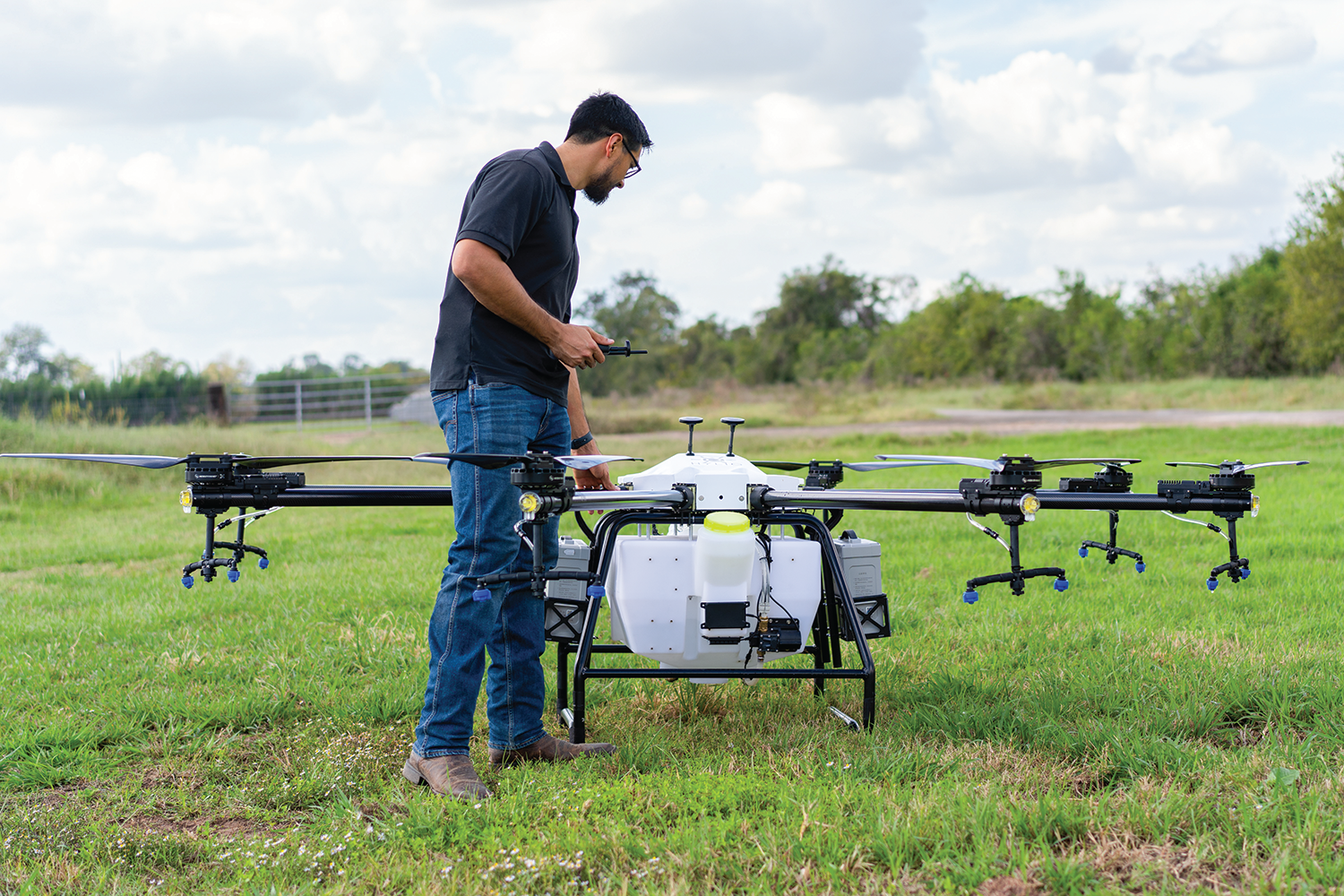
Hylio’s unmanned aerial vehicles, or UAVs, range in size from small drones with 2.5-gallon tanks to 16-foot-wide drones with 18-gallon tanks, with prices ranging from $25,000 to $75,000.
They can be used on a wide array of crops, from 10-acre blueberry farms to vast orchards or rice fields. In addition to cutting back on water use—and on the fuel costs associated with aerial applicators—the battery-powered drones can also aid farms struggling to find enough employees or keep up with rising labor costs.
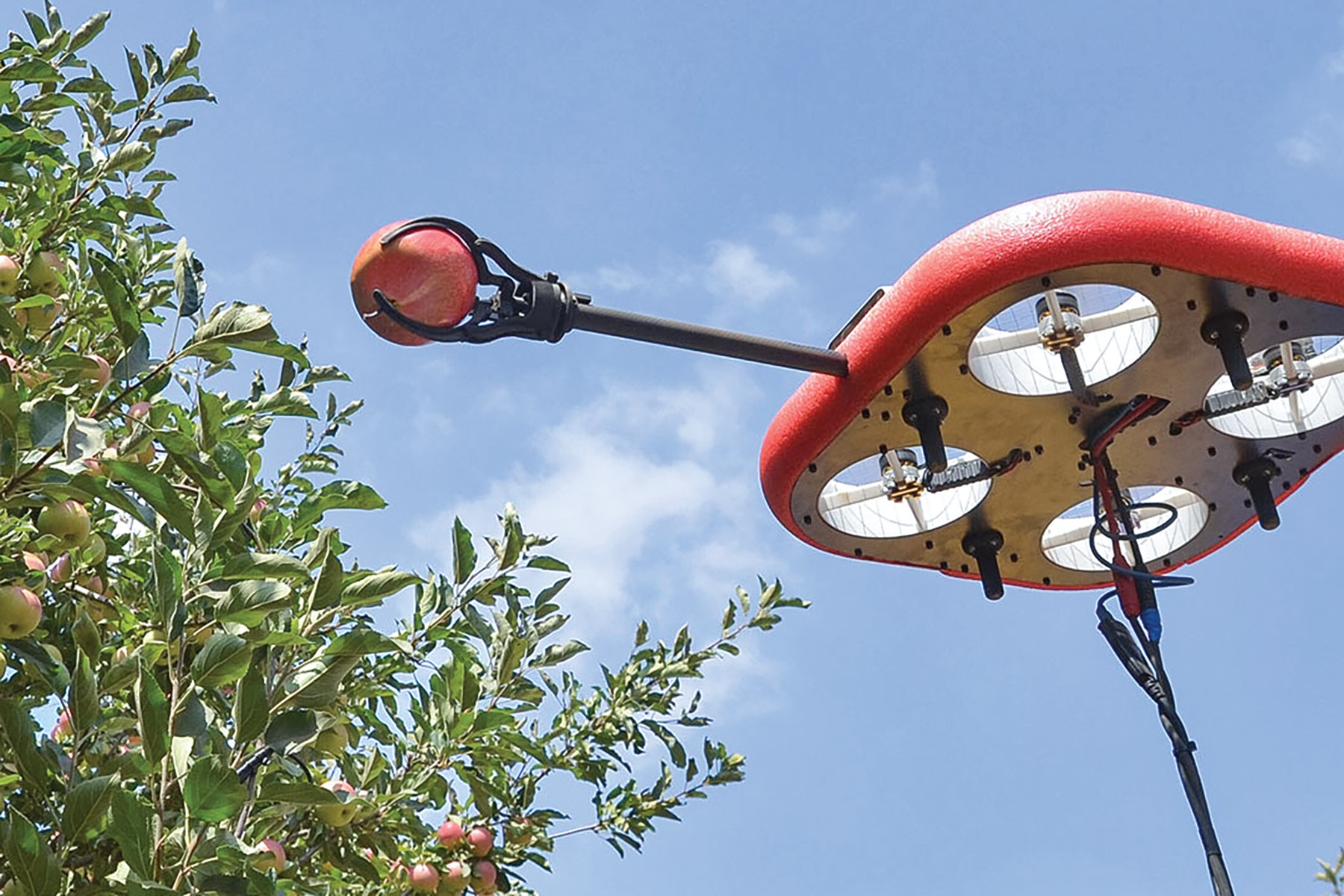
The use of aerial technology is drawing increasing interest for multiple agricultural benefits. Last month, as the World Ag Expo in Tulare presented awards for its “Top 10 New Products,” one of the winners was an autonomous flying robot used to harvest tree fruit, including peaches, nectarines, plums, pears, apricots and apples.
Moshe Porat, founder and CEO of Tevel, an Israel-based robotics company, said in a statement that the company hopes to offer “a full harvesting solution” that can be employed by California growers. The firm’s Flying Autonomous Robots platform harvester, debuted at the Expo, is equipped with eight aerial robots. They use computer vision algorithyms to collect data on each piece of fruit picked.
Meanwhile, the Hylio drones—and similar agricultural drones made by other companies—can be operated from a laptop and programmed to follow specific flight paths, covering roughly 40 acres in less than half an hour. They can also be manually directed using a controller.
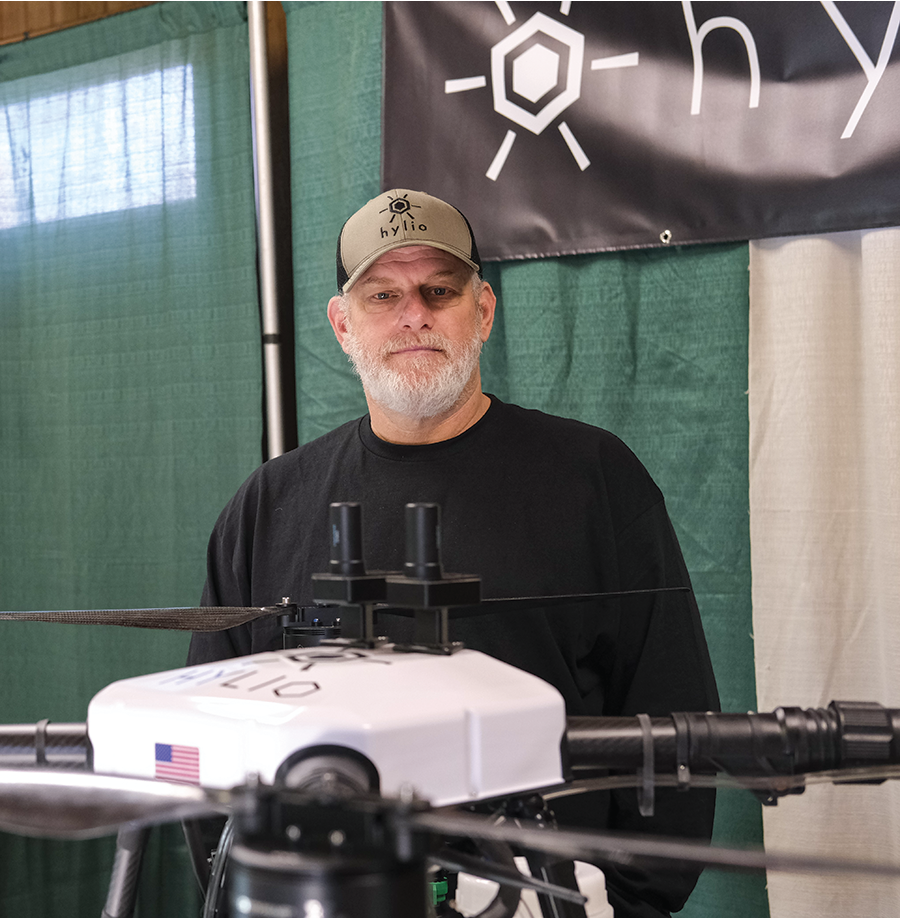
“If you can operate your iPhone, you can operate this drone,” George said as he promoted the drones at the Colusa Farm Show last month.
In his rice fields and almond orchards, George has used them to replace ground rigs and aerial applicators to spray his crops. Using those traditional methods would take a four-person crew to cover the same ground, he estimated.
“There’s just fewer and fewer people that are taking on-farm labor positions,” George said. “In some ways, that’s a good thing, because people are getting more educated and working at higher levels. But manual labor is what drives this country. The ability to do that with a machine—and have one person operate what four people used to do—makes it more economical for the farmer.”
It also allows workers to avoid contact with pesticides. “With a ground rig, you’re driving under the trees and spraying up into them, and it’s falling right back on top of you,” George said. “Whereas with the drone, you’re sitting back in the base station while it’s delivering the material.”
The convenience of the drones has not compromised the work’s efficacy. On the contrary, George said his yields have improved by about 8%. He attributed the better results to the drones’ ability to target every spot on a field. “I’m hitting the edges of my fields much better than I ever was,” George said. “It’s complete coverage with no missed spots.”
In his orchards, the drones also have technical advantages. “They are phenomenal for orchards because they have very good leaf agitation,” he said. “You’re able to spray both sides of the leaves because of the downdraft from the propellers.”
Despite the obvious agricultural merits of drones—and clear interest in the technology from growers—some farmers have cited outdated regulations as an obstacle to incorporating drones into their farming operations.
“Right now, they’re applying under a license that was originally intended for pilots 50 years ago,” George said, referring to state regulations that require farmers using drones to spray crops to acquire an aerial applicator license, the same credential required of fixed-wing pilots.
“Sometimes technology surpasses regulation and regulation needs to catch up,” George said. “Once it catches up with ag drones for farming, the process will be a lot smoother.”
(Caleb Hampton is an assistant editor of Ag Alert. He may be contacted at champton@cfbf.com.)





.svg.png)
