


Colleges prepare workers for high tech farm future
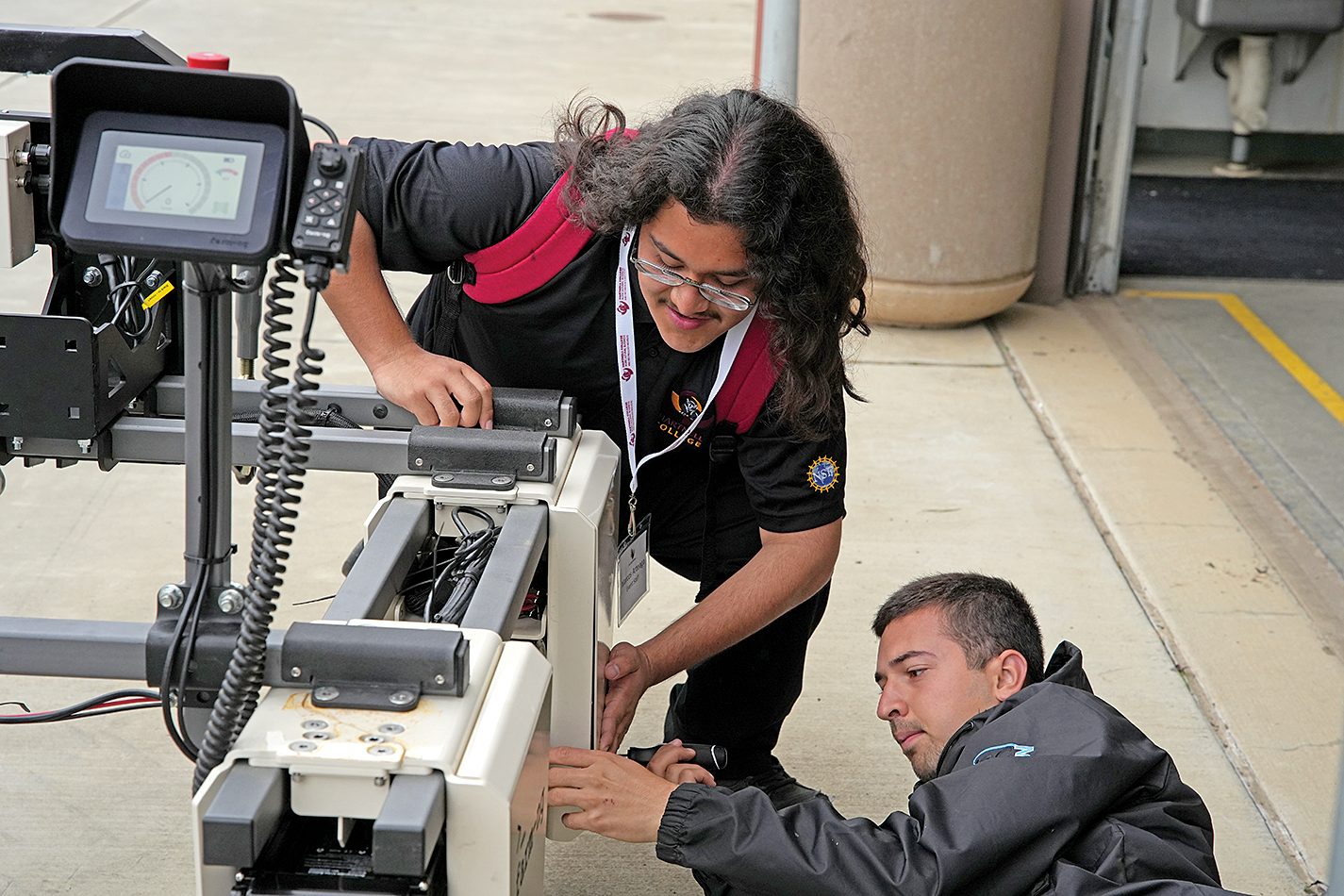
Earlier this year, Hartnell College students Marcos Arteaga, left, and Napolean Navarro get hands-on experience through one of the school’s agricultural technology courses in Monterey County.
Photo/Hartnell College



By Caleb Hampton
In farmer Al Stehly’s San Diego County vineyards, drones apply pesticides to grapevines once sprayed by workers wearing backpacks.
In Napa Valley, instead of human hands, mechanical leafers pull grape leaves away to expose the vines’ fruit zones to sunlight.
As worker shortages persist, labor costs rise and technology advances, the way farms operate is changing.
“We’re trying to automate as much as possible,” said Johnnie White, operations manager of Piña Vineyard Management, which manages more than a thousand acres of winegrapes in Napa Valley.
California has led the way in developing cutting edge agricultural technologies, enabling farms to do more with fewer workers and to make farm work safer and more efficient. But these advances, in a state with a $50 billion agriculture sector, are also creating a challenge.
“We need more skilled employees to be able to run this technology,” White said.
To meet that need, farmers, agricultural leaders, college systems and government agencies are collaborating to launch new initiatives and expand existing programs.
Some of the training programs, which are largely conducted by community colleges, teach experienced farmworkers new skills, while others target young people entering the workforce for the first time.
Last year, the Central Valley Community Foundation received $65 million, the largest ever federal award for Central Valley agriculture, to create the Fresno-Merced Future of Food Innovation Initiative. The project, which is also called the F3 Initiative, includes one of the nation’s most ambitious plans to “upskill” the existing agricultural workforce, aiming to train 4,000 farmworkers on new technologies over the next few years.
Christy Patch, director of collective impact at the Central Valley Community Foundation, said F3 partner organizations are currently working with industry partners to develop an “applied ag systems” curriculum for eight community colleges in the Central Valley. The certificate program is expected to begin in fall of 2024.
In planning the program, staff surveyed 9,000 farmworkers to find out “how and where they want this learning to happen,” Patch said, “to make sure this program, when it launches, is accessible.”
In 2021, the Western Growers Association received a $750,000 award from the California Department of Food and Agriculture to develop a “Next Gen Ag Workers” curriculum for colleges across the state. That program began this year and is to be fully implemented by 2025. It aims to provide specialized training to 330 professors, primarily at community colleges, and to reach 2,750 students. It also gives member growers subsidies to pay farm interns working with new technologies.
Carrie Peterson, the program’s grant manager, said the curriculum was developed so that colleges without established agricultural technology programs could begin offering courses in the short term and teach students the “skills that all our members are saying are really crucial.”
Meanwhile, Hartnell College in Monterey County has been teaching students and farmworkers agricultural technology courses since 2006, scaling up its programs over the past several years to meet the needs of the region’s fresh produce and value-added sectors.
“The local agriculture industry really stepped in,” said Clint Cowden, dean of career technical education and workforce development at the Salinas-based college. Hartnell formed a steering committee with executives from some of California’s largest leafy greens companies and advisory committees with frontline supervisors from local farms and processing plants.
Those groups “gave us the ability to see around corners” and learn which skills local farm employers needed workers to know, Cowden said. “As the industry adjusts and changes, we want to adjust and change with it.”
Today, Hartnell offers several disciplines within agricultural technology, including programs in robotics and mechatronics, automotive technology, food safety, plant science and welding. “Hartnell does a great job of working with industry and building curriculum off what they need,” said Napoleon Navarro, an agricultural engineering student at Hartnell.
He said the community college program is preparing him well for a career in agriculture. “It really sets students up for success,” said Navarro, who plans to pursue further studies and work in agricultural engineering.
In addition to educating students such as Navarro, Hartnell provides “contract education” for farm businesses and fresh produce companies, including Central Coast-based giants such as Taylor Farms, retraining their employees so they can adapt to new roles.
At one work site, Hartnell worked with hand sorters whose job was to manually cull low-quality materials from leafy green mixes on the processing lines of the company’s salad-packing plant.
The company was “looking at using optical eyes to do that,” Cowden said, referring to technology that can identify insects or diseased plant parts and use air or vibrating discs to extract them from the mixes.
Hartnell staff taught the workers the basics of electricity, hydraulics and pneumatics, and how to use a programmable logic controller, so that they could leave the processing line to become maintenance mechanics servicing the machines.
The idea, Cowden said, is to “take the person doing that highly repetitive, easy-to-automate job and turn them into the machine operator or the next level up.”
While farmers and college administrators emphasized the importance of attracting young people to careers in agricultural technology, they said the knowledge California’s seasoned farmworkers already possess is invaluable to incorporating new technologies on a farm. “When we look at our farmworkers transitioning to new technologies, we see all of this institutional knowledge,” Cowden said.
To use a mechanical leafer, said White, the Napa vineyard manager, he needs an operator “who knows that you’re pulling the leaves off and you’re not damaging the clusters of fruit.”
The same goes for operating a mechanical harvester, which tends to either leave some fruit on the vine or get everything including undesirable materials. “It’s a balance,” White said. “You have to have skilled employees to be able to understand that and adjust the machines accordingly.”
As they introduced automated technology to their vineyards, White and Stehly both promoted from within, providing in-house training to tech-savvy employees.
On Stehly’s farm, two field coordinators are now licensed drone operators. A third employee, who worked pruning vineyards, is studying to take the licensing exam.
“The first shot at all of this goes to existing employees,” Stehly said. “I’m doing these things to make their jobs safer and easier, not to replace them.”
Labor advocates have cautioned that automation could displace farmworkers. Farmers and economists disagree, pointing out that machines have not come close to reversing the shortfall of workers.
With an aging farm workforce and a decades-long impasse in Washington on proposed immigration reforms, many farmers see technology as the only solution.
Growers and vineyard managers in Napa are again resorting to the expensive temporary foreign worker program, only allowed when insufficient domestic workers can be found, to harvest grapes for this year’s vintage. “Everyone around here is invested heavily in the H-2A program, including ourselves,” White said.
He added that even after importing workers and automating some operations, he would not turn away a local looking for work in a vineyard. “If they show up, we still have work for them,” White said. “We could always use a little more labor.”
(Caleb Hampton is an assistant editor of Ag Alert. He may be contacted at champton@cfbf.com.)





.svg.png)
