


Breeding may support machine harvests
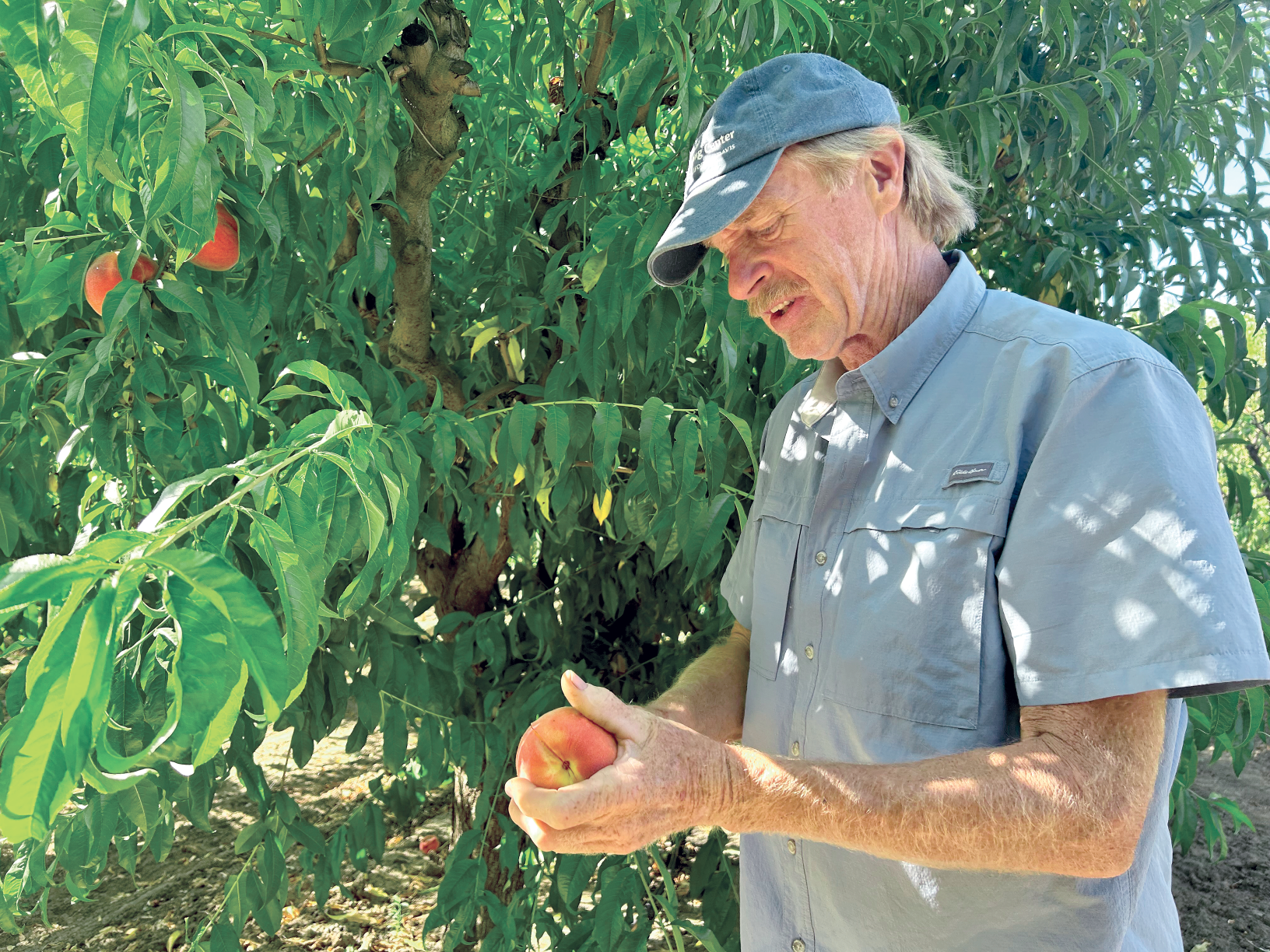
Thomas Gradziel, a plant geneticist at the University of California, Davis, examines a Kader peach variety at an experimental orchard. He says the peach sector is breeding varieties that are firmer and more adaptable to machine harvesting and that are better equipped for challenges of climate change.
Photo/Christine Souza


Photo/Christine Souza
By Christine Souza
With the rising cost of labor and a shortage of skilled workers to hand-pick fruit, California canning peach growers are looking to science for solutions, including breeding new varieties that are firm and flavorful and could lead to greater adoption of mechanization at harvest.
“We’re going into a future where everything seems to be changing for growers. Labor costs are skyrocketing, regulations are skyrocketing, and climate is going through unpredictable changes,” said Thomas Gradziel, geneticist and professor in the Department of Plant Sciences at the University of California, Davis. “Because of the inevitable high cost of these changes, the best option for control is genetic options.”
New varieties are essential, he added, to make peach farming economically sustainable.
For more than 30 years, growers have funded breeding by Gradziel to develop new and improved clingstone peach varieties. Growers have about 50 commercial varieties to choose from, but a dwindling labor supply and a changing climate mean new varieties are needed.
Gradziel maintains 40 acres of peach varieties at the university’s Foundation Plant Services in Davis, and another 40 acres of parent stock at the UC Davis Wolfskill Experimental Orchard in Winters.
“Breeding programs like ours are pipelines,” Gradziel said, noting that breeding new varieties requires up to a 40-year commitment with years of testing by the university and field trials by growers before a variety is introduced.
“Every year, you’re putting in new material and bringing out material from that previous five to 10 years, so it’s a constant progression,” Gradziel said.
To develop the “stay-ripe” trait, which allows the fruit to remain on the tree longer without deteriorating, he brought genes in from two related species—almonds and wild peach. The trait brings cling peach growers a step closer to mechanized harvest in which only one pass may be needed.
Flavor is essential, Gradziel said, noting the fruit must have good soluble solids and a good sugar-acid ratio. Other traits Gradziel brings in include firmness, disease resistance, pest resistance, tolerance to heat and tolerance to salinity.
“As we’re looking at this new germplasm that has a whole range of new characteristics, we’re looking for things like the stay-ripe characteristic, things that are more mechanically harvestable and where, even under low chill, we get uniform flowering and good fruit set,” Gradziel said.
At Wolfskill, from the parental blocks, Gradziel said he has a one- to two-week window to generate about 10,000 successful crosses. Ten-thousand seedlings may offer a 20% set, so he needs 50,000 to 80,000 new crosses annually.
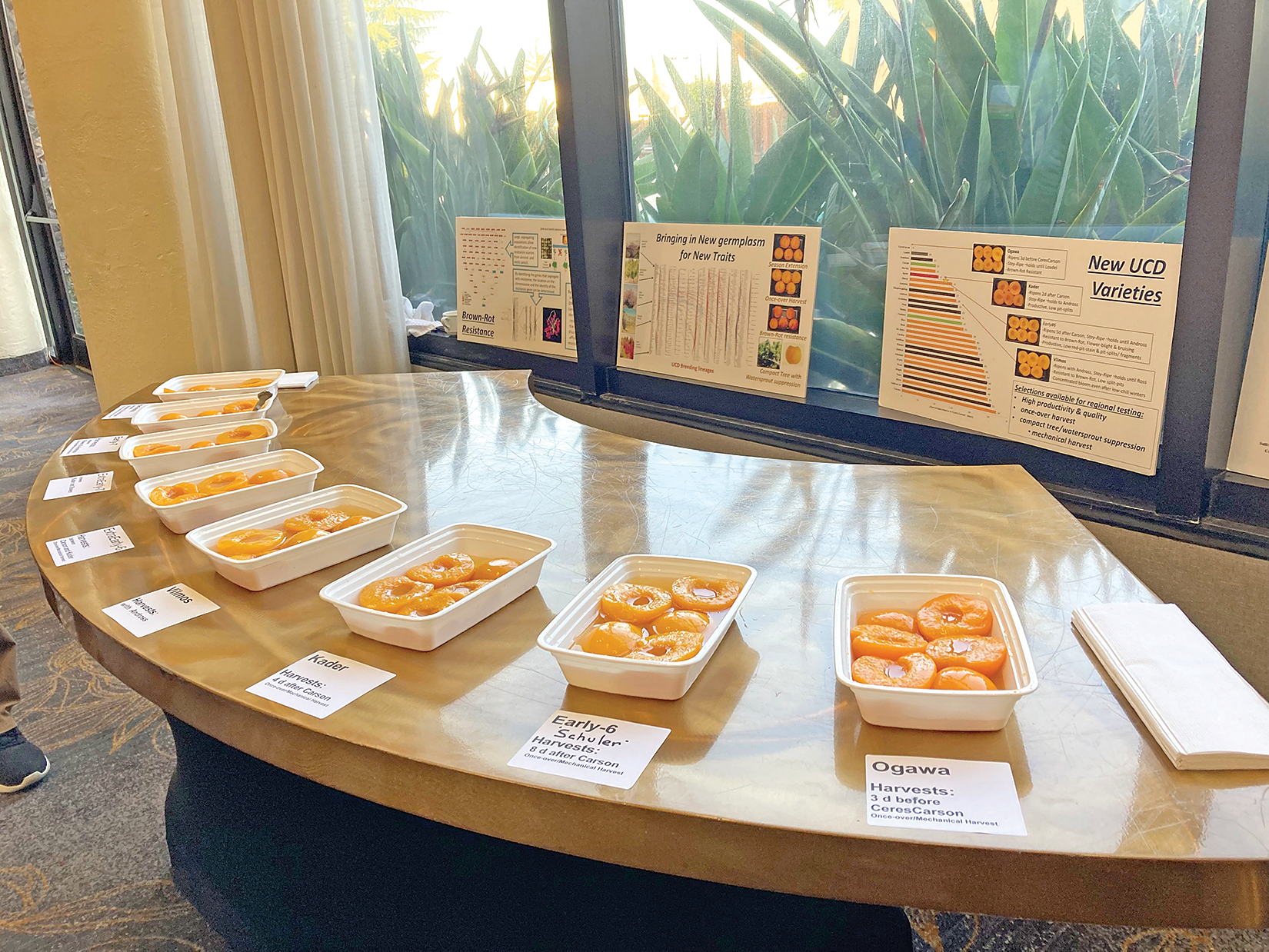
Tested for 20 years, the early-season Kader variety can fill a gap in supply for canneries, while also ticking other boxes. Gradziel noted that Kader produces uniform flowers under low chill, so he said he is confident it will do better than traditional varieties. Plus, it has the stay-ripe trait.
It remains to be seen whether Kader will do well in all cling peach-growing regions, he said. The university’s Schuler, another early-season, stay-ripe variety, contains a gene that shuts down red pigment in the fruit and reduces pit staining.
“As a farmer, you want the best producing varieties,” said Robbie Bains, who grows cling peaches in Sutter and Yuba counties and operates a custom harvesting business.
He said farmers must have varieties for canners throughout the growing season, and some varieties work better machine-harvested than others. To limit fruit damage, Bains modified his “catch-frame” harvesting machines to have a lighter touch, and he tries to grow firmer varieties such as the Kingsburg Kling.
“For mechanical harvesting, you want the fruit to be a little bit on the greener side, so it’s a firmer peach and can take a little bit more of the blow as it goes,” Bains said. “If you pick it mechanically, it still looks really good when we put it in the bin, but it deteriorates a lot faster, so it is just a matter of how quickly we can get it into a can.”
UC Davis researchers are also working on the next generation of harvesters that shake the tree and avoid bruising the soft fruit. But these systems are years away from use in orchards, said Rich Hudgins, president and CEO of the California Canning Peach Association.
In 2022, about 10% of California cling peaches were mechanically harvested. Hudgins said he anticipates the percentage of peaches harvested by machine will increase slightly this year.
“For us to be successful in converting to more mechanical harvest in our orchards, we need peaches that have firm enough pressure to withstand the mechanical harvest process,” Hudgins said. “We have to have uniform ripening so that all of the peaches have proper maturity when removed from the tree.”
Hudgins added that shorter trees on semi-dwarf rootstock are promising and would help growers reduce labor costs, which are 70% of a grower’s total costs. Shorter trees mean pickers spend less time on the ladder and more time picking fruit closer to the ground.
“California growers are the best in the world as far as production efficiency, but we are also one of the highest-cost producers in the world given our labor costs and the regulatory climate in the state,” Hudgins said. “The answer for us long term will be to reduce our labor component and play to our strength in being efficient producers with high-yielding varieties.”
Bains said he believes new technology such as mechanization and robotics are the future.
“It’s far away, but it’s not that far away,” he said. “That (robotic) technology will trickle down into farming. Maybe I will see it in 15 years.”
(Christine Souza is an assistant editor of Ag Alert. She may be contacted at csouza@cfbf.com.)





.svg.png)
