


UC highlights new technology to battle pests, weeds


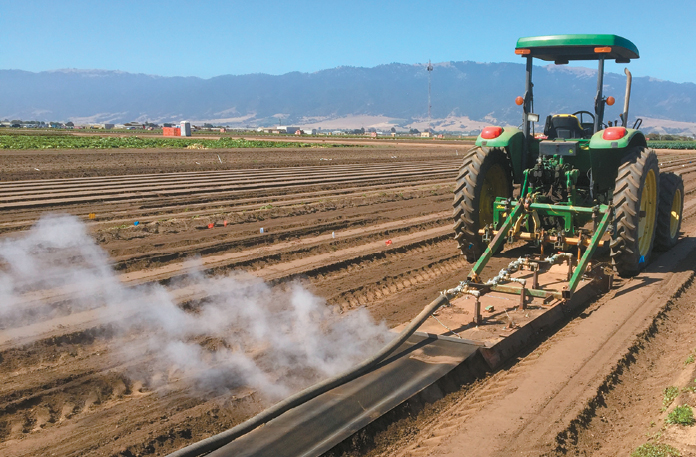
Photo/Courtesy Steve Fennimore/University of California
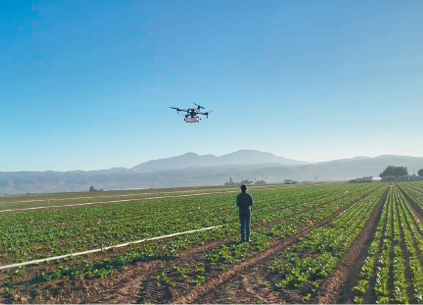
Photo/Courtesy Addie Abrams/University of California
By Bob Johnson
California vegetable growers may benefit from new and improved technologies that allow them to manage pests and weeds, while reducing reliance on pesticide applications.
Rather than hand weeding, steam treatment of a band of soil along the seed line may be an economical way to manage weeds in lettuce and reduce the need for chemical fumigation, according to researchers at the University of California Cooperative Extension, who led presentations on integrated pest management at a meeting last month in Salinas.
“In vegetable crops, we have a shortage of new registered herbicides. We have to create our own technology,” said Steve Fennimore, a UCCE vegetable weed specialist in Salinas. “We use Kerb, which was registered in 1972, and Dacthal, which was registered when (Dwight D.) Eisenhower was president.”
Previous UC experiments have shown steam to be as effective as any fumigant in managing weeds or pathogens in vegetables, he said. The problem is treating the entire bed with steam is too slow and expensive to be a viable alternative.
“There are engineering solutions to make steam viable for weed control,” said Fennimore, who studies chemical and nonchemical methods of weed control with the objective of reducing costs and to develop automated weeding systems to mitigate labor challenges.
Hand weeding iceberg lettuce costs an average of $635 an acre, according to a 2023 UCCE study on the sample costs to produce and harvest film-wrapped iceberg lettuce. The figures for production cost in that study were derived from interviews with vegetable growers in Monterey, Santa Cruz and San Benito counties.
Steam treating a band of soil along the seed line can rid the planting bed of pathogens and viable weed seeds. Applying a spot treatment to the area where the crop is planted reduces the need for steam by 93%, Fennimore said.
“With a 4- to 5-inch band, we’re treating the weeds that are most expensive to remove by hand,” Fennimore said. “Steam reduced hand weeding, improved lettuce vigor compared to Kerb and also helped to control pythium wilt.”
In the 2023 trials, the application of a band of steam 4 inches wide and 5 inches deep reduced purslane weeds in the seed line by 99%, shepherd’s purse by 88% and little mallow by 42%.
“It’s not knockout, but it’s pretty good,” Fennimore said. “Steam also worked with onions. There were fewer weeds and more large onions than with Dacthal.”
UC researchers are studying whether the band-steaming alternative offers some control of fusarium wilt in lettuce.
“A French machine makes steam that is 400 degrees Fahrenheit, which disperses better in the soil,” Fennimore said.
Fennimore is also working with a self-propelled machine that can steam-treat a band along the seed line in beds that are 40,42, 80 or 84 inches wide.
Other researchers at the meeting shared other new technology that may help vegetable growers achieve better weed control with reduced reliance on chemical herbicides.
Spinach growers, who face the challenge of removing weeds in beds planted so densely they create a carpet of spinach, may also benefit.
A laser reduced spinach weeds by 80% to 85%,” Fennimore said.
The laser machine uses cameras and software to distinguish small weeds from young vegetable seedlings and removes the weeds with precisely targeted lasers, he added.
In another experiment, researchers said releasing beneficial insects from drones shows promising results to help manage thrips. The beneficial insects are applied using drones equipped with cylinders that release the small insects uniformly as the drone makes passes across the field.
Use of drones can save money and improve uniformity compared to releasing the beneficials by hand while slowly walking across the field.
Western flower thrips are a threat to lettuce because after the tiny insects feed on a plant infected with impatiens necrotic spot virus, they can transmit the destructive disease to other plants they feed on.
“These drones have cylinders that rotate and release green lacewings and predatory mites,” said Addie Abrams, a UC Davis postgraduate researcher in the lab of UCCE entomology specialist Ian Grettenberger. “We released them in insectary or noncrop areas. The data will be available soon.”
UC researchers noted that precision applicators show promise. Putting the material directly on small plants improves targeted insecticide use while maintaining pest control.
“A precision sprayer only applies the spray in a targeted band,” Abrams said. “This technology allows us to concentrate product on the plant.”
Precision technology has been tested with systemic materials used to control aphids that are taken up by young lettuce plants. Seedlings in the studies were treated with insecticides spirotetramat or Movento, and thiamethoxam or Mentara, which are taken up by the plant to provide long-term aphid control.
(Bob Johnson is a reporter in Monterey County. He may be contacted at bjohn11135@gmail.com.)





.svg.png)
