


Commentary: New overtime rule cut earnings for farm employees
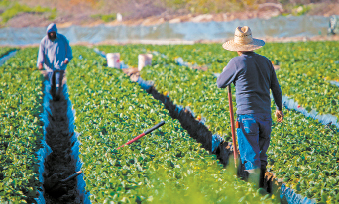
Supporters of Assembly Bill 1066 said California’s farm workforce would see higher paychecks under the new overtime law for agriculture. Instead, the bill resulted in decreased hours and income.



By Bryan Little
In 2016, when the California Legislature contemplated Assembly Bill 1066 to phase out agricultural overtime rules in place since 1977, advocates for agriculture warned policymakers of adverse consequences for farm employers and employees alike.
But the bill’s author, then-Assembly Member and now California Labor Federation President Lorena Gonzalez argued that the legislation would increase earnings and set a historic example for other states to follow.
Seven years after Gov. Jerry Brown signed AB 1066 into law, the results are in. According to research from the University of California, Berkeley, agricultural workers have seen reduced work hours and less income since 2019 and 2020, when AB 1066 triggered the first adjustments to overtime rules for the largest, best-resourced California agricultural employers.
Before AB 1066, farm employees were allowed to work up to 10 hours a day for six days a week before time-and-a-half overtime pay was required.
In 2019, farms with 26 or more employees were required under AB 1066 to pay overtime pay after 9 ½ hours in a workday or 55 hours in a workweek. Beginning in 2022, employers of 25 or more employees were required to pay overtime premiums after 8 hours in a day or 40 hours in a week. That standard is to kick in on Jan. 1, 2025, for employers with 25 or fewer workers.
However, the eight-hour workday and 40-hour workweek fail to recognize the fundamental reality of agriculture. Farm work is available to employees seasonally—during planting, pruning, cultivation and harvesting—and for much of the year, not at all.
The wisdom of allowing for overtime in agricultural employment after 10 hours a day for as many as six days in a workweek lies in the fundamental fact that agricultural employees need to work when work is available to them. For years, California wage-and-hour policy recognized this reality—until the passage of AB 1066.
The research of Alexendra E. Hill of UC Berkeley confirms what the California Farm Bureau and other agriculture advocates predicted at the time of AB 1066’s passage. The bill led to decreases in weekly working hours and earnings for California crop workers. The results are hardly an example for other states to follow.
Hill noted that “these losses are consistent with employers restricting hours to avoid paying the higher overtime rates.”
Hill’s analysis is based on California agricultural employees’ self-reported working hours and earnings to the National Agricultural Worker Survey, a widely respected and long-running U.S. Department of Labor survey of agricultural employees’ working and living conditions.
Hill’s analysis covers only the first two years of implementation of AB 1066. But, based on initial findings, employers in coming years will be hard-pressed to afford to pay overtime wages. Smaller farms can be expected to be even more careful to control overtime wage costs to remain competitive while producing in California.
Any agricultural producer can tell you that farmers and ranchers don’t dictate the prices they can charge for their products.Markets that are beyond their control dictate that. As AB 1066 has added to production costs for agricultural producers, it has also harmed farm employees.
Asked by a journalist for comment on Hill’s research, a spokesperson for the United Farm Workers offered a tepid defense of AB 1066: “We have an option to keep fighting for an agricultural economy in which workers are treated with dignity and have a real say.”
Sadly, that is a unique piece of rhetorical art in defense of legislation that has resulted in depriving agricultural workers of actual earnings, which farm employees and their families depend on. A law that results in fewer working hours and less pay hardly offers anyone much dignity.
It is also likely that the implementation of AB 1066 in the years after 2020 will show that its negative impacts have only been magnified in damage to rural economies and communities. These are communities that have suffered the worst impacts of drought, flooding and COVID-19. They have faced housing shortages and high housing costs, healthcare shortages, underperforming public schools and underfunded public services.
Following the implementation of AB 1066, emboldened labor advocates went on to pass AB 2183 in 2022. As a result, that union organizing legislation now deprives California agricultural employees of the right to a state-supervised, secret ballot elections. What will agricultural workers get? The opportunity to surrender 3% of their wages for union representation.
Based on false promises of AB 1066, it is hard to imagine farm employees will see any rewards from AB 2183. Our agricultural workers and communities deserve better than dubious pledges and misguided legislation that fail to help anyone.
(Bryan Little is director of employment policy for California Farm Bureau and chief operating officer of Farm Employers Labor Service, or FELS. He may be contacted at blittle@cfbf.com.)





.svg.png)
