


National delegates adopt policies vital to California
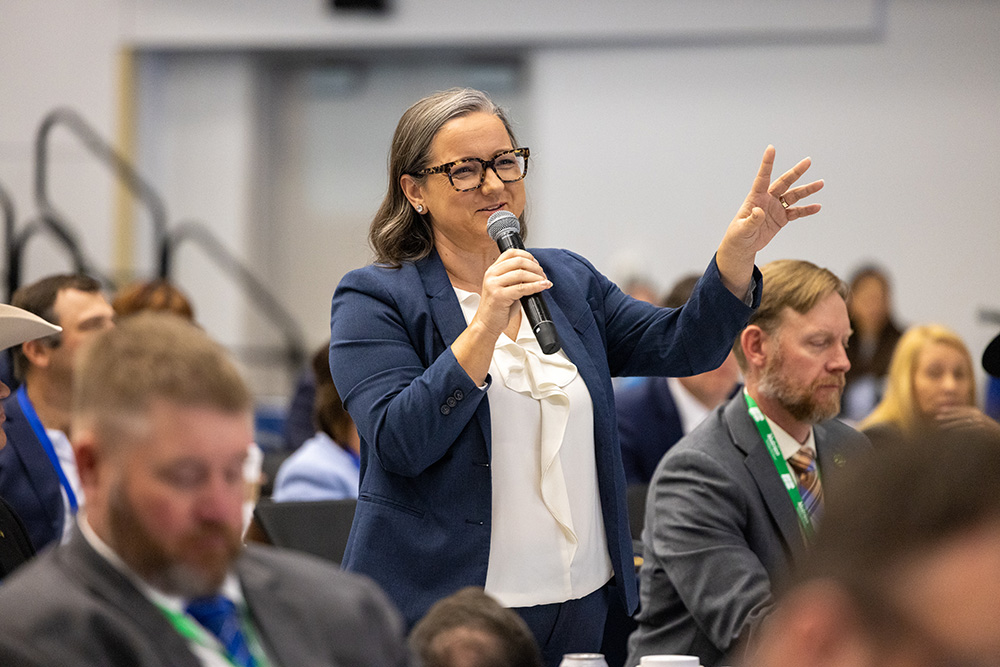
California Farm Bureau President Shannon Douglass, with First Vice President Shaun Crook seated right, speaks at the American Farm Bureau Federation Annual Convention delegate session.
Photo/Courtesy of American Farm Bureau Federation


By Ching Lee
California delegates to the American Farm Bureau Federation succeeded in advancing several changes to the organization’s policy on water use and table wine.
AFBF adopted all four of the policy changes that California Farm Bureau submitted through the delegate process during the 107th AFBF Annual Convention in Anaheim Jan. 9-14. The policies approved at the meeting will direct the nation’s largest general farm organization in its legislative and regulatory efforts in 2026.
The convention drew 4,500 registered attendees and 110 speakers, according to AFBF. Prior to this year, California last hosted the AFBF convention in 2015, in San Diego. AFBF was scheduled to hold its 102nd annual convention in San Diego in 2021, but the event was moved online due to COVID-19 safety restrictions and concerns.
California Farm Bureau President Shannon Douglass, who is an AFBF voting delegate, welcomed the opportunity to showcase the state’s diverse agriculture and spotlight the unique challenges its members face. She praised the months of work by Farm Bureau members and staff during the past year, especially at the organization’s commodity advisory committee meetings, which helped the state Farm Bureau identify policy areas that needed discussion and change at the national level.
“The process starts at the county level,” she said. “Our members’ participation influences policy on key issues that affect their businesses and livelihood.”
For example, discussions about revising an AFBF policy on table wine started at the Sonoma County Farm Bureau, which brought attention to a loophole in the U.S. duty drawback program that has become a de facto import subsidy. The program distorts the U.S. wine market and provides a significant cost advantage to large companies that import low-cost foreign bulk wine, bottle it domestically and export a similar product. The importers can recover 99% of duties, taxes and fees, resulting in millions of gallons of imported wine entering the U.S. virtually tax-free.
During AFBF’s delegate session, California Farm Bureau pointed out that the ongoing misuse of the duty drawback system has hurt domestic winegrape growers and wineries and cost American taxpayers billions of dollars. AFBF delegates adopted a policy change in support of closing the loophole for imported wine.
Matthew Viohl, a federal policy director for the California Farm Bureau, noted the state Farm Bureau first took up the issue last year during its policy development process, and the change is already reflected in California Farm Bureau’s policy book.
“Inclusion in AFBF policy now enables Farm Bureau advocates in Washington, D.C., to engage lawmakers and federal agencies on this issue,” he said.
California Farm Bureau also successfully advocated three updates to AFBF water policy, following up on a request from AFBF for western states to review the organization’s water and land use policies to account for recent challenges.
One change relates to Colorado River diversions. With water rights, diversions and other issues impacting allotments of the Colorado River, the policy addition solidifies AFBF’s position promoting agriculture as the primary use for Colorado River diversions.
Another revision relates to water resource development. AFBF added language to its policy “prioritizing federal funding for the creation of new and improvement of existing water storage, recharge and conveyance projects in the western United States.”
Given the significant challenges facing many western states on water storage and infrastructure, Douglass said inclusion of this language “will be more direct in highlighting the need for federal efforts to boost storage, recharge and conveyance projects in the western U.S., particularly if the need to supersede state inaction is necessary.”
The third change deletes outdated language in AFBF policy to reflect the modern needs of the West related to the U.S. Bureau of Reclamation, Douglass said.
Due to the complex nature of water rights and the sprawling overlap on federal, state, local and tribal oversight, she said, “we believe it is important to have a guiding federal agency oversee water management in the western U.S.” She said the change also avoids complications in states that are unable or unwilling to address the challenges that impact agriculture in water-related issues.
That all four of the policy recommendations California Farm Bureau submitted sailed through without debate on the delegates floor is “a testament to the organization and the work that we’ve done over the past several years,” said California Farm Bureau First Vice President Shaun Crook, who is also an AFBF voting delegate.
“It’s not just a rubber stamp at the end of the year,” he said. “These are policies that have been discussed and thought through, and the changes have been well vetted when it comes time to cement them in the book.”
Viohl said AFBF continues to adjust the workforce and immigration sections of its policy book, which “tends to grow more than it shrinks year to year,” with some sections getting “very challenging to navigate” due to how dense and duplicative some of the language can be.
“We are hopeful the latest round of changes, primarily from AFBF’s Labor Issue Advisory Committee meeting, will help make it easier to get the industry aligned behind comprehensive labor legislation eventually,” Viohl said.
AFBF President Zippy Duvall said the discussions during the voting session highlighted how farmers across the nation continue to struggle with high production costs, trade imbalances and low commodity prices. The policies the delegates set give AFBF “clear guidance on how we should address those challenges in the coming year.”
Throughout the convention, California voices helped shape national conversation through different workshops and sessions. For example, Douglass joined senior leaders from the U.S. Department of Agriculture in a discussion about how the department is adapting disaster assistance, conservation tools and crop insurance to better meet the realities of specialty crop producers.
California Farm Bureau staff and different county Farm Bureau directors and members also participated in workshop discussions on topics ranging from how Farm Bureau organized a coalition to defeat a local initiative in Northern California that would have been destructive to family farms; how beginning farmers and ranchers are finding ways to make their businesses work; reducing the stigma around mental health; the rich history of Orange County agriculture; and opportunities and challenges of agricultural workforce reforms and what to expect in the next three years.
Meanwhile, California’s Young Farmers & Ranchers competitors advanced on the national stage, with Ben Abatti of Imperial County YF&R earning a spot in the Top 10 of the Achievement Award competition and Leah Groves of Trinity County YF&R advancing to the Top 10 in the Excellence in Agriculture Award. J.P. Beall of San Bernardino County YF&R also represented the Golden State in the Discussion Meet, reaching the Top 16 and showcasing dialogue on issues facing agriculture.
“We could not be more proud of our YF&R award competitors for what they’ve accomplished at the national level and how well they represented California agriculture with their dedication, innovation and leadership,” Douglass said.
In addition, California Farm Bureau and the affiliated Farm Employers Labor Service, or FELS, participated in the Farm Bureau Gives Back campaign by volunteering to pack heat-safety kits to support farmworkers and promote heat illness prevention. FELS plans to distribute the bags—each of which contains sunscreen, Chapstick, a water bottle, electrolytes, two scarves and a large-brimmed hat—throughout California this year.
Ching Lee is senior editor of Ag Alert. She can be reached at clee@cfbf.com. Connor Duncan, a strategic communications analyst for the California Farm Bureau, contributed to this report.






.svg.png)
