


Citrus growers assess risk of new vein clearing virus
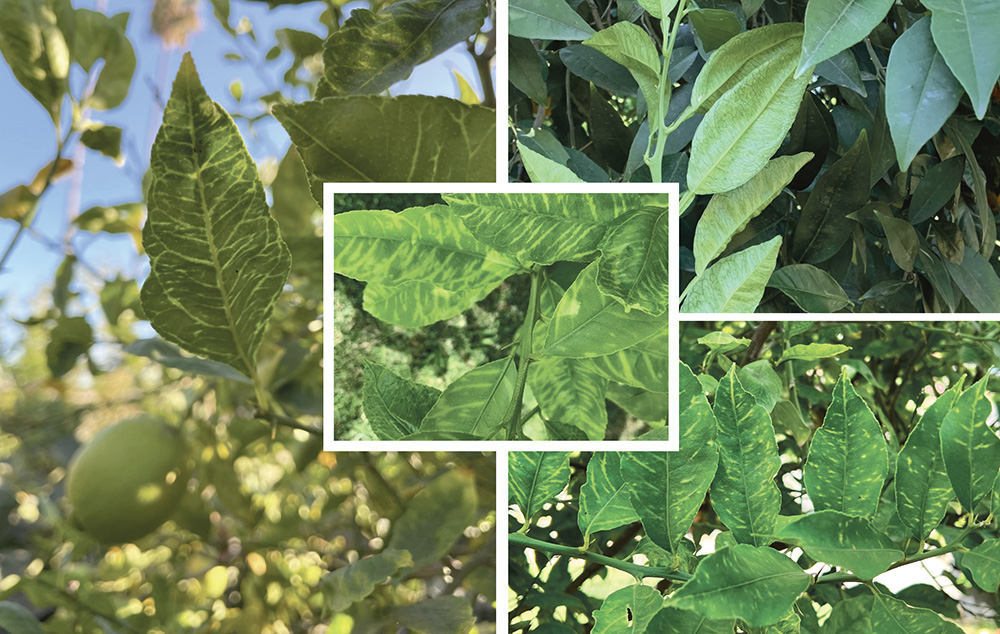
A lemon tree in a Tulare County residence, left, shows classic symptoms of citrus yellow vein clearing virus, which include vein clearing when viewed from the top of the leaves and water soaking when viewed from the bottom, center and lower right. At top right, a sour orange rootstock (lighter green plant) exhibits vein clearing while the adjacent Meyer lemon scion is asymptomatic.
Left Photo/Courtesy of the California Department of Food and Agriculture
Center Photo/Courtesy of University of California
Upper Right Photo/Courtesy of the California Department of Food and Agriculture
Lower Right Photo/Courtesy of University of California


By Vicky Boyd
A new citrus disease that so far remains confined to residential trees has industry leaders taking what they describe as a measured approach because of the unknown risks it poses.
Caused by the citrus yellow vein clearing virus, the disease was confirmed in residential citrus trees during multipest citrus surveys in Tulare County in 2022 and in residential trees in Hacienda Heights near Los Angeles in 2023. The discoveries marked the first time CYVCV had been confirmed in the Americas.
“It’s something that’s still relatively new,” said Casey Creamer, president and CEO of California Citrus Mutual. “I think the way we try to approach things is to put the appropriate amount of concern around it based on the level of risk it poses.”
Keith Watkins, vice president of Fowler-based Bee Sweet Citrus and chairman of the Citrus Pest and Disease Prevention Program Committee, said producers are keeping an eye on CYVCV.
“We’re concerned any time you have a new disease that you’re not sure of how it’s going to do in your environment,” he said. “Fortunately, this doesn’t seem to be too virulent. Trees that have been tested look pretty healthy.”
Watkins acknowledged producers still have a lot to learn about the new virus and rely on researchers to provide the answers.
Meanwhile, he said the industry remains more focused on other pests of greater economic importance, such as the Asian citrus psyllid and the lethal citrus disease the insect can spread, huanglongbing, also known as citrus greening.
Mark McBroom, owner of Bloom to Box Crop Care custom farm management in Brawley and chairman of the Citrus Research Board, agreed.
“Along with everything else we’re combating, (CYVCV) doesn’t seem to be the type of virus, in my opinion, that really deserves to be up front of any major projects or resources or staffing,” he said.
He pointed to a Tulare County residence with one of the first confirmed CYVCV-infested trees. The homeowner frequently gave his citrus away and was known among his neighbors for high-quality, flavorful fruit. In this case, McBroom said, the virus didn’t seem to affect production.
Even in countries that already have CYVCV, Creamer said data on yield impacts are limited. A 2020 article in the Horticultural Plant Journal reported a 20% yield reduction in infected Eureka lemons in China but not in other lemon varieties. The journal authors also discussed groove-like malformations in mandarins and concluded that more information about CYVCV, conducive environments and susceptible cultivars is “urgently needed.”
How the disease responds to California’s climate and production systems are topics the Citrus Research Board, University of California and U.S. Department of Agriculture Agricultural Research Service are tackling.
Until more is known about the disease, Creamer and California Department of Food and Agriculture spokesman Jay Van Rein recommended growers follow best management practices for other citrus pests.
“Harvesters and farm labor contractors operate under a compliance agreement that requires cleaning and sanitation of equipment between groves, which should help protect against the mechanical spread of plant pathogens,” Van Rein said. “Sanitation practices should be followed for both industry and residential properties to reduce the risk of spreading CYVCV.”
Using clean, virus-free plant material to propagate trees also is an important part of disease-prevention strategies, said Georgios Vidalakis, director of the Citrus Clonal Protection Program.
The program now offers virus-free citrus budwood from about 400 different citrus cultivars to commercial producers and homeowners through its website, https://ccpp.ucr.edu/. Users can purchase as few as three buds.
The program also tests and cleans budwood so users can propagate additional trees without fear of spreading diseases, Vidalakis said.
“The best vectors of plant disease are humans. We’re good at moving those diseases around,” he added.
CYVCV was discovered during multipest citrus surveys the state began a few years ago. After the first positive tests in Tulare County, CDFA conducted delimiting surveys and sampling to determine the extent of the infections, Van Rein said. More than 550 residential citrus trees, including lemons and eight citrus species previously not known to become infected under field conditions tested positive for CYVCV.
The large number of infected trees hints at the disease being in the area for some time, Creamer said. The first detection in Hacienda Heights was in a residential citrus tree with 23 different varieties budded onto it, making it nearly impossible to tell the infection’s source, said Vidalakis, who was involved with disease testing and identification. The tree also tested positive for huanglongbing.
Why CYVCV hasn’t become more widespread or an issue for commercial growers is one of the unanswered questions.
CDFA continues to survey residential areas as well as commercial citrus orchards and citrus nurseries as part of the multipest detection program, Van Rein said.
In response to the CYVCV discoveries, CDFA last October enacted interior quarantines around the positive finds in Tulare County and the Hacienda Heights area. The designations, which regulate plant and fruit movement within the quarantine boundaries, are designed to prevent the spread of pests not widely distributed in California.
Currently, no Tulare County commercial citrus producers or packinghouses are affected by the interior quarantines, Van Rein said.
The USDA has not implemented exterior quarantines, which would regulate fruit or plant material moving interstate or export.
CYVCV can infect citrus and a number of other plants, including grapes, according to literature. The virus can be spread by whiteflies, green citrus aphids, melon or cotton aphids and cowpea aphids, all of which are found in California.
Infected plant material, budwood and rootstock as well as contaminated tools and equipment also can transmit the virus.
Disease symptoms include water-soaked leaves, yellow or clear veins when leaves are held up to the light and wrinkled or distorted foliage. In severe cases, infected trees may die back and produce misshapen fruit.
While sour oranges and lemons exhibit the most visible symptoms, numerous other citrus cultivars can become infected but remain asymptomatic. Even in sour oranges and lemons, the symptoms may become significantly less pronounced during summer heat.
Vicky Boyd is a reporter in Modesto. She can be reached at agalert@cfbf.com.






.svg.png)
