


English language program helps farms, employees
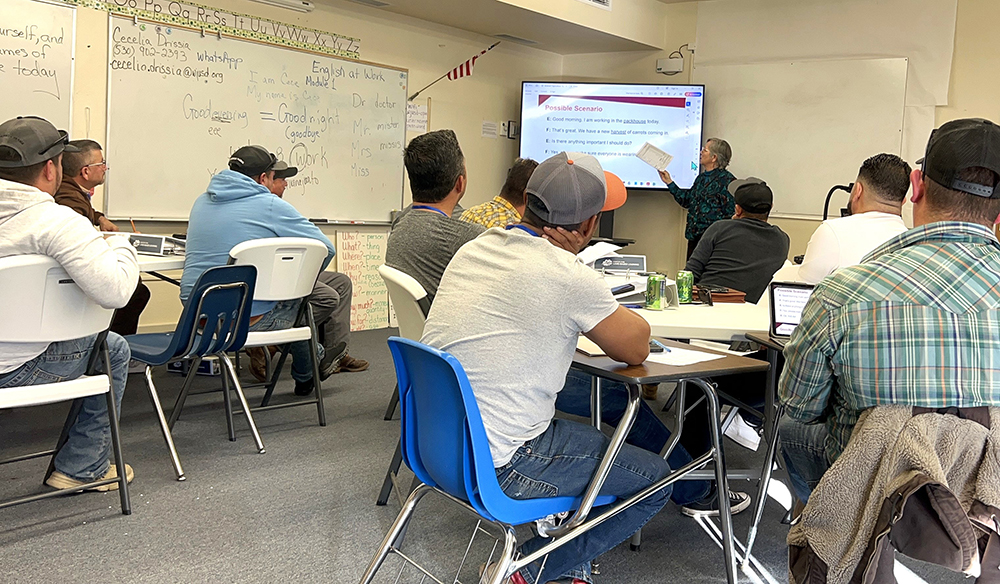
Instructor Cecelia Drissia delivers the English Advance training to a group of employees of agricultural businesses in Yolo County.
Photo/Courtesy of National Immigration Forum


By Ana Negoescu and Bryan Little
For nearly a century, Spanish-speaking workers have been a critical part of American agriculture’s labor force. While the people coming to work on farms bring their talent, loyalty and leadership to the vital work they do, language barriers often create difficulty when it comes to elevating employees to supervisor or leadership roles.

The Pinery LLC, a California-based, family-owned tree grower and wholesale plant nursery, understands that struggle all too well. A member of Farm Employers Labor Service, a California Farm Bureau-affiliated company, The Pinery—like many employers—was looking for ways to improve its employees’ productivity and safety on the job while also retaining valuable talent.
This need is what brought The Pinery to English Advance, a project of the National Immigration Forum. It’s a project that can benefit all of us.
English Advance provides agriculture-tailored English instruction to farmworkers, giving them the communication tools they need to continue their path to success. With funding leveraged from the California Employment Training Panel Workforce Literacy Pilot, The Pinery was able to offer classes designed in partnership with FELS and taught by community college faculty during the workday.
Leaders at The Pinery see the program as a way to invest in employees, strengthen operations and prepare leaders, according to a manager who saw the success of the program through their employees’ growth. The business has decided to continue to invest in its workforce by offering another class next year.
It’s a sentiment shared across industries in which, over the past few years, English Advance has helped employees succeed thanks to their hard work and employers’ forethought. Now we’re excited to offer a special program tailored to the needs of farmworkers and their employers.
These English lessons are created with agriculture settings in mind. Students learn English language skills related to farm operations; employee safety; hygiene and food safety; team leadership and communication; interactions with human resources, landowners and upper management; and other sector best practices and regulations.
The agricultural industry is facing a nationwide labor shortage that we have seen coming for several years. The workforce is aging, and people whose families have been working in agriculture for centuries are now choosing different paths. Farms are facing these challenges head on, but every little bit of assistance and reinforcement helps.

Here in California, the need is great: California agriculture relies on the talents and skills of our workforce to produce the food that feeds America. That’s why the California Farm Bureau and FELS partner with the Forum to develop and deliver English Advance to member businesses.
It’s a true partnership, with the Farm Bureau and FELS sharing not only our workforce challenges but also our existing training materials to inform a tailored English Advance curriculum and real-life, relevant language practice scenarios.
English Advance is one way to solidify the foundations that make a strong labor force, retaining existing talent while giving new talent the tools they need to succeed.
According to the 2022 National Agricultural Workers Survey, 73% of agricultural workers in the United States are Hispanic, coming predominantly from Mexico or Central America. With Spanish speakers making up so much of the workforce, the services employers offer can help get and keep employees on the job and on a clear path up the leadership ladder.
The Center for Land Based Learning’s AgHire program, a leadership training for the Spanish-speaking farm workforce, addresses this part of the workforce and has incorporated English Advance. As a result, employers have extra help in providing training in leadership and communications, digital literacy, regulatory awareness and English.
English Advance’s contextualized curriculum helps workers improve on-the-job communication skills and enables them to advance into roles such as foreman, field supervisor and manager. After piloting this model with 12 employers in 2025, we anticipate new cohorts this year.
With the challenges currently facing the agricultural industry, it’s important to focus on finding the best ways to adapt and grow. Without good workers, farms cannot function. Americans depend on us.
English Advance is ready to partner and help meet these challenges.
Interested California agricultural businesses, local Farm Bureaus and other organizations supporting the workforce can offer and cover the cost of training any time—and through April 1, businesses can leverage existing funding through the Employment Training Panel to access the training program at no charge. If you are interested in offering English Advance to your employees or for more information, contact Ana Negoescu at anegoescu@forumtogether.org.
Ana Negoescu is assistant vice president of Workforce Advance at the National Immigration Forum. She can be reached at anegoescu@forumtogether.org. Bryan Little is senior director of policy advocacy for the California Farm Bureau and chief operating officer for the affiliated Farm Employers Labor Service. He can be reached at blittle@cfbf.com.





.svg.png)
