


Del Monte cannery closure devastates California fruit growers
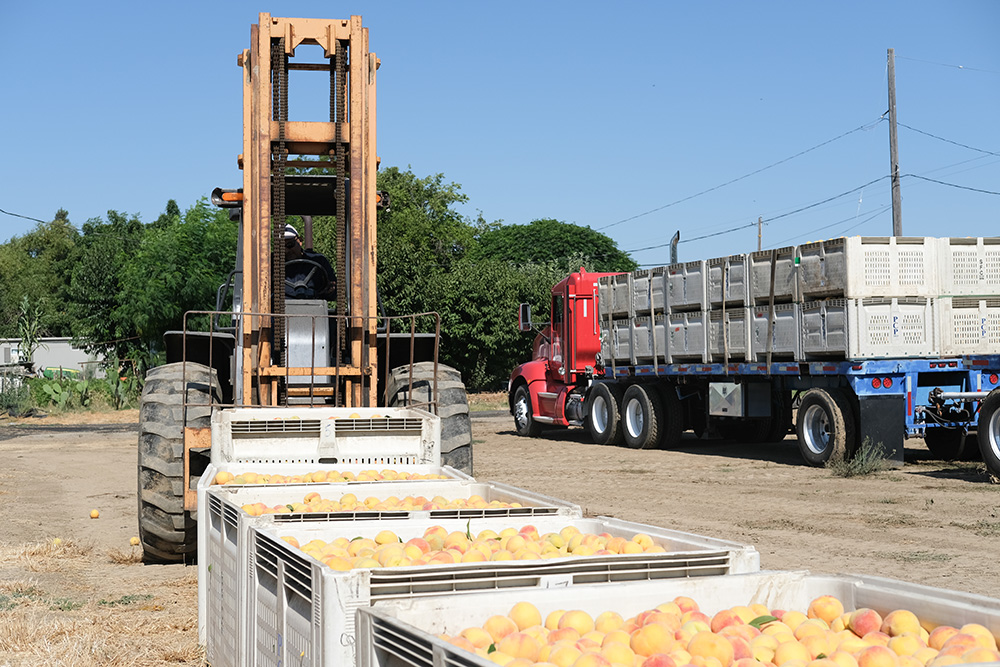
Cling peaches are loaded onto a truck last year in Sutter County.
Photo/Caleb Hampton


By Caleb Hampton
California farmers who grow fruit for canned products suffered a major setback last week as Del Monte Foods announced plans to close its only remaining cannery in the state.
The Walnut Creek-based company filed for bankruptcy in July, citing burdensome debt payments stemming from a prior acquisition of the company and missteps in long-term fruit purchasing commitments made when sales briefly spiked during the pandemic.
This month, following a lengthy court-supervised bidding process, Del Monte auctioned off many of its assets, but no buyer came forward to purchase the company’s cannery in Modesto.
“As a result, Del Monte Foods has made the difficult decision to begin an orderly wind-down of operations at the facility,” the company said in a statement. “We recognize the significant impact this decision will have on our team members, their families, and the community.”
The cannery’s closure will reportedly affect roughly 600 employees and 1,200 seasonal workers in Modesto.
The closure ends Del Monte’s more than 100-year history as a processor of California-grown fruits and vegetables, potentially leaving scores of farmers without a buyer for their produce.
“It’s difficult,” said Ranjit Davit, who grows cling peaches in Sutter County and chairs the California Canning Peach Association’s board of directors. “Growers are very upset about the situation.”
Farmers who planted fruit orchards under long-term contracts with Del Monte said they were weighing their options and bracing for steep losses.
Growers of cling peaches are especially impacted as the crop has no fresh market and is sold entirely to processors. In recent years, Del Monte contracted about 35% of California’s cling peaches, while Lodi-based Pacific Coast Producers contracted about 60% of the crop, with the rest purchased by a few smaller processors.
“It’s pretty devastating,” said Richard Lial, who grows cling peaches in San Joaquin County.
Cling peach growers typically plant new orchards—at a cost of several thousand dollars per acre—after securing contracts with processors that last 20 years, roughly the orchard’s lifespan. It can take close to a decade for a farmer to pay off the initial investment, and Del Monte’s exit from the sector means many growers may never make their money back.
A couple years ago, Lial tore out a productive almond orchard to clear the ground for 50 acres of peaches under a long-term contract with Del Monte. He planted the peach trees last year only to be left a year later with no buyer for the fruit.
“It’s horrible,” Lial said.
The third-generation grower farms a total of 105 acres of peaches, all of which was contracted with Del Monte. He said it may be possible to graft almond trees onto his young peach orchard, and to find a short-term buyer for some of the fruit from his bearing acreage, but neither outcome was certain.
The spacing in his peach orchard is “not ideal” for almonds, Lial said, and Del Monte’s departure will likely leave far more fruit on the market than other buyers can absorb.
“One of my options is just to take everything out,” he said. “It will be a total loss.”
Lial added that the closure of the Modesto cannery could have a “huge trickle-down effect” in the Central Valley, with impacts not only on cannery workers and farmers but on the farm workforce and agricultural supply companies. He said the loss of his peach acreage would likely force him to lay off two employees.
For decades, cling peach growers have faced declining demand due to the year-round availability of fresh fruit, while rising input costs and cheap imports have also challenged the sector. Since 1969, California’s bearing acreage declined from more than 63,000 to less than 14,000, according to the U.S. Department of Agriculture.
Chris Zanobini, executive director of the California Pear Advisory Board, said the state’s pear growers were similarly “concerned about whether they’ll be able to sell the fruit they grow” this year.
While pear growers have an important fresh market, most of the fruit is sold to canneries, with Del Monte purchasing more than 40% of the cannery tonnage last year.
Cling peach and pear growers alike said they were looking to PCP, the only major processor left in California, to potentially pick up their fruit.
The grower-owned cooperative purchased some assets from Del Monte during the bankruptcy sale, including unsold canned fruit inventory.
Mona Shulman, vice president of PCP, said the cooperative was also in the process of licensing some of Del Monte’s shelf-stable fruit product brands from Fresh Del Monte Produce Inc., a separate company that purchased the brands from Del Monte.
Shulman said PCP planned to contract more fruit acreage from farmers this year as the cooperative expands its private-label business to include Del Monte-branded products.
“We intend to market and sell the Del Monte brand going forward for shelf-stable fruits,” Shulman said. “In that mix, we will be acquiring more fruit than we currently process.”
As of this week, PCP, which processes fruit at canneries in Oroville and Lodi, was still assessing the volume and varieties it would need.
“We are in discussions currently for our peach supply needs with attention to varieties that deliver throughout the production season,” Shulman said, adding that PCP would procure fruit “to support a sustainable volume of Del Monte sales” but could not replace the company’s full production.
Unlike most fruit contracts, purchases made this year by PCP may represent a stopgap solution for growers rather than a long-term guarantee.
“It is possible that the contracts will be for a shorter term simply because we don’t know how this is going to work in the mix,” Shulman said. “To protect our company and not overcommit, it is likely a 20-year contract may not be the initial offering.”
Caleb Hampton is editor of Ag Alert. He can be reached at champton@cfbf.com.
See related news stories...
- Pear farmers seek to limit Argentine fruit in US market
- Peach growers await pivotal cannery sale
- Del Monte troubles shake up pear season







.svg.png)
