


Survey finds raids impacted California farm production
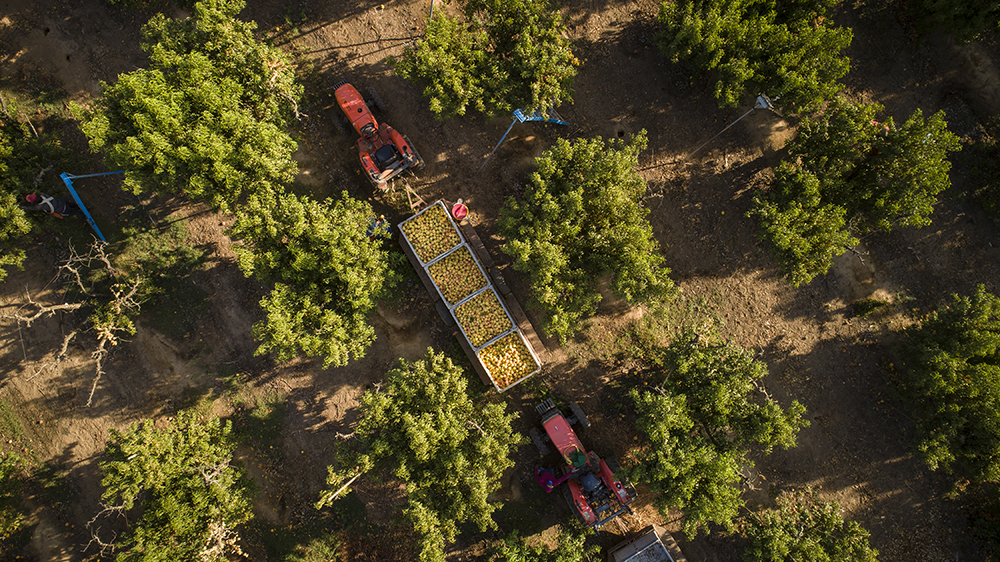
Peaches are harvested in Fresno County in 2022. California’s roughly 800,000 farmworkers help produce about three-quarters of the nation’s fruits and nuts and more than a third of its vegetables.
Photo/Tomas Ovalle


By Caleb Hampton
A new statewide survey has shed light on the impact during the past year of immigration enforcement on farms and farmworkers in California.
The California Farmer Immigration Enforcement Survey, which was conducted by researchers at Michigan State University in partnership with the California Farm Bureau, is the first of its kind to assess the impact of the Trump administration’s mass deportation agenda on California farms.
“We were really interested in understanding whether there have been labor shortages as a result of recent immigration enforcement,” said Zachariah Rutledge, assistant professor and extension specialist at Michigan State University.
Rutledge said the survey focused on California due in part to the state’s outsize role in labor-intensive specialty crop production. The Golden State is home to about a third of the nation’s farmworkers, and it produces more than a third of the country’s vegetables and about three-quarters of its fruits and nuts.
More than 500 farmers from across 50 of California’s 58 counties responded to the survey, which was conducted in late 2025 and early 2026.
Less than 1% of California farmers reported losing workers as a direct result of immigration enforcement. However, around 15% of the farmers surveyed said they lost workers due to concerns related to increased immigration enforcement.
“There were very few reports of direct immigration enforcement activities on farms,” Rutledge said. “There was more anxiety and fear among the farming community as a result of general immigration enforcement efforts more broadly.”
Orange County farmer Mark Lopez said immigration raids last year in Southern California caused about 60% of his 160 workers to stop going to work for two to three months. While there were no raids on his farm, he said the presence of federal agents at gas stations and hardware stores in the area frightened employees.
“Everybody was afraid,” including employees with legal status, Lopez said. “They were seeing people getting jammed up who didn’t do anything wrong.”
Even when there were no worker shortages, farmers said the heightened threat of immigration enforcement caused disruptions to daily farm operations.
Eight percent of surveyed farmers said immigration enforcement led to challenges, including difficulty securing workers, higher labor costs, longer workdays and shifting operations to nighttime to avoid the perceived risk of operating during the day.
An additional 7% of respondents reported heightened stress, anxiety or fear among workers or managers even in the absence of labor shortages.
In total, about a quarter of surveyed farmers said they experienced at least one negative outcome associated with immigration enforcement and the atmosphere around it.
“There was a lot of nervousness and concern and a lot of general disruption in a year when ag employers in California were already facing some pretty significant challenges,” said Bryan Little, senior director of policy advocacy for the California Farm Bureau and chief operating officer of the affiliated Farm Employers Labor Service.
Rutledge said the survey did not quantify the extent of production losses caused by immigration enforcement, but it did find that immigration enforcement impacted agricultural production in California.
About 14% of survey participants said they reduced production as a result of immigration enforcement. Those reductions may include instances in which farmers chose to plant less acreage because of anticipated instability in the workforce and incidents of crops spoiling due to an inability to harvest them.
“We haven’t seen major food shortages,” Rutledge said. But he added the production losses were “not trivial.”
Lopez, the Orange County farmer, said a substantial amount of his strawberry crop went unpicked because his workers were too afraid to report for work.
“When 60% of our people don’t come to work and we have orders placed, we get behind, and we can’t catch up,” he said. “Our fruit has to get harvested or it gets thrown away.”
Even after the strawberries had spoiled, Lopez said he still needed to pay workers to remove them from the plants to prevent rotten fruit from getting moldy and spreading mildew spores across his fields.
“You can’t do business when people don’t come to work,” he said, especially when “you have a commodity that can go bad.”
Farmers who reported labor losses resulting from concerns about immigration enforcement said they used a range of strategies to respond to the situation.
Responses included reducing produc-
tion, relying more on contract labor and hiring workers through the H-2A guestworker program.
Growers of labor-intensive crops such as fresh fruits and vegetables were the most likely to use the H-2A program when faced with labor losses.
Little, the Farm Bureau director and FELS executive, said there was strong interest from farmers throughout the past year in workshops designed to educate them about their rights and their workers’ rights with regard to immigration enforcement.
“We’ve done a lot of education,” he said.
For example, farmers were trained in how to uphold a California law that prohibits employers from voluntarily allowing immigration authorities to access private areas of a worksite without a judicial warrant.
“I think we did a really good job of not only informing the farmworkers of their rights but also the employers and what they can do to protect their fields,” said Norm Groot, executive director of the Monterey County Farm Bureau. “I think that made a big difference.”
Groot added that the Salinas Valley, where much of the nation’s fresh vegetables are grown, had not been a target of recent enforcement actions.
“We’ve been lucky so far,” he said.
California Farm Bureau has long advocated for federal legislation to create a pathway to legal status for longtime farmworkers.
“We still have the everlasting thought that one day our country will allow these people to come and work here and be here,” Lopez said. “When everybody is looking over their shoulder, that’s a problem.”
Caleb Hampton is editor of Ag Alert. He can be reached at champton@cfbf.com.






.svg.png)
