


Subpar snowpack pushes back crop plans for farmers
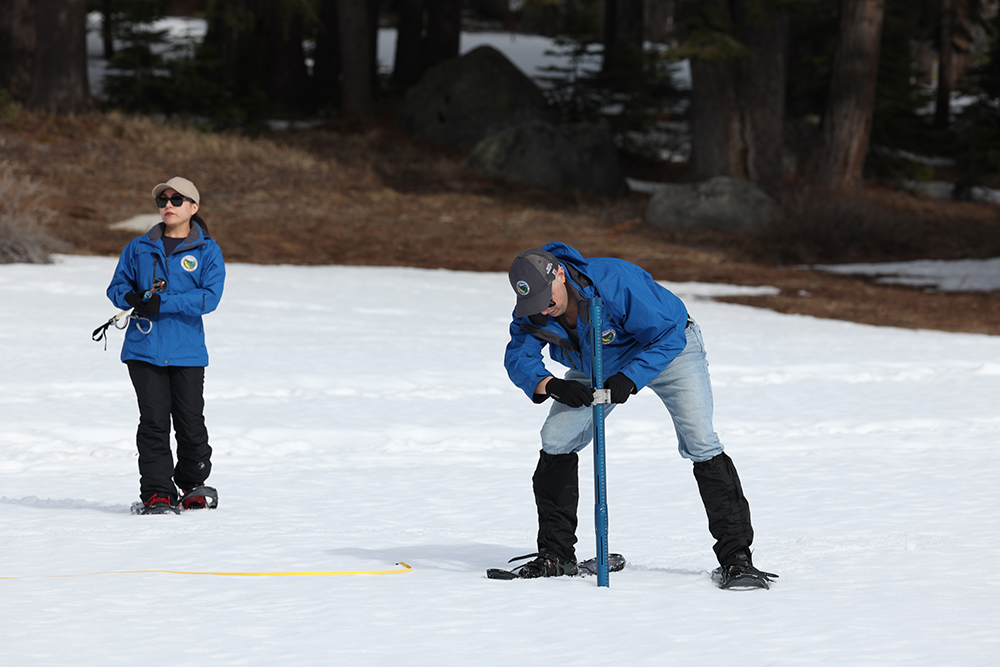
California Department of Water Resources engineer Jacob Kollen, right, and hydrometerologist Angelique Fabbiani-Leon measure the snowpack on Jan. 30 at Phillips Station in the Sierra Nevada.
Photo/Andrew Nixon/California Department of Water Resources


By Manola Secaira
Despite a strong start to California’s wet season, snowpack conditions remain below average.
A deficient snowpack could mean less water available for summer irrigation, threatening to cut surface water deliveries to farmers.
Rainfall at the end of last year helped boost water supplies, enough so that the U.S. Drought Monitor reported no drought conditions anywhere in the state in mid-January.
The rain also helped fill reservoirs throughout California and are currently at levels that meet or surpass their historical average for this time of year.
But in January, conditions dried up. State officials reported the snowpack was at 59% of average by the end of last month.
Andrew Schwartz, director of the University of California, Berkeley, Central Sierra Snow Lab, said the state still saw rainfall during this dry period. But Schwartz said that rain will not improve water supplies as much as precipitation that sticks around as snowpack.
“It’s been so warm that most of that has come in as rain, and we don’t have a lot of snowpack storage,” Schwartz said. “Then on top of it, over the month or so of dry conditions, (snowpack) actually melted quite a bit as well because of the warm conditions.”
Recent storms have helped.
Jay Lund, vice director of the UC Davis Center for Watershed Sciences, said there is still a chance more storms will boost snowpack levels to average before April, when they typically peak. With March and some of April ahead, Lund said California “can still get some decent-sized storms.
California’s snowpack supplies about 30% of the state’s water needs. Agriculture requires a chunk of that, accounting for about 40% of the state’s total water use and 80% of all water used by homes and businesses, according to the California Department of Water Resources.
“We need to have a good snowpack to ensure that the water releases that we’re doing from reservoirs and other management projects can be replenished,” Schwartz said.
San Joaquin Valley farmer Aaron Barcellos said he’s concerned about what water supplies he will be able to get from this winter’s snowpack, especially since about two-thirds of his farm’s water comes from snowpack storage.
The uncertainty has already begun to impact his planning—particularly with cotton, which he has grown since 1988.
“This would be the first year that we are actually thinking about not having any acres,” Barcellos said.
He said the decision seems likely given the current outlook for water allocations and the overall economics of cotton, which he described as “rough” for California farmers the past two or three years.
“That could change if pricing gets better or if we get a better allocation than we’re expecting right now,” Barcellos said. “But right now, we have no evidence of that. ...
“I can’t afford to take the risk from an economic standpoint that I’m going to put a valuable water resource on a crop that may not end up having enough water to finish,” he added.
Like other farmers in his position, Barcellos said his first priority is to irrigate permanent crops such as almonds that demand a lot of water. Other tree crops such as olives and pomegranates, which are more drought tolerant, come next in line.
Kings County farmer Brian Medeiros said his area historically depended on groundwater, which meant there was less of a need to rely heavily on snowpack.
But with ongoing changes required by the state’s 2014 Sustainable Groundwater Management Act, he said he is relying much more on snowpack when deciding which crops to plant for the year. The wintertime oscillation between wet and dry periods has added uncertainty to his crop planning.
“To tell you we have a plan would be a lie,” Medeiros said. “My plan is not set at this point in the year. I’ve never had a year where it’s been this late.”
Up until the beginning of January, Medeiros said rain gauges at his farm showed similar amounts of rainfall seen last year, though there was much more snowpack stored up then.
“It doesn’t do me a whole lot of good here,” he said of the rainfall on his farm. “I need it to snow up in the mountains, so that way I can keep the wells off during the summertime.”
Like Barcellos, Medeiros said his priority will be ensuring his almond crop gets watered. He also planted wheat in November, with hopes that there would be enough winter precipitation to ward off the need for much irrigation.
During a dry spell that lasted from partway through January into February, Medeiros said he was worried he’d have to begin irrigation to make sure the crop survived. But he noted a mid-February storm came just in time to stave off the need.
Lund, the UC Davis researcher, said the wintertime fluctuation between wet and dry conditions isn’t unusual for California. The variable weather makes it hard to know where the snowpack will be by the season’s end.
“We’ve had years that have been very, very dry, and then it gets very, very wet. And we’ve had years that have been very, very wet, and then it gets very, very dry,” Lund said. “We don’t really know until the end of March.”
Manola Secaira is a staff writer of Ag Alert. She can be reached at msecaira@cfbf.com.






.svg.png)
