


Beekeepers assess this year's colony health
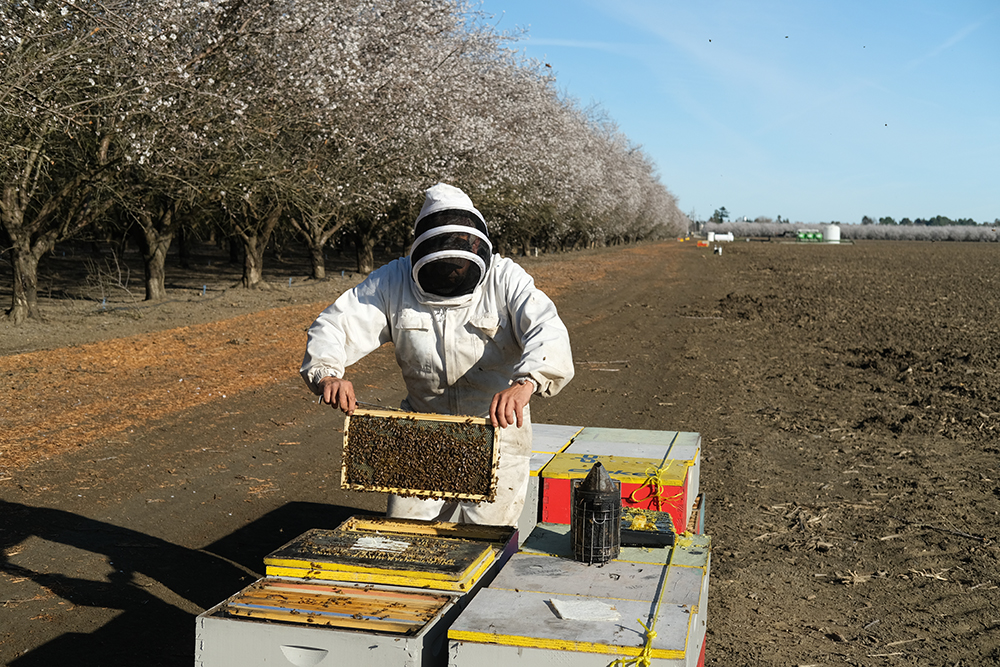
Rodrigo Díaz, a beekeeper at Dixon Bee Co. in Solano County, checks on beehives Feb. 13 in an almond orchard in Dixon. February traditionally marks the start of pollination season as beekeepers throughout the country journey to California’s Central Valley for the six-week-long almond bloom.
Photo/Caleb Hampton


By Vicky Boyd
Although California beekeepers have not seen the devastating hive mortality this winter that they did in 2025, they say they’re still losing colonies.
“Things are looking OK, but we won’t really know until the end of bloom,” said Ryan Burris, California State Beekeepers Association president and a Palo Cedro beekeeper and queen breeder. “It sounds like the numbers are better, but some people still lost a lot of bees.”
Beekeepers nationwide made headlines in the 2024-25 winter when they reported an average of 62% colony losses. With increasing production costs and depressed honey prices, many beekeepers said the current situation is not sustainable economically.
“It’s very, very difficult,” Burris said. “The thing that makes it unsustainable is just the cost that goes into the business and the fact that the honey price is so low when it should be much higher.”
An average beekeeper spends about $350 per hive annually to keep it going, he said. Almond pollination rates average about $200 per hive. To make up the difference, Burris said producers rely on honey sales.
Demand for honey in the U.S. has historically exceeded supply, so some foreign product is imported.
More recently, he said, countries such as India have priced their honey as low as 80 cents per pound when U.S. producers need about $2 per pound to be profitable. The cheaper imports have driven down domestic prices, Burris said.
Photo/Vicky Boyd
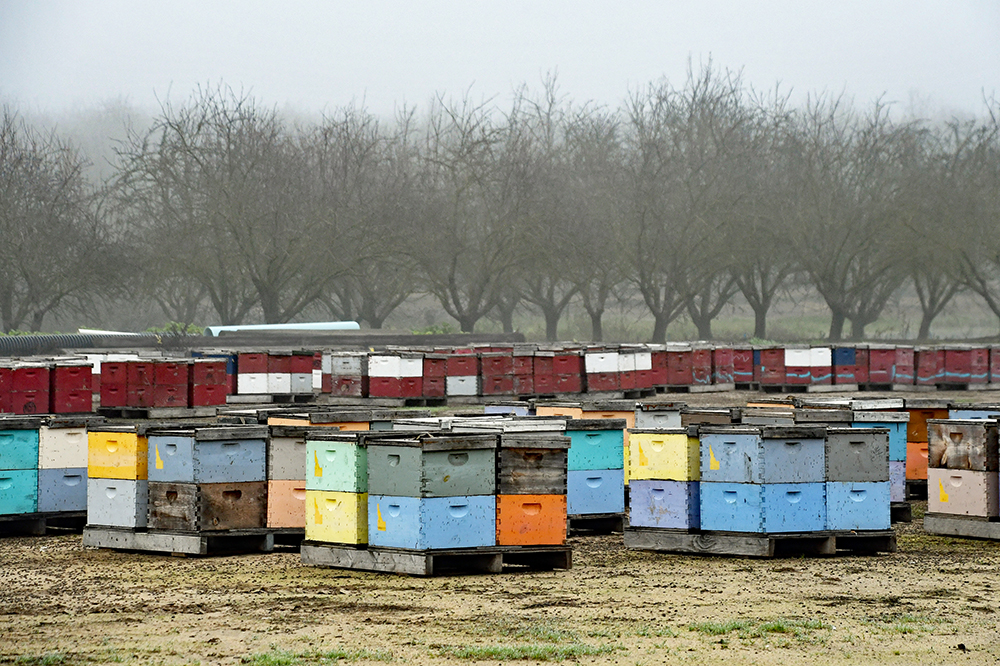
February traditionally kicks off the pollination season as beekeepers from throughout the nation converge on California for the six-week-long almond bloom. The almond industry needs about 2.4 million hives to pollinate the crop, but there are only about 840,000 resident colonies.
In 2025, nearly 1.7 million hives crossed border inspection stations into the state, according to figures from Matt Beekman, a Hughson-area commercial beekeeper and CSBA executive board member.
Arriving bee shipments have steadily declined from 2021, when more than 2 million entered California.
Beekman attributed the decrease to mounting pressures on the industry, including rising costs, ongoing colony stress and long-term attrition among commercial beekeepers.
Nevertheless, Charleen Carroll, a Manteca-area bee broker and owner of Pollination Contractors Inc. for 47 years, said she didn’t experience hive shortages this season. Carroll sources bees from coast to coast through long-term relationships she’s developed with beekeepers.
“Last year was really horrible,” she said. “This year, 99% of our beekeepers are doing great. Next year is like Russian roulette.”
As with many agricultural commodities, Carroll said beekeepers in one part of the country may have strong hives while those in another region may have weaker production due to different environmental conditions.
Fredy Valenzuela, owner of Golden State Honeybees in Paradise, is a smallish commercial beekeeper who offers pollination, honey and queens. He described his colony health this season as about the same as last year, when he didn’t experience significant losses.
“We’re not a big outfit, so we can manage them fairly well and stay on top of things,” Valenzuela said.
Buzz Landon, owner of Buzz’s Bees in Oroville, rents out more than 6,000 hives for pollination. He and his wife also produce honey, breed queens and sell packaged bees.
This year, he described his colony health as “good,” compared to last year, which he said was “really good.”
“They survived the die-off,” Landon said. “It’s learning how to use these new materials.”
He was referring to a handful of new miticides that have been registered for use in California and federally during the past year.
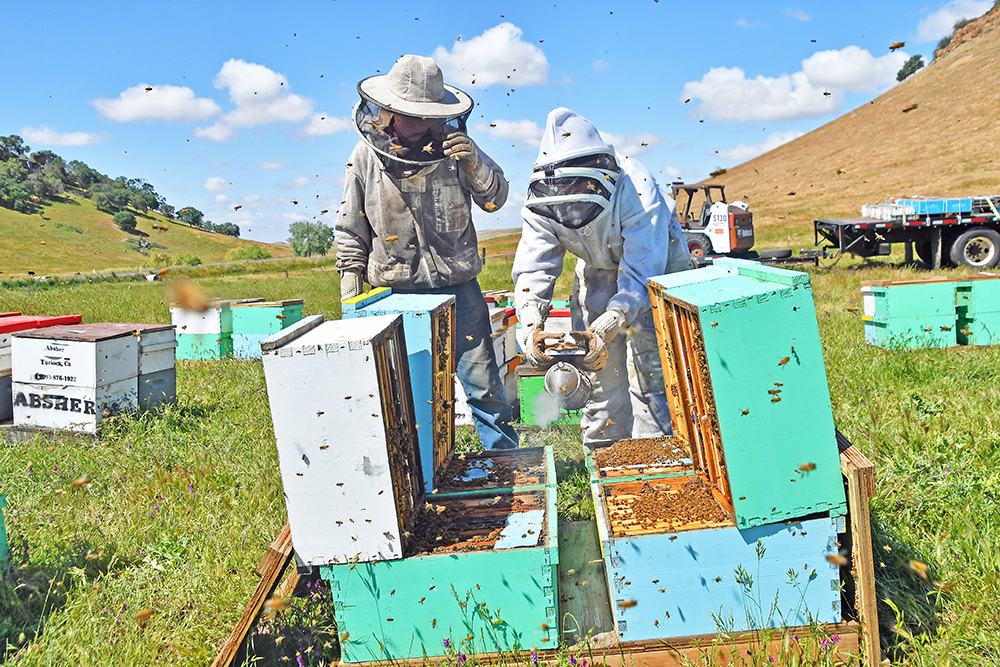
Caleb Absher and his older brother, Cash, run Absher Honeybees, a Stanislaus County operation that offers pollination services and honey. Like many commercial beekeepers, Caleb Absher said they experienced substantial losses during the 2024-25 winter. But this winter, “it looks 100 times better than last year.”
He credited part of the improvement to paying close attention to varroa mites and treatments. Absher also was able to move his bees after pollinating almonds and cantaloupe in the Central Valley to fall forage that had tarweed. A late-blooming native wildflower, tarweed is known for its pollen and nectar production when other plants are done for the season.
Photo/Vicky Boyd
Still top of mind within the industry is the early 2025 disaster, when numerous beekeepers nationwide began to discover dead hives that only months earlier seemed robust. The nonprofit honeybee research organization Project Apis m. responded by conducting a survey to gauge the problem.
Beekeepers representing 68% of the nation’s hives reported average colony losses of 62%. Nationwide, the losses totaled more than 1.1 million hives over a short period.
The U.S. Department of Agriculture Agricultural Research Service Bee Research Laboratory in Beltsville, Maryland, analyzed samples sent in from dead and dying colonies for possible causes. Scientists found unusually high levels of deformed wing virus strains A and B along with acute bee paralysis virus. Both are known to be vectored by varroa mites, pinhead-sized external parasites that feed on adult bees and developing larvae and pupae within brood cells.
The researchers also screened varroa mite samples for resistance to amitraz, a widely used miticide. All the mites were resistant.
Burris was quick to defend amitraz and said the industry shouldn’t broadly dismiss the miticide. Instead, he said beekeepers and researchers should find new ways to use it effectively.
Some beekeepers have turned to oxalic acid, a naturally occurring compound found in many foods, including spinach, to manage mites. Others have enlisted formic acid, another naturally occurring material.
The U.S. Environmental Protection Agency and California Department of Pesticide Regulation recently approved increased labeled rates for Api-Bioxal, a powdered oxalic acid applied using a heat vaporizer. The label change does not apply to oxalic acid used as a dribble between hive frames.
The EPA and DPR also approved VarroxSan slow-release oxalic acid strips. Recently, they registered an RNA interference treatment, Norroa, which targets a specific protein in varroa mites, slowly halting their reproduction. But the pests can still parasitize bees and potentially spread virus as they feed.
As queen breeders, Burris, Landon and others are working with the USDA-ARS Honey Bee Lab in Baton Rouge, Louisiana, to develop queens with the varroa sensitive hygiene trait. Bees with the attribute remove mite-infested pupae from capped worker brood. But breeding for hygiene trait is a slow process.
“It’s something that a lot of queen breeders are trying to look into,” Burris said.
As with other varroa management methods, he looks at varroa sensitive hygiene as simply another tool in beekeepers’ arsenal rather than as a silver bullet.
Vicky Boyd is a reporter in Modesto. She can be reached at agalert@cfbf.com.
See related stories:
- Heavy bee mortality puts almond pollination at risk
- Almond cover crops promote bee-friendly farming
- From the Fields: Jason Miller, Placer County beekeeper






.svg.png)
