


State's olive oil production still has room for growth
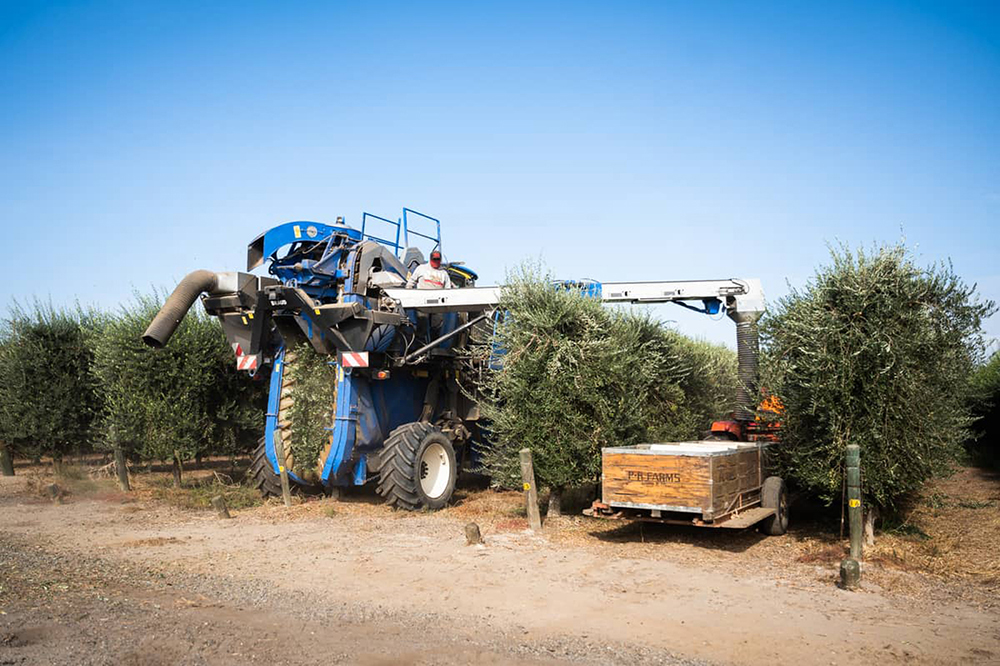
Olives grown for oil production are harvested in Fresno County. Depending on the region, variety and desired oil quality, olives are mature and ready for harvest from September through January. California’s olive oil sector remains young, and plantings of olives for oil continue to expand.
Photo/James Collier for California Grown


By Vicky Boyd
Fueled by changing consumer tastes, attractive contracts, ability to use mechanization and drought tolerance, planting of olives for oil continues to expand in California.
With the state’s olive oil production at 2 million to 4 million gallons annually, or about 5% to 8% of domestic consumption, California olive oil producers still have ample room to grow.
Cliff Beumel, president of Agromillora California Nursery near Chico, said he has seen continued grower interest in olives for oil during the past several years. Unlike the late 1990s and early 2000s, when many olive orchards were planted on speculation with short-term profits in mind, he said today’s producers are taking a more measured approach.
University of California, Davis,
Olive Oil Center
“Olives for olive oil fit in a niche—it’s not a gold rush,” Beumel said. “It’s much more strategic in that (growers) take many factors into account, and they’re looking at risk mitigation.”
Aaron Barcellos and his brother, Aric, are two producers who took that route, planting two blocks of olives for oil in 2018 and one block in 2019. They have contracts with two different olive oil handlers for the fruit.
As part of the family-owned A-Bar Enterprises in Firebaugh, they sought a profitable permanent crop that would do well with reduced irrigation. The blocks on which the trees are planted lie within a federal water district that regularly curtails allocations.
The Barcellos also wanted to diversify their field and permanent crops and looked for something with lower labor requirements.
Aaron Barcellos acknowledged they were still learning about olive cultural practices and how to optimize oil quality with the relatively new super high-density planting system. But he said they remained cautiously optimistic about olives for oil.
“This industry is in its infancy for California and the U.S., so we’re still seeing where we’re going with it, but I do feel there’s potential,” Barcellos said. “I think the economics of where it’s at and where we are today is kind of holding us back, but it’s something that we’ll be looking at.”
Currently, the statewide average yield is about 3.2 tons of fruit per acre, and he said many growers need about 5 tons per acre to break even.
For the Ricchiuti family, which had farmed peaches and then almonds around the Fresno area for four generations, olives offered diversification. Vincent Ricchiuti, chief operations officer of P-R Farms and co-founder of Enzo Olive Oil Co., credited his father, Pat, for seeing the crop’s potential as the “next great opportunity for California agriculture.”
“That vision inspired us to plant our first super high-density olive orchard” in 2008, Vincent Ricchuiti said.
They also transitioned to certified organic production because they believed in improving the land, he added.
As part of their plan, the Ricchuitis vertically integrated and built their own mill to process the fruit shortly after harvest. This allows them to maintain quality and freshness throughout the supply chain and produce 100% estate-grown certified-organic extra-virgin olive oil.
The Ricchiutis and Barcellos are but a few of the state’s approximately 400 producers of olives for oil who altogether farm about 37,000 acres, according to the California Olive Oil Council. Beumel said new orchards are spread throughout the state from Kern County north to Red Bluff. This differs from the turn of the century, when the bulk of the plantings were from Modesto north.
Although growers have cultivated olives for centuries, super high-density plantings with typical 5-by-12-foot spacing, or about 726 trees per acre, are relatively new. The configuration lends itself to mechanical pruning and off-ground harvesting, significantly reducing labor, Beumel said.
Initially, Barcellos said they thought they could get by with just mechanically hedging, topping and skirting trees. But as the plants grew older, he said they had to put a hand crew in to remove deadwood that began to form in the tree interiors. The goal is to keep the trees generating fresh wood, which produces new fruiting buds.
“What we don’t know is will these orchards be viable when they’re 15 years old,” Barcellos said. “That’s one of the things that’s keeping us from planting more—we just don’t know how long they will be in production.”
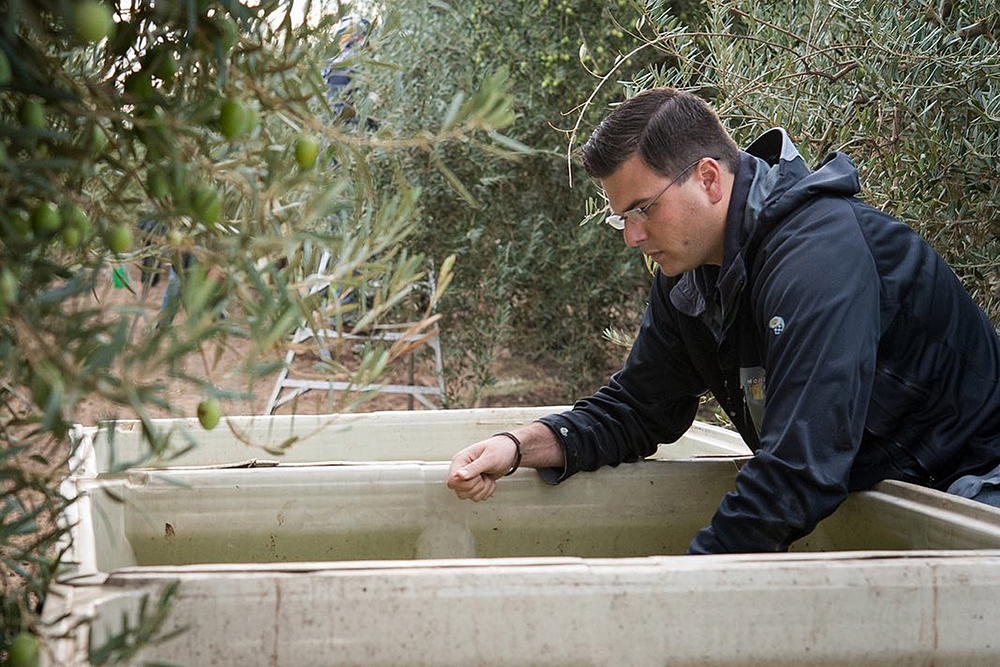
Photo/Courtesy of Enzo Olive Oil Co.
Olives, by their nature, also require significantly less fertilizer, water and protective sprays than tree nuts. As Barcellos puts it, less is more when it comes to olive tree management, which is just the opposite of many other tree crops.
In fact, a recently published University of California, Davis, study found that super high-density olive trees produced the same yields and high-quality oil with 25% to 50% less nitrogen fertilizer than recommended for traditional orchards.
Under optimum conditions, Beumel said growers can harvest olives in the second leaf and obtain about 60% of their yield potential. By the third year, the trees could be in full production.
At the same time, consumers are discovering the health benefits of olive oil, which several studies have ranked above seed oils. In response, demand has increased.
Ricchiuti said Enzo has benefited from the trend and has expanded production. Nevertheless, he said his business continues to educate consumers that not all olive oils are created equal.
“Consumers today are much more aware of what goes into their food,” Riccuitti said. “They want something healthy, authentic and traceable. They want to know where their products come from. Olive oil fits perfectly into that mindset, especially when it’s domestically grown and certified organic.”
Enzo specializes in extra-virgin olive oil, the highest-grade oil made from the first cold-pressed extraction of olives without heat or chemicals. In addition, extra-virgin olive oil must meet specific chemical benchmarks and be free from 12 flavor and aroma defects established by the International Olive Council. The California Department of Food and Agriculture has even stricter standards for a handful of plant-based compounds.
All commercial handlers in the state that mill more than 5,000 gallons annually are required to participate in mandatory sampling and testing to verify quality under the statewide Olive Oil Commission of California marketing order. About 13 commercial producers account for about 90% of olive oil milled in the state.
Vicky Boyd is a reporter in Modesto. She can be reached at agalert@cfbf.com.
See related news stories...
• Proper irrigation key to preventing 'plant destroyer'
• Research advances mechanized table olive harvest
• State specialty crops receive funding to increase exports





.svg.png)
