


Purple sweet potato varieties gain interest, acreage
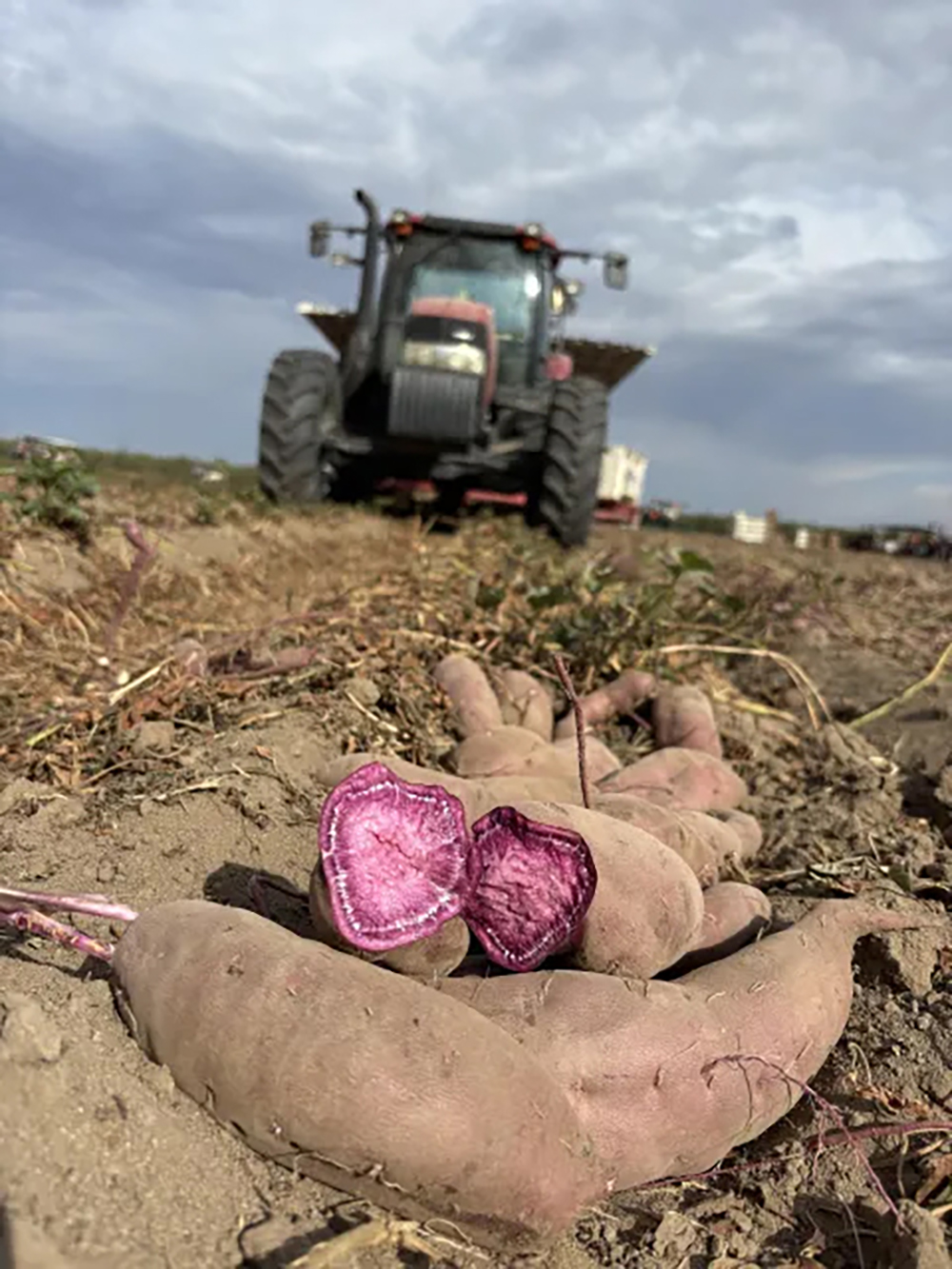
The Regal Purple sweet potato is one of at least six cultivars with purple skin and purple flesh being grown in California. In total, the purple varieties account for about 1,000 acres statewide.
Photo/Scott Stoddard


Most sweet potatoes are yellow or orange, but purple varieties are gaining in popularity, with increased acreage in California.
Five years ago, a few growers were dabbling in purple sweet potatoes. Now about 1,000 acres are being grown in the Golden State, according to Scott Stoddard, University of California Cooperative Extension farm adviser in Merced County.
At least six varieties of purple sweet potatoes are being grown, Stoddard said, noting growers remain hesitant about sharing what they have planted because they hope to cash in when the varieties are still new and hot.
Two purple-skinned varieties with purple flesh—Stokes Purple and Ben Yagi—are owned by a company. Stoddard said Stokes started the purple trend. Another is an unpatented experimental variety that Stoddard calls Purple Rayne. Other experimental varieties include Purple Majesty, Purple Splendor and Regal Purple.
Farmers in Hawaii grow Okinawan, which has white skin and purple flesh, but the variety doesn’t yield enough to be economically sustainable for California growers, Stoddard said.
Introducing purple sweet potatoes to retailers required educating them, according to Jeremy Fookes, director of sales for Merced County-based A.V. Thomas Produce Co., which owns the Stokes Purple and Ben Yagi varieties. Because Stokes Purple has drier flesh, it needs to be cooked twice as long as orange-flesh varieties.
The company grows more than 500 acres of Stokes Purple, which is carried by commercial grocers and independent stores across the country and shipped to the Middle East.
California produces about 25% of U.S.-grown sweet potatoes, with most of it grown in Merced, Stanislaus and Kern counties. Some 85% of California sweet potatoes are sold for the fresh market, with the rest used to make french fries or baby food.
During the past five years, California plantings shrank from more than 21,000 acres to about 18,000 acres as sweet potato sales slumped, prices stagnated and production costs climbed for the labor-intensive crop. Four sweet potato packing sheds closed.
But there’s hope that improved varieties could turn the sector around. For nearly 25 years, Stoddard has been seeking a better red sweet potato variety to replace Diane, which he said yields well but is susceptible to root knot nematodes and does not store well.
He thought he found the answer with Burgundy, released in 2014, but the red-skinned variety didn’t perform as well for growers as it had in his test plots.
In 2021, Vermillion—another red-skinned variety with bright-orange flesh that stores well—was released as an alternative to Diane. It now accounts for 10% to 15% of California sweet potato acreage.
Because there are no sweet potato breeders in California, Stoddard collaborates with Louisiana State University, which sends him about 30 varieties each year for screening. He noted four of the six most important commercial sweet potato varieties grown in California started with the LSU breeding program.
Stoddard tests about 40 new lines every year with growers. Potential new lines are selected based on shape, color, flavor and potential yield. Three to five varieties are then selected for the second year of testing.
Bellevue, originally created by LSU in 2006, entered California trials in 2008 and was formally released in 2015. The variety has orange skin and bright-orange flesh with resistance to root knot nematodes. The variety comprises around 15% of California sweet potato acreage, Stoddard estimated. It is also grown in Canada, Netherlands, Portugal, Spain, Egypt, Australia and New Zealand.
Stoddard’s research found that cracking occurred in Bellevue when harvested in cold temperatures. He recommends harvesting it before Oct. 15 and in the warm afternoon.
Bellevue, Vermillion and Diane account for about two-thirds of California sweet potato production. Other popular varieties include the white-flesh Murasaki and Bonita.
Stoddard said he sees promise in the purple varieties as California moves away from orange-flesh sweet potatoes that other regions can grow.
California growers have also created a niche for organically grown sweet potatoes, as the Golden State is one of only a few regions that can grow organic sweet potatoes profitably, Stoddard said.
In states such as Louisiana, Mississippi and North Carolina, insects rob too much yield in organic sweet potato production, whereas California growers frequently don’t have to use insecticides. Instead, they suppress nematodes, grubs and other soil-borne pests by dry fallowing, leaving fields unplanted every other year, Stoddard said.





.svg.png)
