


Some Christmas tree farms sell out early
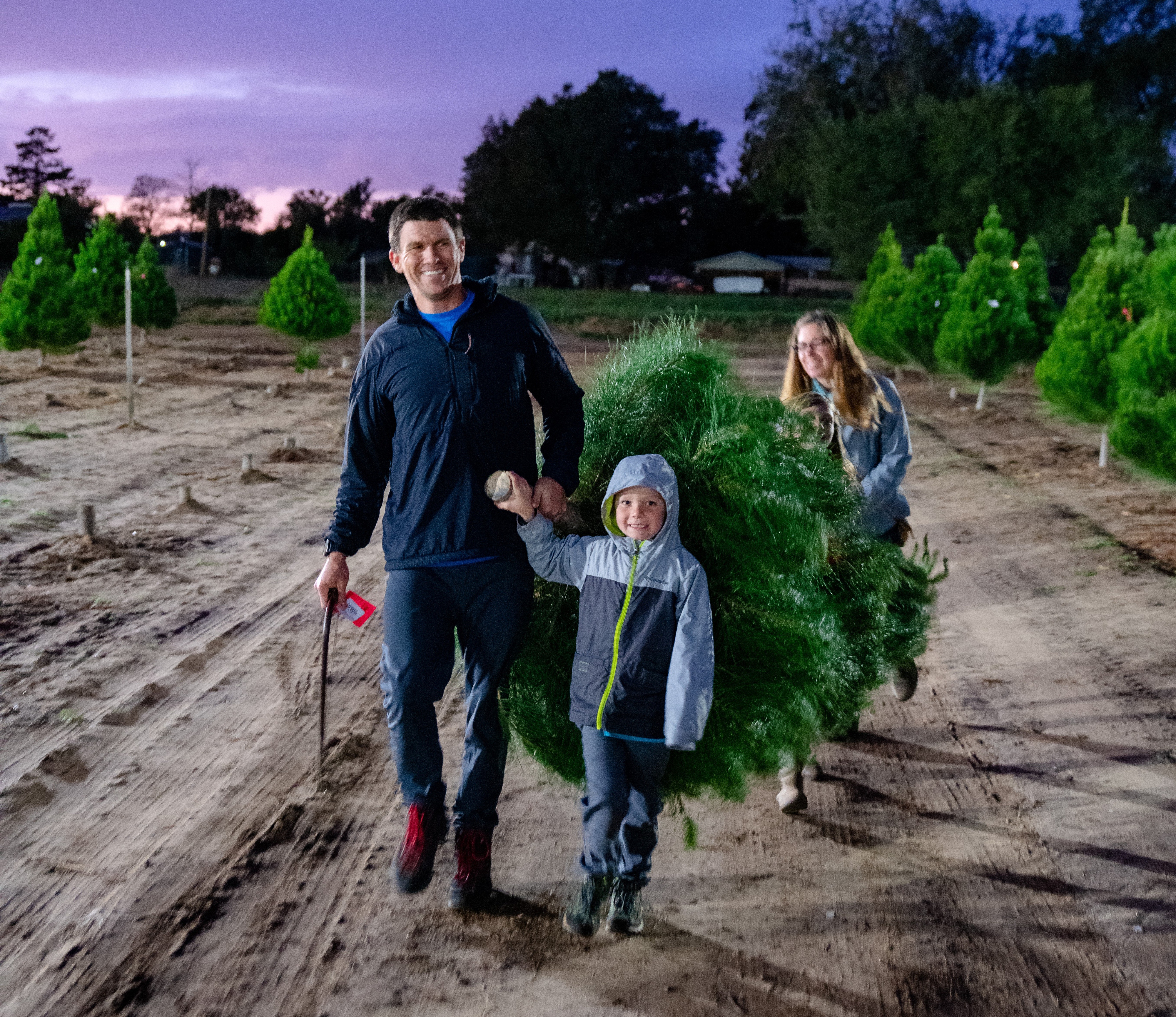
To avoid overcutting so that they have a crop for future years, more California choose-and-cut Christmas tree farms have closed early this year, telling customers they’re sold out.


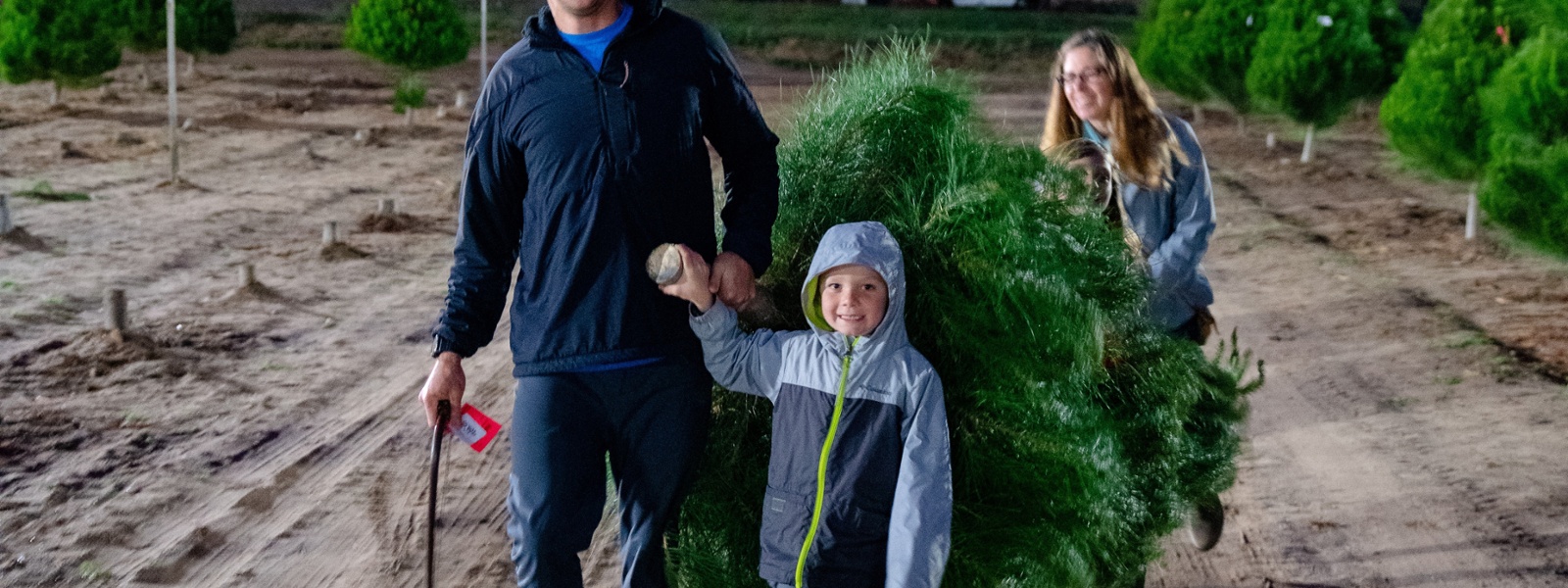
Danny Rogers, his son Greyson, daughter Rylan, obscured by tree, and wife Carly carry away a Christmas tree they cut from Holloway’s Christmas Tree Farm in San Luis Obispo County.
By Ching Lee
To avoid overcutting so that they have a crop for future years, more California choose-and-cut Christmas tree farms have closed early this year, telling customers they’re sold out.
At Apple Hill, a popular tourist destination in El Dorado County, most Christmas tree farms closed after two weeks of opening, with smaller farms closing after the Thanksgiving weekend, said Sam Rumbaugh, who operates Indian Rock Tree Farm in Camino.
“We have more customers than we have trees to supply every year now,” she said. “We wish we could be open like the good old days,” when the farm sold trees until Christmas Eve. “It’s just not possible for us to do that anymore.”
Rumbaugh said Christmas tree farms in her region already faced a shortage as more people from surrounding cities flock to Apple Hill for the annual tradition of picking and cutting their own trees. This year, farms had fewer trees to sell due to losses from the drought. The early spring freeze further reduced supply by killing new growth on many of the trees. On top of that, the September heat wave added more damage, Rumbaugh said, compounding “what was already an ongoing issue with supply and demand.”
It’s not just weather issues that have shortened the supply of Christmas trees. There are fewer Christmas tree farms statewide, largely from owners retiring, and few new ones have come along to replace those that have closed. That leaves the remaining farms with “more customers than we can supply,” Rumbaugh said.
There were 324 Christmas tree farms in 2017, down from 385 in 2012, according to the U.S. Department of Agriculture. California Christmas tree acreage dropped from 13,805 to 9,836 during that time. However, the number of trees cut grew from 109,045 in 2012 to 138,803 in 2017.
Nationally, supplies of farm-grown Christmas trees have been tight since 2016 and remain tight again this season, according to the National Christmas Tree Association. Even so, the association said there are enough trees for those who want one, though some locations will sell out early. Because of their popularity, choose-and-cut farms tend to sell their available trees quickly, the association said.
Nearly 21 million real Christmas trees were purchased last year, according to a NCTA survey. More than 28% of farm-grown trees were bought at chain stores such as Walmart and Home Depot, while choose-and-cut farms accounted for nearly 27%. Tree lots, nurseries, nonprofits and online sales made up the rest.
For farms that still have trees to sell, rainy weekends this month slowed crowds coming to cut them. After record sales and overcutting his trees the past two years, Carl Holloway, owner of Holloway’s Christmas Tree Farm in San Luis Obispo County, said he brought in an additional 300 to 400 precut trees from Washington and Oregon to supplement his farm’s inventory.
His opening weekend turned out not as busy as last year, when he sold 2,100 trees in three days. The rain, he said, “hurts us more than anything.” He described business this year as “good” but far from the 2020 season, which he said was “insane and busy beyond belief.”
The first year of the pandemic proved a boon for Christmas tree farms and other agritourism sites, which offered people cooped up from the lockdowns something to do outdoors. That year, Holloway said he overcut his fields by about 400 trees “because I just couldn’t keep the people out of them.”
Inflation and the overall economy “without a doubt” have impacted business, Holloway said. He raised prices “on just about everything” this year. People still come to the farm and stay two or three hours, he said, “but they’ll leave without a tree.”
“They can find a tree $10, $15 cheaper at one of the big discount stores,” he said.
In recent years, Don and Peggy Moore of Twain Harte Tree Farm in Tuolumne County have opened their choose-and-cut farm—now in its 50th year—just for the Thanksgiving weekend, typically selling 500 to 700 trees a year. The retired couple is transitioning the farm, in part to wholesaling their trees, Don Moore said, though it remains unclear whether their son would take over next year.
Instead of the “wall to wall people” at the farm, Moore reported “lighter than normal” crowds this season, with sales dropping about 35%. He said he thinks it may have been because the Stanislaus National Forest issued 5,000 free permits that allowed people to cut two trees per household in the forest.
At 46, Chris Hammond, who operates Tabletop Christmas Tree Farms in Tuolumne County, remains one of the state’s younger Christmas tree farmers. He was in his mid-20s when he bought land in Groveland and started planting trees in 2001. He sold his first Christmas trees in 2008. In those days, he would open every other year “because I just didn’t have enough supply.” He still doesn’t and has kept his farm closed to the public for the past three years, selling trees by appointment only. He continues to plant new trees, he said, but it will take seven to 12 years before they are big enough to harvest.
“The demand’s there,” he said. “I just can’t grow enough trees. It’s always been an inventory thing for me.”
Even though he’s raised prices—from $10 a foot to $12—people continue to buy his trees, he said. With fewer tree farms left in the state and less acreage devoted to growing Christmas trees, Hammond raised concern that real trees could become so expensive that people will be forced to buy artificial ones.
For Keith Garlock of Garlock Tree Farm in Sonoma County, the rainy weather has been his biggest challenge this year, even though Thanksgiving weekend “was very strong, and the weather was quite cooperative.” Since then, he said he’s noticed fewer people “tailgating and spending prolonged periods” on the farm.
“That’s the nature of our business,” he said. “If the weather doesn’t cooperate, then it discourages people from wanting to get out and trounce around.”
Instead, more customers bought trees and left quickly. He noted he sold most of the precuts from Oregon, and his suppliers did not have trouble shipping him the number of trees he wanted.
Unlike other choose-and-cut farms that are trying to conserve their inventory, Robert Criswell of Black Road Christmas Tree Farms in Santa Clara County said he’s trying to thin his fields after a limited opening in 2020, when he made 10% of his normal sales. He now has more and bigger trees, and he’s “going for volume,” trying to sell “a whole lot of trees cheaply and get them out.”
Criswell has kept prices at $70 a tree for the past three years. Despite the wet weekends, he said the rain did not seem to stop people from coming to the farm.
“I saw a whole lot of people totally soaked, cold and having the time of their lives,” he said.
(Ching Lee is an assistant editor of Ag Alert. She may be contacted at clee@cfbf.com.)





.svg.png)
