


Hemp producers weigh potential fallout of new law
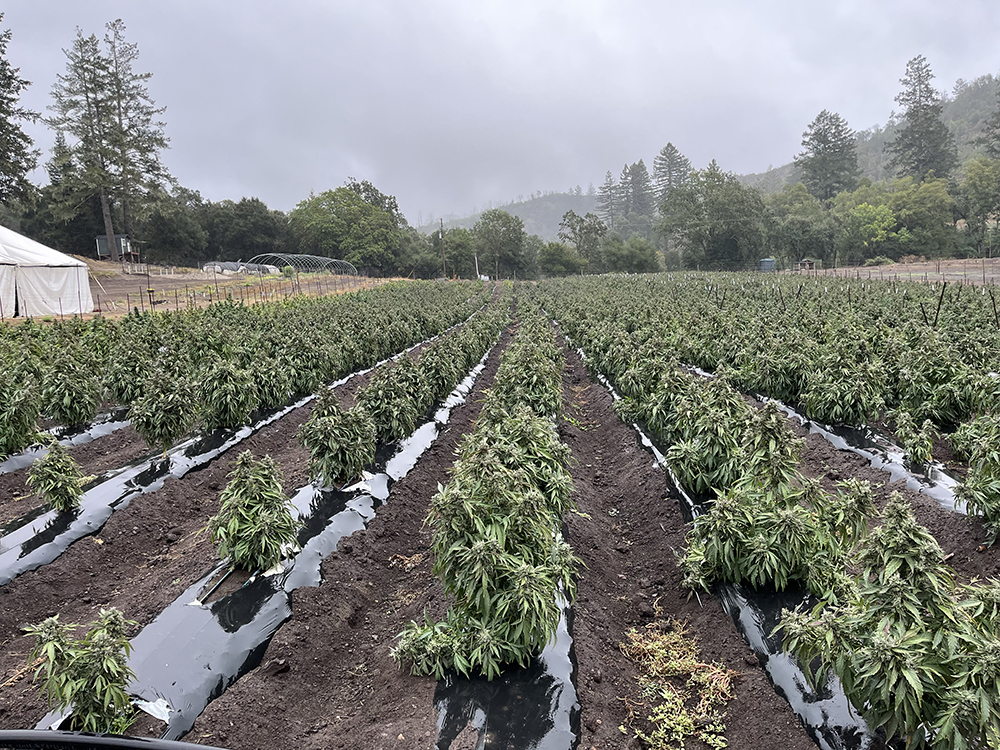
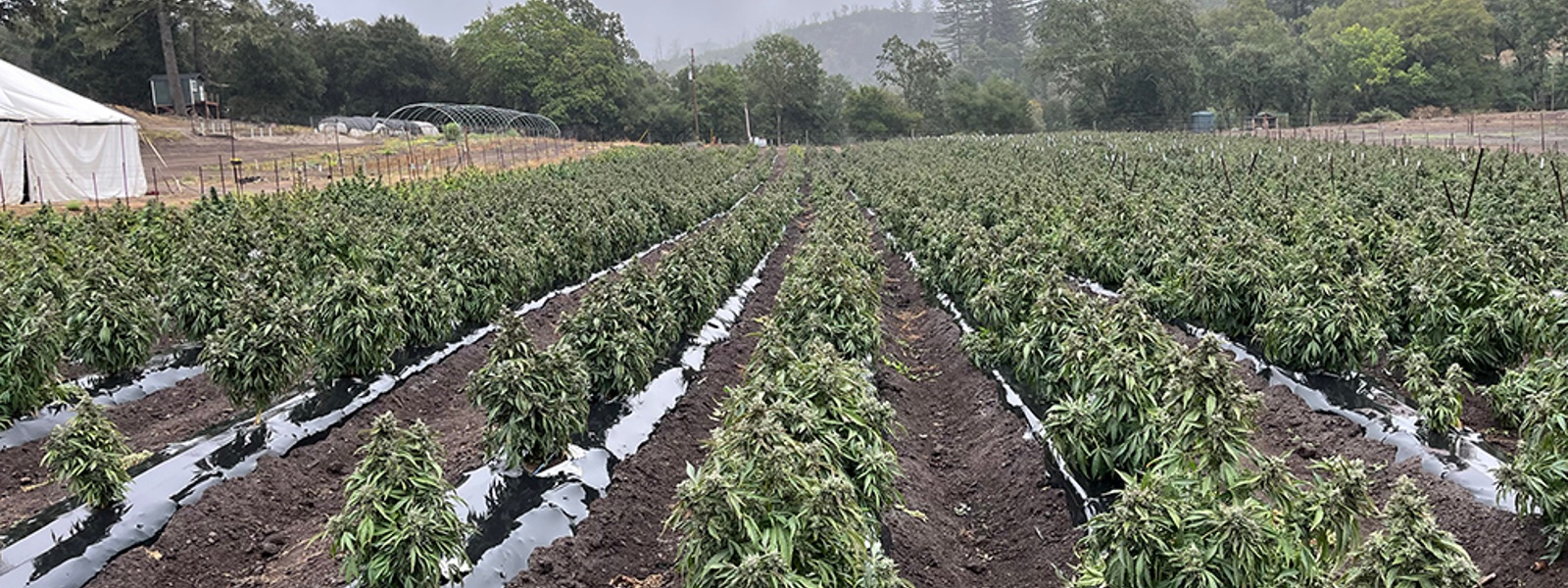
Industrial hemp is grown at a Sonoma County field. Though the 2018 Farm Bill legalized hemp production, Congress has tightened the definition of hemp by imposing strict limits on intoxicating hemp products. Some hemp advocates say the new federal limits could have catastrophic impacts on the fledgling industry.
Photo/Courtesy of Sonoma County Department of Agriculture, Weights and Measures


By Rob McCarthy
A new federal law that revises what qualifies as legal hemp has California growers, regulators and other stakeholders assessing what impact the changes would have on the fledgling industry.
Signed into law in November as part of a broader spending package to reopen the federal government, H.R. 5371 narrows the federal definition of hemp by imposing strict limits on intoxicating hemp products. The new provisions close what Congress considered a problematic loophole in the 2018 Farm Bill, which legalized hemp.
Under the 2018 Farm Bill, legal hemp was defined as containing no more than 0.3% delta-9 tetrahydrocannabinol, or THC, the psychoactive compounds found in cannabis. But the old law did not assess hemp-derived cannabinoids such as delta-8 THC and others that also produce intoxicating effects. This enabled explosive growth in intoxicating hemp products, which are effectively banned with the recent regulatory changes.
The new law, which takes effect November 2026, no longer assesses only delta-9 THC content. Instead, it adopts a total THC limit of 0.3%, a threshold so low that hemp advocates say the new federal limits could criminalize hemp with trace amounts of THC that naturally occur in the plant but that are not enough to be intoxicating.
But Jack Norton, who farms more than 200 acres of hemp for Terpene Belt Farms in Alameda County, said he wasn’t alarmed by the federal change to ban the sale of intoxicating hemp products.
“I’m not surprised this is happening,” said Norton, whose farm produces hemp essential oil.
The federal government is cracking down because lawmakers previously weren’t specific about the cannabinoids that occur naturally in cannabis plants, Norton said. Some cannabinoids found in hemp are intoxicating; others are not.
While no one is accusing beverage and snack-food companies of breaking the law, Norton said, some businesses have extracted THC from hemp and added it to their products to create a high. The Farm Bill was silent about what could be done with hemp THC, he said, and some food makers took advantage of the loophole.
One hemp-industry trade organization is pushing back. Washington, D.C.-based U.S. Hemp Roundtable is asking the federal government for more time and to meet with hemp stakeholders to talk about “robust” regulation of industrial hemp rather than a product ban, Jonathan Miller, the group’s general counsel, said. Hemp Roundtable represents growers, processors, manufacturers and retailers.
“There is no federal regulation of hemp products,” he said, adding that Congress in 2018 failed to establish a regulatory framework to guide industry stakeholders, leaving that task to individual states.
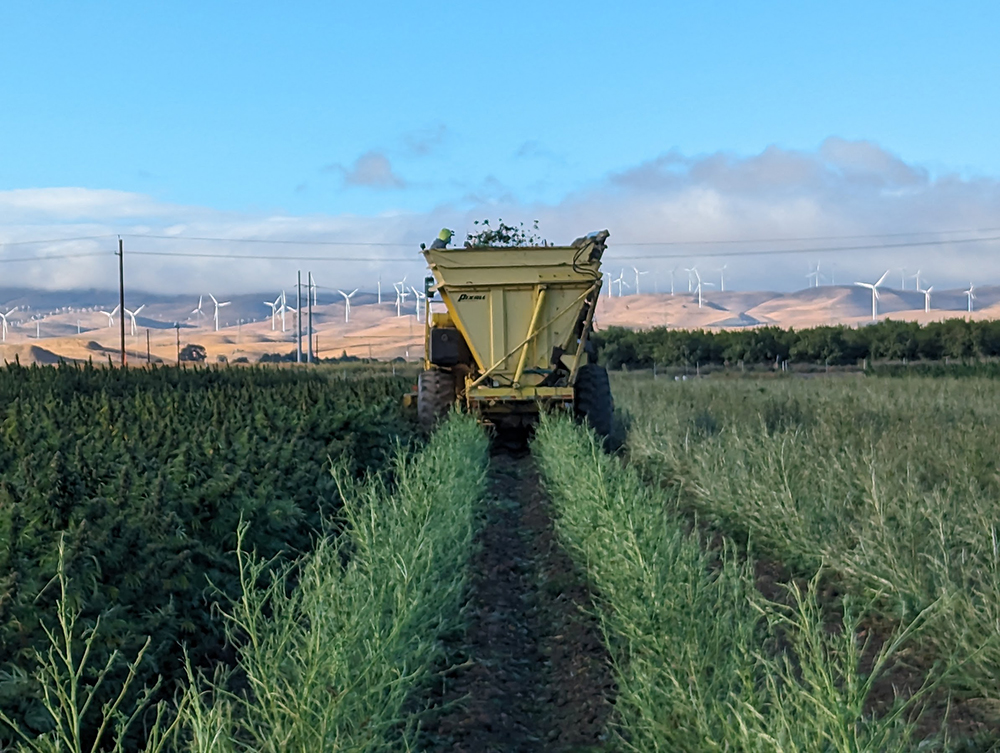
Photo/Jack Norton/Terpene Belt Farms
The reclassification of hemp-extract products in H.R. 5371 would have catastrophic consequences, even for THC-free materials, according to the Nov. 24 bulletin posted on the group’s website. It warned that 95% of hemp extract products now on the market will be labeled Schedule 1 narcotics “while the remaining 5% of THC-free isolates would be impossible to manufacture given the limits on extraction.”
Roundtable advocates for data-driven and fair laws and regulations for hemp industries, including agriculture and businesses that produce oilseed, fiber and extracts such as cannabidiol, or CBD, which is not psychoactive and is marketed as a wellness product.
California was an early adopter of legalized hemp, launching a trial program in 2016 before Congress acted. In the fall of 2019, California removed industrial hemp from its list of Schedule 1 controlled substances and approved hemp farming. The California Department of Food and Agriculture issues licenses to growers, who must report their hemp operation to their county agricultural commissioner. The registration identifies the intended sites for growing hemp and which varieties will be planted.
Sonoma County Agricultural Commissioner Andrew Smith, who serves on the state Industrial Hemp Advisory Board, said hemp is federally recognized as an agricultural commodity that isn’t psychoactive, unlike cannabis. It is a boon or bust to farmers and their manufacturing customers, “depending on who you talk to,” he added.
There’s opportunity for farmers to incorporate hemp into crop rotations, provided there is a market for the harvested biomass, Smith said. Other options include growing hemp for fiber, paper products, animal feed and human food. Hemp can also be turned into bioplastics for consumer and industrial uses, he added.
The failure of Congress to reschedule cannabis holds back the nation’s hemp and cannabis industries from “real normalization,” research and investment, Smith said.
Unlike cannabis, hemp can be transported across state lines to be processed and made into consumables and other goods. This has created another loophole, he pointed out. Without a uniform system for checking hemp load certificates and inspecting trucks, Smith said cannabis is crossing state lines because of lax federal inspection and enforcement. In some cases, there are no border inspection stations to screen hemp moving between states, he added.
As of October, there were 68 growers registered to grow industrial hemp in California on 7,891 acres, not including breeders and research. That’s down from 558 registered growers and 38,464 acres in 2020. Fresno County leads the state in hemp production, with 4,117 total registered acres in 2025.
California lawmakers in September passed Assembly Bill 8, which makes it a crime for out-of-state manufacturers of an industrial hemp-infused food or beverage to market their products before registering with the Department of Public Health. Assemblywoman Cecilia Aguiar-Curry, D-Winters, who introduced the legislation to allow the legal sale of nonintoxicating CBD products, called the companies selling intoxicating hemp products in the state “bad actors” and their actions “unacceptable.”
Smith said H.R. 5371 could hobble California’s industrial hemp industry, and with AB 8, it could create headwinds for growers and breeders planning to expand their operations. AB 8 places the same safety-testing requirements on industrial hemp grown in the state as cannabis, which is overseen by the Department of Cannabis Control. The new regulatory framework will be costly, and it’s unproven, he added.
“Up until now, the only regulation on hemp in the state has been through the cultivation phase,” Smith said. “Once the hemp is harvested, CDFA and county ag departments have little authority on where it goes or what it’s put into.”
It appears AB 8 will regulate the postharvest supply chain and require hemp products to go through the same lab testing as licensed cannabis, he said.
“It’s going to be a huge cost burden on the grower,” Smith added.
Rob McCarthy is a reporter in Ventura County. He can be reached at agalert@cfbf.com.
See related news stories...
- After crash, hemp farmers look to fiber, other uses
- Irrigation specialist outlines conditions for growing hemp
- Industrial hemp prompts interest around the state





.svg.png)
