


California Farm Bureau updates group's policies
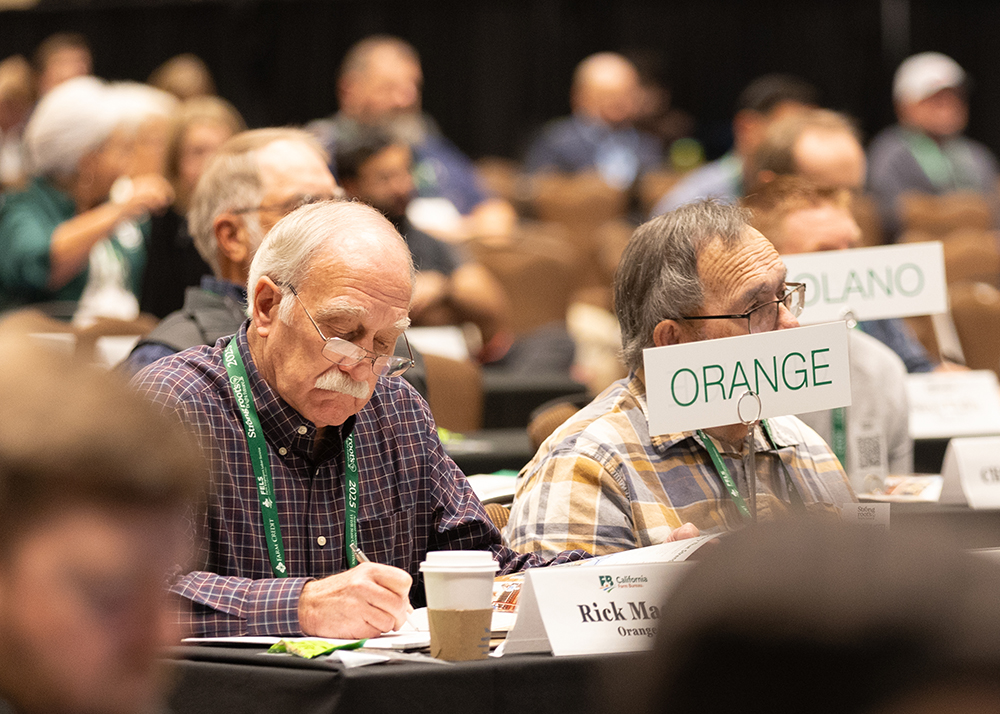
Rick Mack of Orange County participates in the House of Delegates session last week in Anaheim.
Photo/Cheryl Durheim


By Caleb Hampton
California Farm Bureau approved changes to the organization’s policies last week during a House of Delegates session at the organization’s 107th Annual Meeting in Anaheim.

Delegates, who represent Farm Bureau members from each county, voted to approve new and updated policies related to issues such as wine import subsidies, abandoned farmland and immigration enforcement.
Farm Bureau develops policy recommendations each year through its Commodity Advisory Committees, which are groups of members that meet regularly throughout the year.
Farm Bureau’s policies serve as a “guidebook for policy staff on what we support,” said Matthew Viohl, a federal policy director for the California Farm Bureau. “Every year, when we have changes that we want to incorporate—if it’s a new issue that’s come up or maybe we’re unhappy about how a policy was previously written—we take the opportunity to make those changes.”
Throughout the year, policy advocates refer to Farm Bureau’s policies to determine the organization’s stance on numerous bills, regulations, ballot measures and other aspects of local, state and federal policy.
This year, for the first time, roundtable-style committee meetings were held in counties throughout the state, enabling more members to participate in the policy recommendation process.
“There was a lot of dialogue,” California Farm Bureau President Shannon Douglass said.
Douglass added that the new format “really allowed us to get to the heart of some of these issues” and to better represent grassroots perspectives in the organization’s policymaking.
In total, California Farm Bureau approved 13 new or updated policies last week, including nine of its own policies and four proposed updates to American Farm Bureau Federation policies. The proposed updates to AFBF policies now await approval by the national organization.
Several California Farm Bureau policy updates this year came in response to recent challenges the state’s farmers and ranchers have faced.
Low crop prices have plagued growers of many commodities in recent years, and winegrape growers have been hit especially hard amid a global downturn in wine consumption.
Despite many California farmers struggling to sell their grapes, a program meant to promote international trade has for the past two decades incentivized U.S. wineries to import bulk wine, exacerbating the oversupply that has hurt California growers.
Industry leaders in the state brought attention this year to the “duty drawback” program, and Farm Bureau adopted a new policy opposing such “drawback mechanisms” and supporting “trade and tax policies that restore fair competition for U.S. agricultural producers, including winegrape growers, by closing loopholes that subsidize imports at the expense of domestic production.”
Another new policy adopted this year pertains to the tools county agricultural commissioners can use to compel landowners to clean up neglected or abandoned orchards and vineyards.
During the past few years, low commodity prices, high interest rates and other challenges left some farmers unable to afford the cost of managing permanent crops or of removing them, resulting in abandoned acreage and increased pest pressures for neighboring farms.
The problem prompted the creation of a new state law, signed in October, which allows agricultural commissioners to fine landowners if they fail to make a good faith effort to address a pest-related public nuisance on the property.
Farm Bureau had no policy addressing the issue, so the organization wrote a new policy this year modeled on the language of the state law. The new policy supports agricultural commissioners “having the ability to impose civil penalties that provide adequate deterrence to prevent widespread impacts from pests, disease and viruses to other surrounding farms.”
Delegates also approved a revision to Farm Bureau’s policy on immigration reform and enforcement. The organization’s longstanding policy on the issue included language stating that “apprehension of unauthorized immigrants should be carried out uniformly in all industries.”
Farm Bureau removed that language from its policy book, stating in a background brief that the policy limited the organization’s ability “to support carve-outs” related to immigration enforcement for agriculture and other industries, a possibility President Donald Trump floated on multiple occasions this year. As of this week, no such carve-outs had been made.
At last week’s Annual Meeting, Farm Bureau policy advocates also highlighted some of the issues they worked on during the past year—informed by the organization’s policy book.
Bryan Little, senior director of policy advocacy for the California Farm Bureau and chief operating officer of the affiliated Farm Employers Labor Service, discussed Farm Bureau’s efforts to create a state tax credit for farmers that would offset the cost of paying overtime wages.
In response to challenges created by California’s 2016 agricultural overtime law, Farm Bureau sponsored Senate Bill 628, authored by state Sen. Shannon Grove, R-Bakersfield, which would have created a tax credit to cover the overtime premium workers earn when they work more than 40 hours a week or 8 hours a day.
While that bill failed to advance out of a legislative committee, Little said Farm Bureau will continue pushing for the creation of a tax credit to provide relief for farmers and more work hours and income for farmworkers.
“This is going to be an ongoing effort,” he said. “We’ll try to keep that going to get something done.”
Other priorities Farm Bureau policy advocates highlighted from this year include protecting the Williamson Act in the state Legislature, bringing attention to wolf attacks on livestock, and engaging on state and federal water quality regulations.
Caleb Hampton is editor of Ag Alert. He can be reached at champton@cfbf.com.







.svg.png)
