


Almond conference puts focus on 'healthier future'
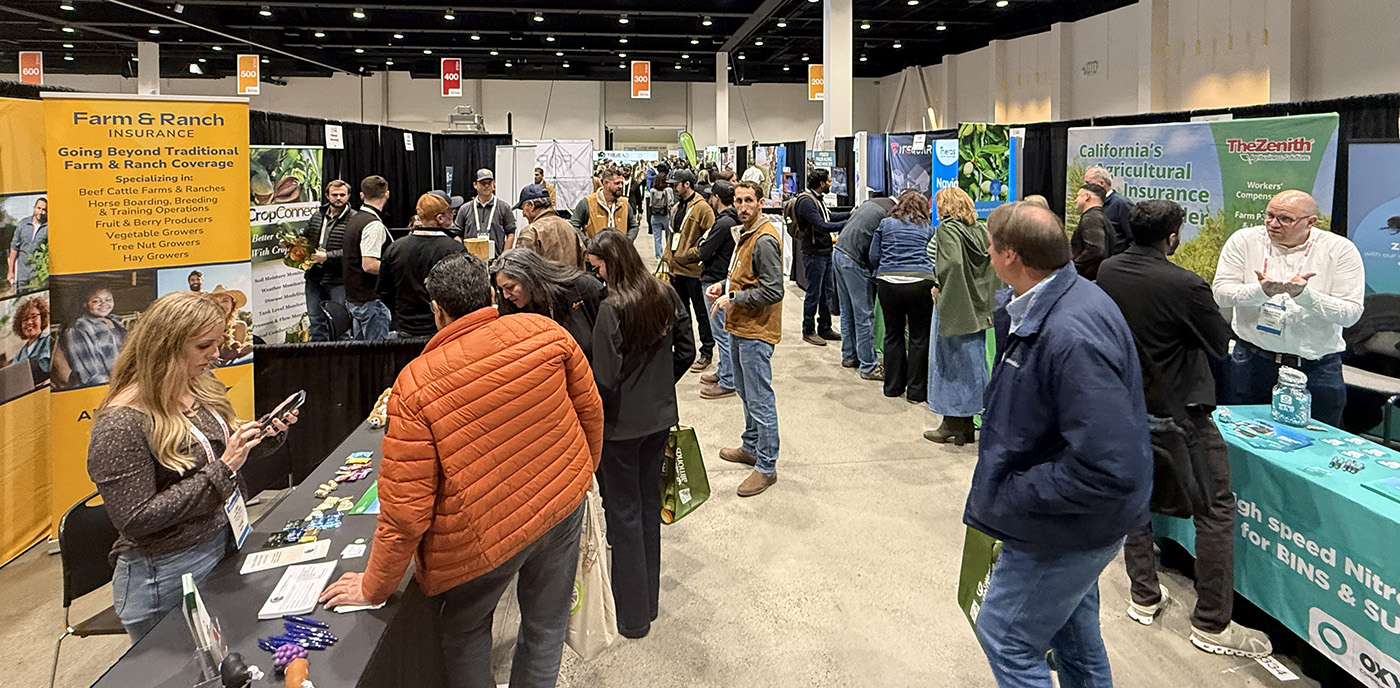
Attendees of the 2025 Almond Conference in Sacramento last week mingled with exhibitors at the event’s trade show. More than 400 vendors showed their wares during the annual three-day conference, which also featured panel discussions, workshops and other sessions with industry experts on key almond topics.
Photo/Mark Billingsley


By Mark Billingsley
Navigating tariffs and wrestling with growers’ rising operating costs will continue to be a focus for the Almond Board of California.
That was the message from Clarice Turner, the board’s president and CEO, during her annual “state of the industry” address to kick off the 2025 Almond Conference in Sacramento last week. Turner also shared good news for farmers and industry professionals about a major change to how the California almond industry forecasts crop yields.
The ABC Board of Directors voted last week to discontinue funding the U.S. Department of Agriculture National Agriculture Statistics Service Objective Measurement Report. The almond board’s subjective forecast will continue to be published annually in May, Turner said. The announcement received a round of applause from attendees.
Growers have complained that this year’s USDA forecast overestimated the size of the crop, causing almond prices to plummet.
“I know we’ve all been frustrated with the market volatility we’ve experienced as an industry, especially following the release of the objective estimate this past July,” Turner said.
She acknowledged the USDA objective forecast has been a useful tool for the industry since the 1960s, especially as state crop acreage was expanding.
“However, when the crop shifted from growing to consolidating and declining acres, like we’ve seen over the last four years, the calculation started to become problematic,” Turner said.
Feedback from growers and processors highlighted ongoing challenges in accurately capturing variables such as larger crop sizes, diverse grower practices and weather events across the state’s production regions, ABC reported. The board said it will continue to collaborate with USDA and industry partners to refine crop estimation methods.
Turner said ABC’s continued investment in nutrition research has yielded unexpected and positive results that the organization will herald moving forward in search of sales growth for the state’s No. 1 agricultural export.
“We are one of the healthiest nuts and the most researched food, which has allowed us to break through in many ways that our competitors really haven’t been able to,” she said.
She spoke about a new research study that ABC and Brightseed Bioactives, a San Francisco biotech company, started this year that harnesses novel artificial intelligence techniques and tools to identify 530 health-promoting compounds in almonds.
“That’s four times more than we previously knew existed,” Turner said.
The newly identified compounds are associated with brain health, gut health, and metabolic, cellular and immune health, Turner noted. The findings continue to underscore the benefits of almonds, she added, giving ABC a platform to engage with consumers and health professionals.
“Due to the industry’s leadership and investment in nutrition, the world knows that almonds are healthy, and health is the top reason that people choose almonds,” Turner said.
She talked about a new ABC nutrition affairs program that engages influential medical policy and scientific stakeholders to educate the public about the health benefits of almonds and drive global demand.
“Cultivating a healthier future” was the theme of this year’s conference, which featured more than 400 vendors on the main convention floor during the three-day event.
The almond board’s prior focus on getting almonds into snack foods was successful in building growth, but the snack food market is down, even for healthier snack foods, Emily Fleischmann, ABC’s senior global marketing director, reported. She said consumers are pulling back due to higher prices and economic uncertainties.
For the third year, the almond board has partnered with celebrity football coach Deion Sanders to boost domestic almond consumption with the “Look Good, Feel Good, Snack Good” campaign. Domestic consumption of almonds remains nearly three times that of any other tree nut, with 671 million pounds shipped in fiscal year 2024-25, according to ABC.
India remains the largest export market for California almonds. Most California almonds are exported to India in-shell to leverage tariff benefits. The state shipped 423 million pounds to the South Asian nation in 2024-25. ABC partnered with popular Bollywood actress Ananya Panday and cricket star athlete Rishabh Pant to tout the benefits of almonds for health, vitality, energy and recovery, said Craig Duerr, chairman of ABC’s global marketing development committee.
India in September lowered the goods and service tax, or GST, on California almonds from 12% to 5%. It lifted the 20% retaliatory tariffs in 2023 that were imposed in response to U.S. steel and aluminum tariffs during the first Trump administration. While this restored market opportunities for California almonds in India, California almond exporters continue to face uncertainty as India and the U.S. negotiate a larger trade deal.
The uncertainty makes it tough to plan, and importers delay shipments due to the uncertainty, said Jonathan Hoff, CEO of Monte Vista Farming Co. in Denair and former ABC board member.
“They’re really not confident enough to go out and buy in long-term quantities the way they typically would, which has resulted in this hand-to-mouth feeding,” he said. “It’s been a little bit challenging for us as growers and packers to plan out our production schedule, execute a sales strategy, but it’s been especially difficult for our customers to plan out their purchases.”
Other concerns addressed during panel sessions included orchard pests. Almond Alliance Vice Chair Katie Staack credited research funding in helping to identify and reduce the damage of the Carpophilus beetle, which appeared in the San Joaquin Valley a few years ago. ABC and Almond Alliance secured $500,000 to fund the research. Detection remains difficult, and the most effective means of eradication or control are still being discussed.
“(The beetle) is so small, it’s really hard to combat,” said Staack, facility manager for her family’s Grizzly Nut Co. in Stanislaus County. “You have to get a direct hit on its exoskeleton. It’s hard to even see it in processing.”
Despite ongoing barriers and challenges, Turner emphasized the resilience of the industry and its people.
“We cannot afford to wait for change,” she said. “We must be the force that creates it. Together, we’ll not just weather the storm; we’ll redefine what’s possible for California almonds as we have together in the past. The strength and the spirit of California almond growers remains the very foundation of this industry.”
Mark Billingsley is a reporter in Carmichael. He can be reached at agalert@cfbf.com.
See related news stories...
- Increased almond shipments signal better times ahead
- Almond farmers see 'silver lining' amid tough times
- Almond conference focuses on growing global demand






.svg.png)
